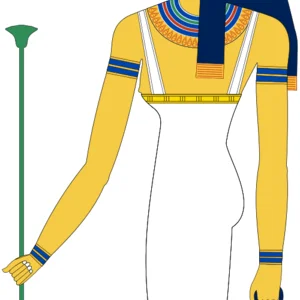

Pakhet (“she who scratches”) is a lioness goddess of Egyptian mythology, a deity of the hunt associated with the desert and the wadis. A protective figure with a warlike nature, she was identified by the Greeks with Artemis during the Ptolemaic period.
Pakhet
Pakhet
6 min read
Frequently asked questions
Key Facts
- Lioness goddess of the desert whose name means “she who scratches” or “the tearer”
- Attested as early as the Egyptian Middle Kingdom (around 2000 BC) in the Coffin Texts
- Has a rock-cut temple, the Speos Artemidos, carved near Beni Hasan during the reign of Hatshepsut (around 1470 BC)
- Identified with the Greek goddess Artemis during the Ptolemaic period (from the 3rd century BC onward)
- Deity of the hunt linked to the wadis, associated with lioness goddesses such as Sekhmet and Bastet
Works & Achievements
Rock-cut temple dedicated to Pakhet, a masterpiece of architecture carved into the cliff and commissioned by Hatshepsut. The central site of her cult.
A long text engraved at the entrance of the sanctuary, celebrating the restoration of Egypt and devotion to Pakhet; a precious historical source on the Hyksos.
A second rock-cut sanctuary nearby, linked to the worship of local deities and testifying to the region's religious importance.
The identification of Pakhet with the Greek goddess Artemis, a striking example of Greco-Egyptian religious syncretism.
The enduring image of the lioness-headed woman crowned with the solar disc, integrated into the repertoire of protective goddesses.
Anecdotes
The name Pakhet means "she who scratches" or "she who tears." The Egyptians imagined her as a lioness hunting at night in the desert ravines (the wadis), watching for her prey along the dried-up watercourses. This image of a nocturnal huntress made her a feared and respected protector.
Pakhet had a great rock-cut sanctuary carved into the cliff near Beni Hasan, in Middle Egypt. The queen-pharaoh Hatshepsut (15th century BC) had it built and engraved a famous long inscription there in which she boasts of having driven out the Hyksos invaders and restored order to the country.
When the Greeks arrived in Egypt, they saw in Pakhet, the lioness-goddess of the hunt, the equivalent of their own huntress goddess Artemis. So they renamed her sanctuary "Speos Artemidos," meaning "the cave of Artemis," a name it still bears today.
Pakhet belongs to the great family of Egyptian lioness-goddesses, alongside Sekhmet and Bastet. Like them, she embodied the ambivalence of the feline: a warlike violence capable of protecting the pharaoh and destroying his enemies, but also a force that had to be appeased through rituals.
In some texts, Pakhet is called "she who opens the ways" and associated with the wedjat eye as well as with protection against snakes and the forces of chaos. She was depicted as a woman with a lioness's head, sometimes crowned with the solar disk, emphasizing her link to the destructive sun of the desert.
Primary Sources
I have raised up what was in ruins; I have restored what was left unfinished since the Asiatics (Hyksos) were in the midst of the Delta… ruling in ignorance of Ra.
Pakhet the great, whose power is great, who roams the wadis at nightfall, the one who scratches.
The Greeks called this sanctuary carved into the rock the Grotto of Artemis, identifying the local lioness-goddess with their own Artemis the huntress.
Key Places
Rock-cut sanctuary carved into the cliff by Hatshepsut, the chief place of worship for Pakhet. The Greeks named it the “Grotto of Artemis.”
Middle Egyptian necropolis famous for its nomarch tombs, near the sanctuary of Pakhet. A regional center of her cult.
Dry valleys and desert lands where Pakhet was said to hunt at nightfall. The mythical domain of the lioness goddess.
Religious capital of the New Kingdom where the cult of protective lioness goddesses such as Sekhmet and Pakhet flourished.
Typical Objects

Sacred musical instrument shaken during ceremonies to soothe the lioness goddesses and ward off hostile forces. Its metallic rattle was meant to calm the goddess's fury.

Effigy of Pakhet shown as a woman with a human body and the head of a lioness, sometimes crowned with the solar disk. Placed in the sanctuary, it housed the presence of the goddess.

Protective amulet shaped like an eye, linked to the solar and feline deities. Worn to guard against bad luck and snake bites.

Blade symbolizing the goddess's claws, evoking her power to tear apart and destroy enemies. It appears on the amulets of protective deities.

Stone slab where worshippers laid bread, beer and meat to feed and appease the goddess. A central element of worship in the rock-cut sanctuary.

Emblem set upon the goddess's head, marking her bond with the scorching desert sun and with Ra. A symbol of the fearsome power of the sun.
School Curriculum
Vocabulary & Tags
Key Vocabulary
Daily Life
Morning
As a deity, Pakhet has no human daily routine: it is her priests who structure her days. At dawn, they would purify her statue in the sanctuary, burn incense, and recite the first prayers to awaken the goddess.
Afternoon
In the heat of the day, the sanctuary remained a place of coolness and silence within the heart of the cliff. The priests watched over the offerings laid on the stone table and maintained the cult far from the crushing sun.
Evening
Night was the favored domain of Pakhet, the huntress of the wadis. She was imagined roaming the desert ravines in search of her prey, and people recited formulas to win her protection against the dangers of the night.
Food
The goddess was symbolically fed through offerings: bread, beer, game meat, and fowl placed before her effigy. As a lioness, she was associated with the flesh of the desert animals she was believed to hunt.
Clothing
Pakhet is depicted wearing the long, fitted dress of the Egyptian goddesses, sometimes adorned with patterns. Her lioness head could be crowned with the solar disk and a uraeus, the rearing cobra that symbolizes power.
Housing
Her “dwelling” was the rock-cut sanctuary of Speos Artemidos, carved into the stone of the cliff. This sacred cave, cool and dark, sheltered her statue and protected it from profane eyes.
Historical Timeline
Period Vocabulary
Liens externes & ressources
Références
Œuvres
Le Spéos Artémidos
vers 1470 av. J.-C.
L'inscription dédicatoire d'Hatchepsout
vers 1470 av. J.-C.
Le « petit Spéos » voisin
Nouvel Empire
Assimilation à Artémis
période ptolémaïque
Représentations iconographiques
Moyen et Nouvel Empire