
Hatshepsut is one of the rare women to have reigned as pharaoh of Egypt. After serving as regent for her stepson Thutmose III, she took power around 1478 BCE and ruled for more than twenty years. Her reign was marked by prosperity, major architectural projects, and a celebrated trading expedition to the land of Punt.
Frequently asked questions
Key Facts
- Came to power around 1479 BCE, first as regent for the young Thutmose III, then as a pharaoh in her own right
- Had the famous mortuary temple of Deir el-Bahari built, a masterpiece of Egyptian architecture
- Organized a major trading expedition to the land of Punt to bring back incense, myrrh, and exotic goods
- Had monumental obelisks erected at Karnak in honor of the god Amun
- Died around 1457 BCE; Thutmose III would later attempt to erase her name from the monuments (damnatio memoriae)
Works & Achievements
Temple built on three stacked terraces set into the cliff face, regarded as a high point of Egyptian architecture and the major monument of her reign.
Pair of monumental obelisks raised in the Temple of Amun; one of them, nearly 29 m tall, is still standing today.
Great maritime mission that brought back incense, myrrh, gold and precious woods, reviving Egypt's long-distance trade.
Shrine of red quartzite and granite built to house the sacred barque of Amun, decorated with reliefs detailing her festivals and achievements.
Program to rebuild the sanctuaries damaged under the foreign rule of the Hyksos, proclaimed in her inscriptions.
Small temple carved into the rock in Middle Egypt, dedicated to the lioness goddess Pakhet, bearing a long inscription of royal propaganda.
Anecdotes
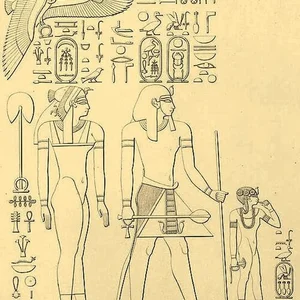
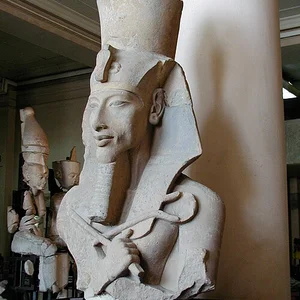
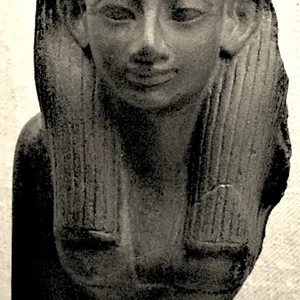
To assert her legitimacy as pharaoh, Hatshepsut had herself depicted on monuments with the masculine attributes of power: the royal kilt, the headdress, and above all the false ceremonial beard worn by sovereigns. Statues thus show her as a man, even though the texts sometimes refer to her in the feminine.
Hatshepsut organized a famous trading expedition to the land of Punt, a distant region probably located near the Red Sea coast (modern-day Horn of Africa). The Egyptian ships brought back incense, gold, ebony, panther skins, and even living myrrh trees, which were then planted in front of her temple.
Before becoming pharaoh, Hatshepsut was only a regent: she governed in the name of her young nephew and stepson Thutmose III, still a child. After a few years, she took the leap and proclaimed herself pharaoh, ruling as co-sovereign.
After Hatshepsut's death, attempts were made to erase her memory: decades later, her statues were smashed and her name was chiseled out and replaced on certain monuments. Archaeologists long believed this was an immediate act of revenge by Thutmose III, but today it is thought that these destructions were mainly meant to remove a woman from the official list of kings.
At Karnak, Hatshepsut had two immense pink granite obelisks erected, carved at Aswan. One of them, still standing, is nearly 29 meters tall and remains one of the tallest ancient obelisks preserved in Egypt.
Primary Sources
Loading of the ships, in great quantity, with the marvels of the land of Punt: all the fragrant woods of the divine land, heaps of myrrh resin, green myrrh trees, ebony and pure ivory.
I did this with a loving heart for my father Amun… As for anyone who shall hear this, let him not say that what I have said is a boast, but let him rather say: “How like her it is, to be truthful toward her father.”
The god Amun takes on the appearance of the king to beget the royal child; he declares: “Hatshepsut shall be the name of my daughter… she shall exercise beneficent kingship over this entire land.”
Key Places
Religious capital of the New Kingdom and center of the cult of Amun. Hatshepsut was born and lived here, on the east bank of the Nile (present-day Luxor).
Terraced mortuary temple set against the cliff on the west bank of Thebes, a masterpiece of Hatshepsut's reign. Its walls tell the story of the expedition to Punt.
Vast complex dedicated to Amun-Ra at Thebes, enlarged by Hatshepsut, who erected two pink granite obelisks there.
Royal necropolis carved into the mountain on the west bank of Thebes. Hatshepsut had her tomb (KV20) built here.
Site for extracting pink granite, in the far south of Egypt. This is where the obelisks intended for Karnak were cut.
A distant trading region, probably toward the Red Sea coast and the Horn of Africa. Target of Hatshepsut's famous maritime expedition.
Typical Objects
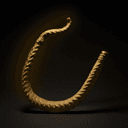
A braided, curved beard that pharaohs attached to their chin during ceremonies. Hatshepsut wore it to assert her royal office, traditionally a male one.
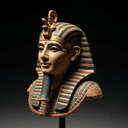
A striped headcloth with lappets worn by pharaohs, often adorned with the uraeus, the rearing protective cobra. It appears on statues of Hatshepsut as a sovereign.
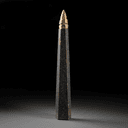
A tall stone needle with a gilded tip, raised in pairs before temples in honor of the sun god Amun-Ra. Hatshepsut had some erected at Karnak.
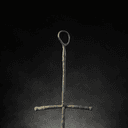
The crook-shaped scepter and the flail held crossed over the chest were the insignia of pharaonic power. They symbolized the king's role as shepherd and guarantor of order.
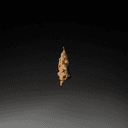
Fragrant resins brought back from the land of Punt and burned during rites in honor of the gods. Their trade was a great success of Hatshepsut's reign.
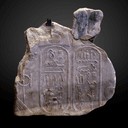
An elongated oval enclosing the pharaoh's name in hieroglyphs, a symbol of eternal protection. Hatshepsut's bears her coronation name, Maatkare.
📷 Domaine public · Wikimedia Commons ↗School Curriculum
Vocabulary & Tags
Key Vocabulary
Tags
Daily Life
Morning
At daybreak, the pharaoh performed a ritual washing followed by the dressing ceremony, surrounded by servants. The morning was devoted to rites in honour of Amun and to reviewing the affairs of the kingdom with high officials.
Afternoon
In the afternoon, Hatshepsut received her vizier and her scribes to manage the administration: taxes paid in kind, temple works, trade expeditions. She might also inspect the construction sites that marked her reign.
Evening
The evening unfolded in the comfort of the royal palace, to the sound of harps and songs. A refined meal was taken before bed, while guards kept watch over the residence.
Food
The royal diet was rich and varied: bread and beer formed the staple, supplemented by meats (beef, poultry), Nile fish, vegetables, figs, dates and grapes. Honey provided sweetness and wine accompanied the banquets.
Clothing
People wore garments of fine white linen, a light fabric suited to the heat. During ceremonies, Hatshepsut donned the male royal insignia — kilt, nemes headdress and false beard — as well as rich jewellery of gold and semi-precious stones.
Housing
The pharaoh resided in a vast palace of mud brick with painted walls, at Thebes, near the temples. The cool rooms, courtyards and gardens offered a luxurious setting, far from the modest houses of the common people.
Historical Timeline
Period Vocabulary
Visual Style
Style artistique égyptien du Nouvel Empire, XVIIIe dynastie : bas-reliefs en grès doré, pigments lapis-lazuli et ocre rouge, représentations hiératiques d'Hatchepsout en pharaon sur fond de terrasses colonnadées face aux falaises de Deir el-Bahari.
Sound Ambience
Ambiance sonore de la cour royale de Thèbes sous la XVIIIe dynastie : cloisons de pierre taillée, chants liturgiques au temple d'Amon, encens de myrrhe et bruissement de lin dans les couloirs royaux.
Liens externes & ressources
Références
Œuvres
Temple funéraire de Deir el-Bahari
vers 1465 av. J.-C.
Obélisques de granit rose de Karnak
vers 1470 av. J.-C.
Expédition commerciale vers le pays de Pount
vers 1470 av. J.-C.
Chapelle Rouge de Karnak
vers 1460 av. J.-C.
Restauration des temples après les Hyksôs
vers 1470 av. J.-C.
Speos Artemidos (temple rupestre)
vers 1465 av. J.-C.