Imaginary interview with Judy Garland
by Charactorium · Judy Garland (1922 — 1969) · Music · Performing Arts · 6 min read
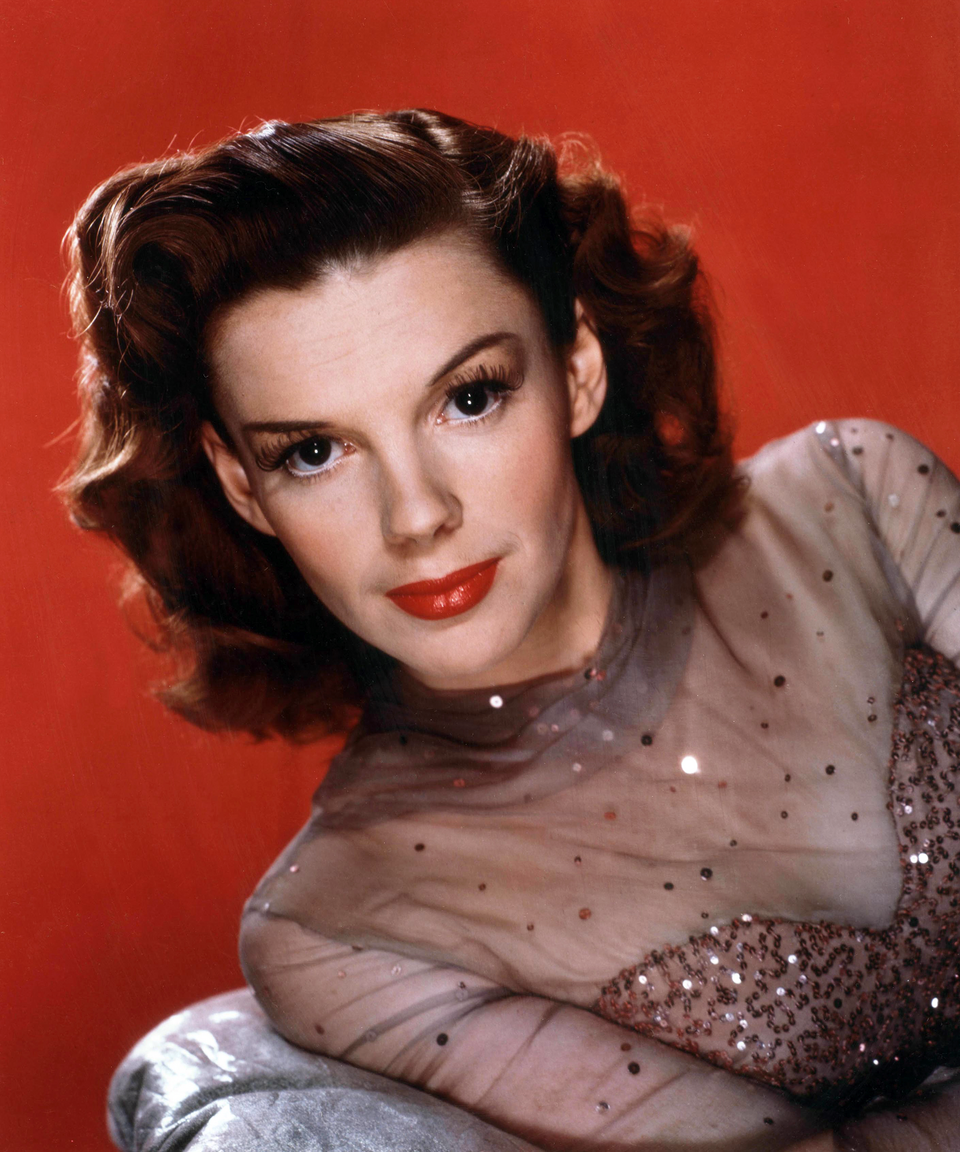
London, a winter evening in 1968, in a small rented apartment in Chelsea cluttered with suitcases never quite unpacked. Judy Garland, forty-six, lights a cigarette, sits by the window and smiles — that raspy voice and cracked gaiety that made Carnegie Hall weep. She agrees to look back, one last time, on the rainbow and the machine that built her.
—How was that little Dorothy born who ended up following you all your life?
Picture a sixteen-year-old girl, her chest strapped under a gingham dress to look younger, standing on a Culver City soundstage in the blazing heat of the lights. Victor Fleming asked me to believe in a yellow brick road, and oddly enough, I did. The Wizard of Oz, in 1939, was my first big role, my first costume forever: that blue-and-white apron, those ruby slippers that weighed like lead on my feet. I didn't know then that those shoes would outlast me, that they'd be put under glass in museums. Dorothy wanted to go home. I never really knew where mine was.
Those shoes would outlast me.
—It's said that Over the Rainbow almost got cut in editing. What happened?
It's true, and it still chills me. The bosses at MGM thought the song was too slow; they wanted to cut it so as not to slow down the film — a song in a Kansas barnyard bored them. It was Harold Arlen, who composed it, and the director who fought to keep it. And there it is: it won the Oscar for Best Original Song in 1940. When I sing it, even today, I'm not singing a melody, I'm singing a door left ajar, that somewhere over the rainbow where troubles melt like lemon drops. People think it's a lullaby for children. It's the saddest song I know.
I'm not singing a melody, I'm singing a door left ajar.
—Do you remember the mornings of filming at MGM, back then?
They woke me at five. Two hours of makeup, a broth, black coffee, a cigarette, and the first pill to keep me going. They called them vitamins. They were Benzedrine, amphetamines to run all day, then barbiturates at night to fall into sleep like falling into a well. I was sixteen. They weighed me, strapped me, decided what I ate and who I loved. One day, I told reporters, in 1950, when they fired me: They had me on a treadmill. I had to look a certain way, sing a certain way, be a certain age. That's exactly what it was. A treadmill you could never stop.
They called them vitamins. They were Benzedrine.
—That studio system, how would you describe it to someone who never experienced it?
A dream factory that crushes the children it employs. The studio system owned everything: my name — I was born Frances Gumm and they renamed me at twelve —, my face, my weight, my engagements. A diet of broth, coffee and cigarettes to fit into the dresses. No one thought of protecting a kid under contract; there were no laws for that. A journalist once asked if I had a childhood. I replied that I was born at age twelve on a Metro-Goldwyn-Mayer soundstage: I was not a child star. I was an adult star who happened to be a child. You can't make up for the years you were never allowed to live.
A dream factory that crushes the children it employs.
—After that firing, how did you get back on stage?
Through fear, mostly. In 1951, they offered me the Palace Theatre in New York, the old temple of vaudeville where my parents would have dreamed of playing. I was broken, ruined, they said I was finished. And yet, alone in front of those people, without a studio telling me what to do, I discovered something: the stage didn't lie. No editing, no second take, just my voice and two thousand people holding their breath. It was my first real comeback. I understood then that I didn't belong to the cameras of Culver City, but to that fragile moment when you sing live and everything can collapse or save you.
The stage didn't lie. No editing, just my voice.
—And that night of April 23, 1961 at Carnegie Hall, what remains of that concert within you?
A warmth. Two hours standing, them and me, at Carnegie Hall, a hall where you don't usually sing music-hall songs. People got up, sat down, got up again. The next day, a critic wrote that it wasn't a concert but a communion — It was not merely a concert; it was a communion. I never found a better word. The album we made from it, Judy at Carnegie Hall, won five Grammy Awards, including Album of the Year, which no woman had ever won that way. But the awards, frankly, I don't care about. What I keep is that shared breath, those thousands of people who, for one evening, decided to love me.
It wasn't a concert but a communion.
—What sustains you physically when you prepare a tour today?
Afternoons, I rehearse with my conductor, Mort Lindsey, room by room, note by note. Every theater has its acoustics, its way of swallowing or returning a voice, and you have to rearrange, adjust, until the melody marries the walls. I've sung at the London Palladium before an English audience of crazy loyalty; they sometimes know me better than America does. On stage, I wear sequined dresses, a bowler hat and a cane for some numbers — a nod to the vaudeville of my childhood. The body is tired, the voice gets rough, but as soon as the orchestra strikes up, something very old and very young awakens in me.
—Many people rejected by society seem to identify with you. How do you explain that?
I think the broken recognize each other. Those who've been mocked, hidden, forced to wear a mask to seem normal — they hear, in a voice that trembles without breaking, the promise that you can survive. I've spent my life getting back up in public: the Palace, Carnegie Hall, every comeback was a way of saying you're not finished as long as you can still sing. I don't really know why so many men and women who have to hide who they love write to me, wait for me at stage doors. Maybe because Over the Rainbow speaks of a somewhere where you could finally be yourself. That somewhere, I never found it either.
The broken recognize each other.
—What does that word 'icon' now attached to your name mean to you?
It's a heavy word to carry, a dress too big. You become a pop icon when your image starts living without you, when red shoes in a window speak to people who've never heard you sing. I see it well: Dorothy has outgrown me, the rainbow has outgrown me. But an icon doesn't sleep, doesn't cry, doesn't count its debts in a rented apartment in Chelsea. I do. I once wrote to my daughter Liza never to let Hollywood change her, that her true voice would be the only thing that truly belonged to her. That's the only legacy that matters: keeping, under the character, the little girl who sang for real.
You become an icon when your image starts living without you.
—Looking back, what would you say to that teenager MGM was strapping into a corset?
I'd tell her to scream louder, but I know she couldn't. They made her look younger, thinner, with chest bindings and appetite suppressants, and she believed that was the normal price of the spotlight. She ended up feeling like a machine, an object set to smile on cue. What I'd whisper to her is that her value wasn't in her waist size or the number of takes she did without sleep. Meet Me in St. Louis, in 1944, all that talent, all that charm — it came from her, not the studio. But you never warn children in time that you're devouring them.
She believed that was the normal price of the spotlight.
—After so many roles, what surprised you most in your own acting career?
That they believed I could cry other than by singing. In 1961, Stanley Kramer offered me a small serious role in Judgment at Nuremberg, a survivor testifying at the bar. No sequins, no orchestra, just a few minutes of bare face — and an Oscar nomination for Best Supporting Actress. I'd spent my life being reduced to the Kansas girl and her golden voice. Discovering they could trust me with silence, with restrained pain, moved me deeply. MGM had made me like a musical toy; it took long after them to finally let me be just a woman who acts.
I'd spent my life being reduced to the Kansas girl.
This imaginary interview was generated by artificial intelligence from sources documented in Judy Garland's profile. It dramatises what the figure might have said based on what we know about them, but does not constitute attested historical testimony. For primary sources and factual documentation, refer to the full profile.