Imaginary interview with Lowitja O'Donoghue
by Charactorium · Lowitja O'Donoghue (1932 — 2024) · Politics · Society · 5 min read
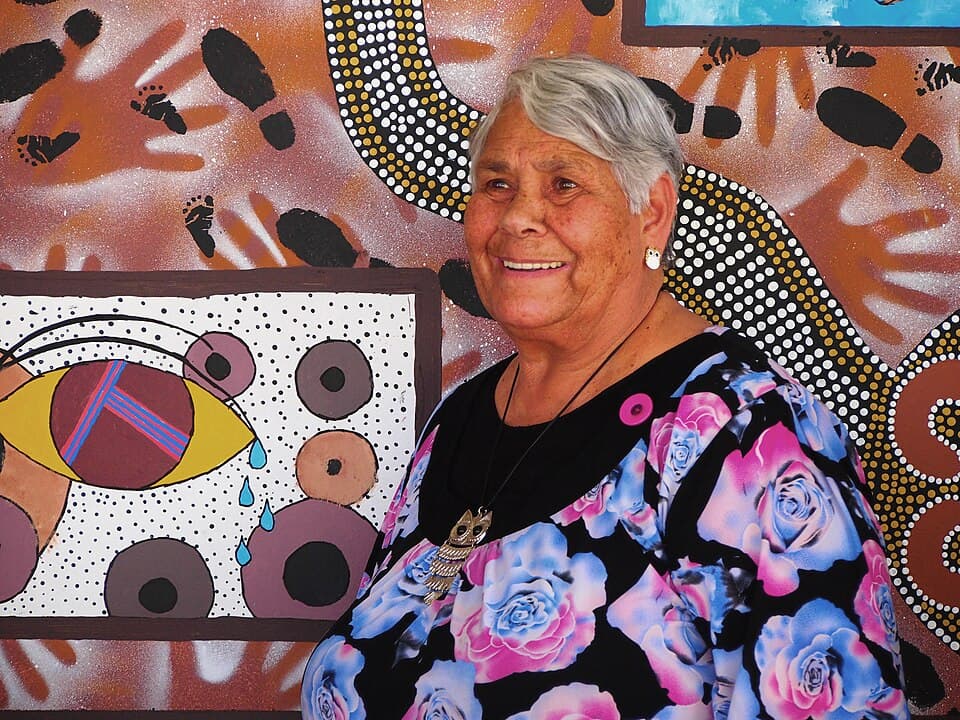
Adelaide, an Australian winter morning. Lowitja O'Donoghue receives us in a modest living room, her decorations displayed without ostentation on a shelf, a yellowed map of South Australia pinned near the window. Her voice is calm, but each sentence carries the weight of ninety years of struggle.
—Do you remember the moment you were taken from your mother?
I don't remember — and that is precisely the crime. I was two years old in 1934 when I was taken from Indulkana to the Colebrook Home mission. For years, I didn't even know my mother's name. They called it benevolence, progress, assimilation; I call it a state policy that stole our identity. It took me decades before I could speak of it aloud. When I finally testified, later, before those who collected our stories, I understood that my silence had been a second prison. There were thousands of us children uprooted like that — the Stolen Generations — and one voice among them had to dare to use the exact word: it wasn't charity, it was theft.
For years, I didn't even know my mother's name.
—What gave you the courage to finally speak about this wound in public?
Silence protects the perpetrators, never the children. When the commission gathered the accounts that would become the Bringing Them Home report, I knew that if I, who had led institutions and shaken hands with ministers, remained silent, then the humblest would never dare. That document of nearly seven hundred pages was not a book: it was a dam finally breaking. I spoke of the separation, the childhood away from my people, the Colebrook mission. I did it so that no one could ever again say "we didn't know." Recognition came slowly — the government's official apology would not come until 2008 — but each testimony was a stone laid on that path.
Silence protects the perpetrators, never the children.
—How does one become a nurse when several hospitals refuse you because of your skin?
With a stubbornness for which I was much criticized. In 1954, I became one of the first Aboriginal women to graduate as a nurse in Australia, but before the white uniform, there were closed doors, stares, polite refusals that all said the same thing. I knocked, knocked again, until an institution gave in. That uniform, I wore with a pride few can imagine: it represented two victories in one, that of a woman and that of my people. The profession of caregiver taught me a truth I never let go of — that every human life has exactly the same value. That lesson became the foundation of everything I fought for thereafter.
That uniform represented two victories in one: that of a woman and that of my people.
—How did caring for bodies nourish your political struggle?
People think health and politics are two worlds; they are the two ends of the same rope. In the 1960s, in Adelaide, I developed health services for Aboriginal communities that had access to nothing. Taking the pulse of a malnourished child, you quickly understand that their fever has causes that are not written on a prescription: poverty, uprooting, contempt. Care taught me to listen before judging, to stand at the bedside rather than the podium. When later I consulted rural communities, I did the same gesture as at the hospital: listen, take faithful notes, report back. Medicine gave me my method as much as my anger.
—What did your appointment as head of ATSIC in 1990 represent for you?
An honor, yes, but above all a burden. Becoming the first chairperson of ATSIC, the first Aboriginal woman to lead a national body that spoke for our peoples to the federal government, was hailed even abroad as a symbol. But I never forgot one thing: I was not asking for charity. We were asking for justice, recognition, the right to decide our own future as the first inhabitants of this land. Leading ATSIC from 1990 to 1996 meant translating that demand into land rights, schools, clinics. The title did not belong to me: it was entrusted to me in the name of all Indigenous Australians, and I wore it as one carries a mandate, not a crown.
We were not asking for charity, we were asking for justice.
—How do you carry the voice of an entire people without betraying it?
By constantly remembering that the voice is not your own. When I traveled to communities in central Australia, among the Yankunytjatjara from whom I come and elsewhere, I went not to speak but to gather. My afternoons were filled with audiences, consultations, convincing officials; but all that was only worthwhile if, behind it, there was the exact words of a desert grandmother that I had pledged to faithfully repeat in Canberra. The microphone, at national and international forums, was only a relay. To betray would be to smooth their words to please the powerful. I always preferred to displease by being accurate. A spokesperson who listens to themselves has already stopped serving.
A spokesperson who listens to themselves has already stopped serving.
—Do you remember what you felt when you carried the Olympic flame in Sydney?
A dizziness, I admit. In 2000, at Stadium Australia, holding that torch before billions of eyes, me the child torn from her mother, me the little girl from the mission — there was in that contrast something beyond my own life. That fire was not a sporting feat; it was a gesture extended to the entire nation, a hand offered between Indigenous Australia and contemporary Australia. I thought, as I ran, of all those who had never been counted, never recognized. The flame illuminated, for an instant, a reconciliation still to be built. But a symbol is not enough: a torch burns and goes out, while justice must endure.
A torch burns and goes out, while justice must endure.
—Do you think these grand symbolic gestures really change things?
They open doors, but they don't cross them for us. Reconciliation is not a gift a government can grant us from above; it is built day by day, between people, through truth, through listening, through shared commitment. A flame in Sydney, a flame carried, a handshake on a platform — all that moves people, and emotion is needed to shake hearts. But the next morning, there are still children without clean water, lands to return, apologies to be made. I sat on the Council for Aboriginal Reconciliation from its inception in 1991 precisely because I distrusted symbols without follow-through. The symbol lights the fire; it is patient work that keeps it burning.
The symbol lights the fire; it is patient work that keeps it burning.
—What did the doctrine of terra nullius, which the courts finally overturned, mean to you?
Two Latin words for immense violence: terra nullius, 'nobody's land.' As if our ancestors had not walked this soil for tens of thousands of years. Our presence was erased with a legal stroke to justify taking our lands. The Mabo decision in 1992 finally shattered that lie by recognizing Native Title, our customary rights to ancestral lands. I will never forget what that meant: that the law ceased to declare us invisible. I, who always keep maps of the Indulkana region near me, know that a land bears names, songs, the dead. To deny that was to deny human beings.
Our presence was erased with a legal stroke.
—At ninety, why did you insist on defending the Voice to Parliament referendum?
Because you don't lay down your arms when the finish line is in sight. In 2023, supporting the Voice to Parliament, the proposal to enshrine an Indigenous advisory body in the Constitution, was the natural extension of my whole life: from the 1967 referendum that finally counted us in the census, to ATSIC, it was always about the same thing — being heard where decisions about us are made. The result was negative, and that grieved me deeply. But a people that survived assimilation and the Stolen Generations does not measure justice by the duration of a single ballot. I wanted my last public word to still be a yes to the dignity of my people.
You don't lay down your arms when the finish line is in sight.
Sources
This imaginary interview was generated by artificial intelligence from sources documented in Lowitja O'Donoghue's profile. It dramatises what the figure might have said based on what we know about them, but does not constitute attested historical testimony. For primary sources and factual documentation, refer to the full profile.