Imaginary interview with Lý Thường Kiệt
by Charactorium · Lý Thường Kiệt (1019 — 1105) · Military · Politics · Literature · 6 min read

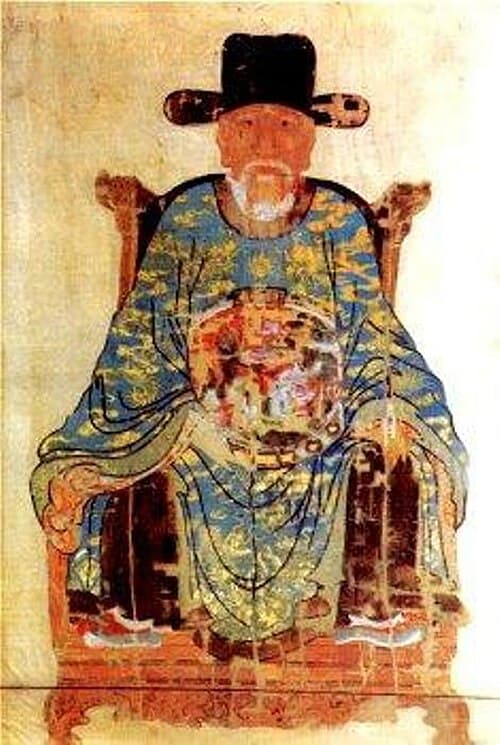
We met him in the imperial citadel of Thăng Long, not far from the Thái Hòa ward where he was born, at the hour when the guard drums mark the changing of the watch. The old general, draped in his court robes, has served three emperors of the Lý dynasty; he speaks slowly, like a man who has spent sixty years measuring his words as much as his blows. Here is the interview that fiction allows us to imagine.
—How does a child of Thăng Long enter the service of the emperor?
I was chosen in 1041, barely out of childhood, to serve in the inner court as Hoàng môn Chi hậu — the one who stands close to the sovereign and anticipates his desires. The reason given then makes me smile today: my face was pleasing, they said, and it was judged that such a face should appear near the throne. Strange gate through which I passed! I lost there what a man loses upon entering the palace, but I gained the only place from which one can see power up close. My family was a house of officers with solid roots, not princes; it took that favor of chance and of the gaze to place me, young, at the heart of a court that would occupy me for more than sixty years.
My face was pleasing, they said, and it was judged that such a face should appear near the throne.
—What do you remember of the years when you climbed the ranks of the court?
Patience, before glory. In 1053 I was made Nội thị sảnh Đô tri, chief of the attendants of the inner court, and I learned that governing men begins with governing the hours: the dawn audiences, the consultations where one weighs a word as one weighs rice. Under Emperor Lý Thánh Tông, accession in 1054, I was finally entrusted with military duties. But do not think the sword came first; it came after the corridors, after the rites, after understanding who in the palace truly held the reins. From my youth, I had applied myself as much to letters as to martial arts, and I had studied the treatises on war: a courtier who neglects either makes himself one-eyed.
Governing men begins with governing the hours.
—Do you remember the campaign against Champa and the capture of its king?
1069. I had been placed at the vanguard of the royal expedition, and it was there, in the southern lands, that I captured King Chế Củ in person. A captive king is not kept like a simple prisoner: he is negotiated. To regain his freedom, he ceded three prefectures to Đại Việt — gain that no pitched battle would have yielded faster. Upon my return, the emperor granted me what a subject dares not hope for: the Quốc tính, the imperial family name, the very name of the ruling lineage. I ceased to be a simple officer and became Thiên tử nghĩa đệ, adoptive brother of the Son of Heaven. A name, you see, sometimes weighs heavier than a province.
A captive king is not kept like a simple prisoner: he is negotiated.
—What does it mean to receive the name of the emperors themselves?
It is to enter, alive, into the blood of a dynasty without being born into it. With the name Lý came also the titles: Phụ quốc Thái phó, Grand Tutor Assistant to the State, one of the highest ranks in the hierarchy, and the rank of Khai quốc công. Such an honor is not an ornament to hang on one's robe; it is a debt. I was not given the sovereign's name so that I might shine, but so that I might answer for the empire as a son answers for his father's house. From then on I wore the court robes codified for my rank, distinct in their colors from those of lower officers — not out of vanity, but because order demands that every man visibly bear the weight he holds.
It is to enter, alive, into the blood of a dynasty without being born into it.
—How would you describe the succession crisis of 1072?
Emperor Lý Thánh Tông died, and his heir was only seven years old: a child on the throne is a house whose door remains open to all winds. The concubine Ỷ Lan leaned on me, who held the army, to set aside the official regent, Dương Thái hậu. What followed, I do not adorn with any sweetness: the regent and seventy-two ladies-in-waiting were buried alive alongside the deceased emperor, according to the dark customs of those times. Prime Minister Lý Đạo Thành was dismissed and exiled to Nghệ An. One then governs buông rèm, behind the curtain, the empress having become Hoàng thái hậu. I became the effective regent for the young Lý Nhân Tông. Power is not picked up with clean hands.
A child on the throne is a house whose door remains open to all winds.
—How does one live with such an episode on one's conscience?
You speak of conscience like a man who has never held a dynasty at the end of his arm. I do not judge myself by your measures; I judge myself by the order I had to preserve. A kingdom without firm regency is a kingdom that the Song already eye as prey. That the curtain of power — the buông rèm — hid a hard hand, so be it; but behind that curtain, the young Lý Nhân Tông grew up, reigned, and the empire held. I do not say those times were without shadow. I say that a man placed at the summit must sometimes carry what a common man will never have to lift, and answer for the entire house when the child who commands it can barely walk.
I do not judge myself by your measures; I judge myself by the order I had to preserve.
—Why did you attack Song China before it attacked you?
Because he who waits for the blow has already half received it. In 1075, I learned that Vương An Thạch — Wang Anshi, in power among the Song — was preparing the conquest of Đại Việt, arguing that our country was exhausted from its wars. Should I wait, wisely, for his armies to cross our prefectures? I applied the principle of the ancients: tiên phát chế nhân, strike first to control the adversary. With Tôn Đản, I launched over one hundred thousand soldiers against the prefectures of Khâm, Ung and Liêm, carrying the war onto their own soil. Leading the fleet in person, I saw our war junks sail northward. It was not audacity: it was arithmetic. One does not let the fire start at the neighbor's when the wind blows toward one's own house.
He who waits for the blow has already half received it.
—What do you say to those who judge this strike reckless?
Let them count the living afterward, not the indignant beforehand. Striking Khâm, Ung and Liêm on Song territory, with over one hundred thousand men and by water route, was not a fit of fever: it was destroying the stores, the men, and the invasion plans where they were being prepared. This feat of arms, it is said, carried my name beyond the borders of Đại Việt; let them comment on it, so be it, but let them understand it. A preemptive strike is only just if the invasion was real — and that of Vương An Thạch was. When the Song finally came, it was to be stopped, not to surprise us. I had chosen the terrain, the hour, and the river. The reckless one is he who lets the enemy choose in his place.
Let them count the living afterward, not the indignant beforehand.
—They say a doubt still hangs over your true family name. What of it?
A man may know the names of kings and be ignorant of his own: such is my singular enigma. Some call me Ngô Tuấn, descendant of Ngô Quyền, based on a genealogy written much later, under the Nguyễn, by Nhữ Bá Sĩ. Others name me Quách Tuấn, and these rely on two steles engraved under my own dynasty, the Lý — that of the An Hoạch Báo Ân tự in 1100 and another in 1159. Remember that Thường Kiệt is only my biểu tự, my courtesy name; my given name was Tuấn. My family held positions generation after generation, according to thế tập. As for the rest, I leave it to the stone carvers to decide: the stone close to the facts lies less than distant memory.
A man may know the names of kings and be ignorant of his own.
—To what stones and writings would you entrust your memory?
To steles, always to steles. The brush reconsiders, oral tradition embellishes, but the stone engraved during the lifetime of the facts retains a rectitude that centuries hardly erode. The stele of the An Hoạch Báo Ân tự, erected in 1100, says my native village: An Xá, in Quảng Đức district. The chroniclers will come later, like the Đại Việt sử ký toàn thư, to report my campaigns and my regency — and I know that a wise historian will always distrust genealogies that are too precise, which lend to the dead details that no living person saw. If one must remember me, let it be through the stones close at hand and through my deeds, not through the tales that the ages polish until they lose their grain.
The stone engraved during the lifetime of the facts retains a rectitude that centuries hardly erode.
Read further
This imaginary interview was generated by artificial intelligence from sources documented in Lý Thường Kiệt's profile. It dramatises what the figure might have said based on what we know about them, but does not constitute attested historical testimony. For primary sources and factual documentation, refer to the full profile.