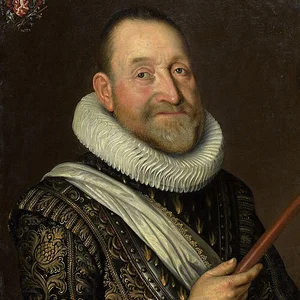

French writer, poet, and soldier, a major figure of Protestantism. A companion-in-arms of Henri de Navarre (the future Henri IV), he is the author of Les Tragiques, a great epic of the Wars of Religion.
Agrippa d'Aubigné(1552 — 1630)
Théodore Agrippa d'Aubigné
France
6 min read
Frequently asked questions
Key Facts
- Born in 1552 near Pons, in Saintonge, into a Protestant family
- Becomes a companion-in-arms and squire to Henri de Navarre from 1573
- Publishes his epic collection Les Tragiques in 1616, denouncing the persecution of Protestants
- Writes the Histoire universelle, a chronicle of the Wars of Religion (published from 1616 onward)
- Goes into exile in Geneva in 1620, where he dies in 1630
Works & Achievements
A sweeping epic in seven books denouncing the sufferings caused by the Wars of Religion; a masterpiece of French Baroque poetry and Protestant literature.
A collection of youthful love poetry, inspired by his passion for Diane Salviati, in the vein of the Pléiade.
A vast chronicle of the Wars of Religion from 1550 to 1601, written by a committed eyewitness; a major work of Protestant historiography.
A prose satire contrasting the “appearance” of court life with the “substance” of men of conviction; a comic and biting work.
Autobiographical memoirs written for his children, a precious testimony to his life and his era.
A satirical pamphlet mocking self-serving conversions to Catholicism, told through the character of Nicolas de Sancy.
Anecdotes
Born in Pons in 1552, the young Agrippa was a child prodigy: it is said that he could read Latin, Greek, and Hebrew by the age of six. When he was barely eight, while passing through Amboise, his father showed him the heads of the Protestant conspirators displayed on the gallows and made him swear to avenge their cause—an oath that would shape his entire life.
During the Wars of Religion, wounded and left for dead after a battle, Agrippa is said to have begun composing in his head the first verses of *Les Tragiques*, his great epic. He would carry this poem within him for decades before publishing it, long after the events it recounts.
A loyal comrade-in-arms to Henri of Navarre, Agrippa never forgave him his abjuration of 1593 (“Paris is well worth a Mass”). A free and caustic spirit, he dared to tell the king harsh truths, which earned him both esteem and disgrace—for Henri IV said of him that he was at once the most faithful and the most impertinent of his servants.
Growing old and threatened in France after the assassination of Henri IV, Agrippa went into exile in Geneva in 1620. He was received there with honor by the Protestant city and ended his days there, continuing to write and defend the Reformed cause until his death in 1630.
Agrippa d'Aubigné is the ancestor of a famous lineage: his granddaughter, Françoise d'Aubigné, would become Madame de Maintenon, the secret wife of King Louis XIV. Thus the fierce Huguenot had as his heir a woman who quietly reigned over the Catholic court of Versailles.
Primary Sources
I want to paint France as a grieving mother, / Who holds, in her arms, two children weighing her down.
An account in which Agrippa d'Aubigné tells his own children the episodes of his life, his battles, and his commitment to the Reformed faith.
A vast chronicle of the Wars of Religion in France, from 1550 to 1601, written by a committed witness and participant on the Protestant side.
A prose satire that, through the character of the Gascon Faeneste, denounces the “appearance” of the court against the “being” of men of faith.
Key Places
Town in western France near which Agrippa d'Aubigné was born in 1552 into a Protestant family.
Site of the 1560 conspiracy whose brutal executions left a lasting mark on the young Agrippa and sealed his commitment to Protestantism.
Residence where Agrippa settled during his exile, defending the Reformed city. He spent his final years in the Geneva region.
City of refuge for Protestantism where Agrippa went into exile in 1620 and died in 1630, welcomed with honour by Calvin's city.
Capital where Agrippa stayed at the court of Henry IV and which was the scene of the Saint Bartholomew's Day Massacre in 1572.
Protestant stronghold of which Agrippa was governor, fortifying and defending it after the Wars of Religion.
Typical Objects

Close-combat weapon of the gentleman-soldier of the Wars of Religion, worn at the side in all circumstances. Agrippa, a man of war, wielded it on the battlefields alongside Henry of Navarre.

Portable firearm emblematic of sixteenth-century armies, used by both infantry and cavalry during the Wars of Religion. It transformed the art of warfare in which Agrippa took part.

Writing instruments of the poet and historian, with which Agrippa composed Les Tragiques and his Universal History. The cut quill and ink were the daily tools of the man of letters.

The holy book translated into the vernacular, at the heart of the Reformed faith that Agrippa defended all his life. Reading the Scriptures for oneself set the Huguenots apart from Catholics.

Metal protection for the torso worn by horsemen and gentlemen in battle. Lighter than medieval armor, it equipped the soldiers of the Wars of Religion.

A fitted, padded jacket worn by men of quality in the sixteenth century, over which the armor was fastened. The garment marked the social rank of Agrippa, a noble of both robe and sword.
School Curriculum
Vocabulary & Tags
Key Vocabulary
Daily Life
Morning
On military campaign, Agrippa rises early to review the troops and check the horses and equipment. In peacetime, in his castle, the morning begins with prayer and the reading of Scripture, faithful to the austere habits of the Huguenots.
Afternoon
The afternoon is devoted to business: maintaining the fortified strongholds in his charge, corresponding with the Protestant leaders, or serving in the household of Henry of Navarre. It is also the time for hunting and weapons practice for the gentleman-soldier.
Evening
In the evening, Agrippa turns to writing, composing his verses and working on his *History*. A cultivated mind, he discusses theology, poetry, and politics with his companions by candlelight.
Food
The diet of a gentleman of the period combined bread, roasted meats, hunted game, fish on days of abstinence, and wine from Saintonge or Gascony. On campaign, meals were more frugal, set to the rhythm of marches and sieges.
Clothing
Agrippa wears the close-fitting doublet, the breeches, and the ruff of the late-16th-century gentleman, plain as befits a Protestant. In battle, he dons the cuirass and helmet, sword at his side and pistol at the saddle.
Housing
A man of war, he lived for a long time in the camps and fortified strongholds he commanded, such as Maillezais. In his later years, he resided in castles, and then in a home near Geneva during his exile, surrounded by his books and manuscripts.
Historical Timeline
Period Vocabulary
Liens externes & ressources
Références
Œuvres
Les Tragiques
1616
Le Printemps (L'Hécatombe à Diane, Stances et Odes)
vers 1570-1573
Histoire universelle
1616-1620
Les Aventures du baron de Faeneste
1617-1630
Sa vie à ses enfants
vers 1620-1630
La Confession catholique du sieur de Sancy
vers 1597-1617