Imaginary interview with Madame de Maintenon
by Charactorium · Madame de Maintenon (1635 — 1719) · Literature · Politics · Society · 5 min read
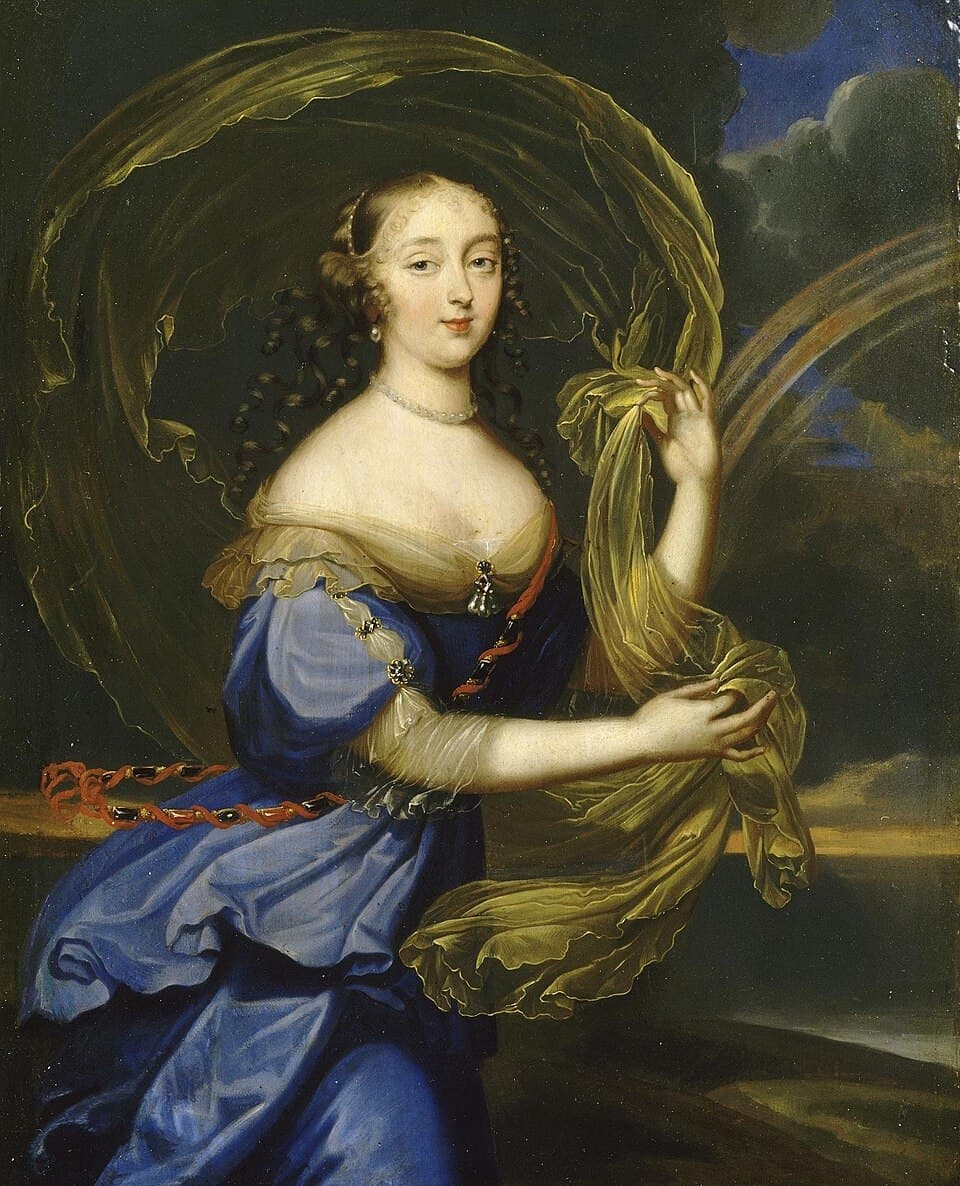
Late autumn 1718. In a modest room of the Maison royale de Saint-Louis, at Saint-Cyr, an old lady of eighty-three receives us, bundled up near a foot warmer of embers. Louis XIV has been dead for three years; she has left everything to live among her demoiselles. She speaks softly, without ornament, but her eye remains bright.
—How would you describe the early years of your life?
People think I was born in purple: I was born in disgrace, in Niort, to a ruined family. My father was condemned for murder, and as a child I knew jail and exile all the way to Martinique, before returning to France in a destitution no one can imagine. I was almost forcibly shut away in a convent; it was a charitable godmother, Madame de Neuillant, who took me in. From those years I kept one thing that no fortune ever took from me: intimate knowledge of what it is to fear for the morrow. When later I wanted to educate poor noble girls, I knew exactly what misery hides behind a fine name that can no longer be fed.
People think I was born in purple: I was born in disgrace.
—What did your marriage to the poet Paul Scarron teach you?
At sixteen, to no longer have to beg, I married Paul Scarron, twenty-five years my senior, nailed to his chair by a disease that twisted his bones. People are surprised at such a marriage; I saw it as a shelter. His house on the rue des Tournelles was poor in money but rich in wit: the fine talkers of Paris passed through, and I learned from them what would become my entire credit — the art of conversation, the art of listening above all. At his death, in 1660, I found myself a widow without a penny. But I had received an education that no dowry equals: knowing how to hold my rank by the mere conduct of my speech.
—Why did you found, in 1686, the Maison royale de Saint-Louis?
Because I knew their distress better than anyone. There exists a nobility that has lost everything except its four quarterings; its daughters, lacking dowries, have no other出路 than bad marriage or abandonment. In 1686, I obtained from the king this House at Saint-Cyr for two hundred and fifty demoiselles — they had to prove four generations of paternal nobility, but they entered poor. My design was not to make them scholars or nuns, but solid women, capable of running a household, of raising children in turn, of living in the world without being taken in by it. I wanted them to be instructed in piety as well as in letters and arts suitable to their station.
There exists a nobility that has lost everything except its four quarterings.
—You wrote the regulations and dialogues of the House yourself. What idea of education did you want to put into them?
A very simple idea: virtue is not formed by speeches but by practice. I wrote and rewrote our regulations, our Entretiens, our proverbs in little plays, because a lesson acted out gets in where a reprimand never passes. I repeated to my girls what I believe with all my heart: 'I wish you had as much taste for virtue as you have for trifles; but I know that virtue is only loved after it has been practiced.' That is my entire pedagogy. One only loves good after having done it; the rest is just fine words that fly away before nightfall.
One only loves good after having done it.
—How was the performance of Esther, commissioned from Racine for your pupils, born?
I wanted a diversion that would also be a lesson. Our girls acted and sang, and I feared profane comedies that heat the imagination. So I turned to Jean Racine — who had, he said, renounced the theater — and begged him to write for Saint-Cyr a subject drawn from Scripture. It was Esther, in 1689. The performance before the king and the entire court was such a triumph that people fought for entry; two years later he gave us Athalie. For a moment, my silent house became the most fashionable place in the kingdom. I was flattered by it, I admit, and that very weakness should have warned me.
—Why did you end up banning these performances that the court clamored for?
Because the remedy was becoming the disease. I saw my demoiselles breathing praise, priding themselves on their graces, turning their heads toward the great lords who applauded them. I had built this House to protect them from the world, and now I was letting the world in, right onto our stage, with its flattery and vanity. They called me cruel to extinguish such a beautiful fire; but what educator sows the pride she has sworn to uproot? So I closed the stage to outside spectators. Better to lose luster than to lose the souls of the children entrusted to me. I never regretted that sacrifice, only that I delayed making it.
What educator sows the pride she has sworn to uproot?
—You married the king in secret. How did you experience this strange position?
As an elevation that never had a name. After the death of Queen Marie-Thérèse, in 1683, the king wanted to marry me; but our union was morganatic and kept secret — queen never, wife always. I was given the lordship of Maintenon, whose name I bear, and apartments adjoining the king's at the château of Versailles. You may imagine glory; it was above all a burden without rest. No crown, no title, but all the weight of intimacy with an aging sovereign. I learned to stand in that light that never fully shone on me, present to everything and named to nothing.
Queen never, wife always.
—It has often been said that you governed the king and his ministers. What is the truth?
Court tongues made me far more powerful than I was. It is true that the king came to deliberate affairs in my apartments, that secretaries of state found me there, and that I heard, from the depths of my armchair, the affairs of the kingdom. But advising is not ruling. I always dreaded those cabals that attributed to me an authority I fled; I wrote to Cardinal de Noailles: 'I do not seek to extend my authority; I seek only not to harm what I have undertaken for God in this house.' That is my truth. My true government was Saint-Cyr, not the king's council.
—You are known for an austerity that contrasted with the splendor of Versailles. How did you live, amid so much magnificence?
Against the grain of everything around me. In that palace where people vied in embroidery and powdered wigs, I wore dark dresses, of good fabric but without a thread of gold, simple headdresses. I suffered from cold as a chronic ailment; my apartments were kept well heated, a rare luxury at Versailles, and I slid the warming pan of embers into my bed. My table was broths and vegetables, my wine watered. My day began and ended with prayer; my book of hours never left me. They called me the dévote, and I was one without false shame: I had known too well the nothingness of vanities to be caught up in them late in life.
—Your name is often associated with the Revocation of the Edict of Nantes. What do you reply to this reproach?
That I am attributed a power I never had. The Revocation, in 1685, was the will of the king and his councils, not the work of a converted woman who held neither seal nor office. Born myself into a Protestant family, returned to Catholicism, some have wanted to see in me the soul of this rigor; honest people will one day see what it really was. What I know is that my part was Saint-Cyr, and I gave everything to it. After the king's death, in 1715, I refused pension and title to retire here, among my girls, to pray and dictate my letters. It is among them that I wish to die, not amid the splendor I fled.
I had known too well the nothingness of vanities to be caught up in them late in life.


This imaginary interview was generated by artificial intelligence from sources documented in Madame de Maintenon's profile. It dramatises what the figure might have said based on what we know about them, but does not constitute attested historical testimony. For primary sources and factual documentation, refer to the full profile.