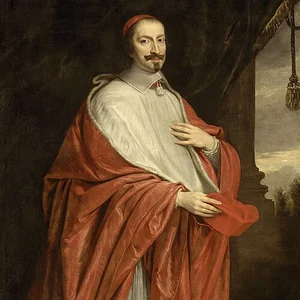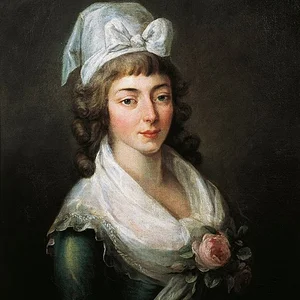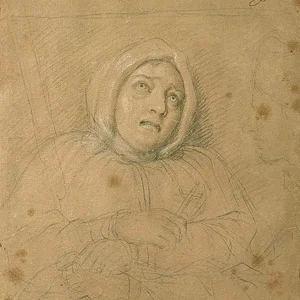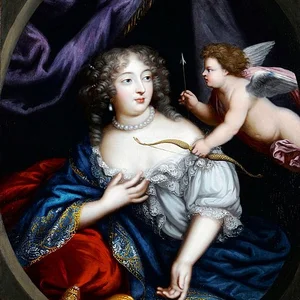

Born in 1635, Françoise d'Aubigné endured a wretched childhood before becoming governess to the legitimized children of Louis XIV, then his secret wife around 1683. In 1686, she founded the Maison royale de Saint-Louis at Saint-Cyr, a pioneering educational institution for young women from impoverished noble families.
Madame de Maintenon(1635 — 1719)
Madame de Maintenon
France
8 min read
Frequently asked questions
Famous Quotes
« One must suffer, one must love, one must pray: that is the whole of life.»
« We cannot always do what we wish; we must resolve to wish for what we do.»
Key Facts
- 1635: born in Niort into a ruined noble family, father imprisoned
- 1652: marriage to the burlesque poet Paul Scarron, who opened the Parisian salons to her
- 1669: appointed governess to the legitimized children of Louis XIV and Mme de Montespan
- c. 1683: secret marriage to Louis XIV following the death of Marie-Thérèse of Austria
- 1686: foundation of the Maison royale de Saint-Louis at Saint-Cyr for the education of 250 young women from impoverished noble families
Works & Achievements
A pioneering educational institution welcoming 250 impoverished young noblewomen aged 7 to 20. The first secular state school for girls in Europe, it stands as Maintenon's most significant and enduring achievement.
A prolific letter-writer, Maintenon left behind an enormous correspondence addressed to the king, ministers, pupils, and those close to her. These letters are an invaluable historical source on court life and her pedagogical thinking.
A collection of pedagogical dialogues and moral playlets written or inspired by Maintenon for the pupils of Saint-Cyr. These texts reveal an original approach to female education, virtue, and life in society.
At Maintenon's initiative, Racine wrote this biblical tragedy, performed by Saint-Cyr pupils before the court. The event brought considerable cultural prestige to the institution.
A body of pedagogical and moral rules written and revised by Maintenon herself, defining a comprehensive educational programme combining letters, domestic sciences, the arts, and religious formation.
Anecdotes
Françoise d'Aubigné spent part of her childhood in prison: her father, convicted of murder, was imprisoned in Martinique, and the young girl followed him there with her mother. On returning to France in complete destitution, she nearly ended up forced into a convent before a kindly godmother, Madame de Neuillant, took her in.
At sixteen, to escape poverty, Françoise married Paul Scarron, a celebrated but paralyzed poet twenty-five years her senior, confined to his chair by a bone disease. This marriage of convenience opened the doors of the Parisian literary salons to her and taught her the art of conversation; when Scarron died in 1660, she found herself a widow with no resources.
As governess to the illegitimate children of Louis XIV and Madame de Montespan, Françoise grew deeply attached to them and often clashed with their mother over their upbringing. The king, impressed by her devotion and intelligence, entrusted her with ever-greater responsibilities, eventually drawing her into the inner circle of the court and then into his own private life.
For the students of Saint-Cyr, Madame de Maintenon commissioned Jean Racine to write two plays on biblical subjects: *Esther* (1689) and *Athalie* (1691). The performance of *Esther* before the king and the entire court was a major social event; but feeling that the spectacle was stirring too much vanity in the young girls, she eventually banned further public performances.
After the death of Louis XIV in 1715, Madame de Maintenon immediately withdrew to Saint-Cyr, refusing any pension or official title. She spent her final four years there among the young women she had educated, teaching, praying, and dictating her correspondence until her death in 1719, at the age of eighty-three.
Primary Sources
“I wish you had as much taste for virtue as you have for trifles; but I know that virtue is only loved after it has been practiced.” Letter to a student of Saint-Cyr.
“I speak to you as a mother who loves you, and who would wish you to be as happy in this world as you will be in heaven, if you are good.”
“She governed the king, the ministers, affairs of state; she was in all things the soul of the council, and disposed of favors and disfavors with incomparable skill.”
“I do not seek to extend my authority; I seek only not to harm what I have undertaken for God in this house.”
“The young ladies shall be instructed in piety, in letters, in the arts befitting their sex, and formed in all Christian and civic virtues.”
Key Places
Birthplace of Françoise d'Aubigné in 1635. She spent a difficult childhood there marked by poverty and family instability, before being taken in by her godmother.
The heart of power under Louis XIV, Maintenon resided there from the 1680s in apartments connecting directly to those of the king. It was here that she exercised her discreet but very real influence on royal policy.
Institution founded in 1686 by Maintenon to house 250 young noblewomen without means. She taught there herself, resided there frequently, then retired there permanently after the death of Louis XIV.
A lordship purchased for her by Louis XIV in 1674, from which she took her name. This remodelled medieval château symbolizes her extraordinary social ascent, from poverty to nobility.
After her marriage to Paul Scarron, Françoise frequented Parisian literary salons and sharpened her mind there. It was in this cultivated milieu that she developed the art of conversation that would later captivate the king.
Typical Objects

Converted to Catholicism in her youth, Maintenon was deeply devout. Her prayer book was her most cherished possession, and she devoted several hours each day to prayer and religious services.

A prolific letter writer, she composed thousands of letters to loved ones, to Saint-Cyr students, and to ministers. Her portable writing desk allowed her to write even during the court's travels.

Known for her austere and unpretentious dress in the final decades of her life, she favored warm and understated clothing, in stark contrast to the splendor of Versailles — including a dark dressing gown she wore for her lessons at Saint-Cyr.

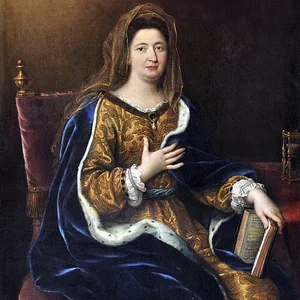
The famous bust-length portrait painted around 1694 depicts Maintenon at the height of her influence. She holds a book, a symbol of her piety and her passion for education, and wears a plain outfit that contrasts with official court portraits.

A chronic sufferer of the cold, Maintenon had her bed and apartments warmed with warming pans filled with embers. The king himself made sure her rooms were always kept well heated.

Maintenon personally wrote the pedagogical and moral regulations of her institution. These handwritten notebooks, constantly revised, bear witness to her pioneering thinking on the education of young women.
School Curriculum
Vocabulary & Tags
Key Vocabulary
Daily Life
Morning
Maintenon rose early, beginning her day with a lengthy personal prayer before attending Mass. At Versailles, she would then receive secretaries of state and occasionally ministers in her apartments, where the king would come to visit her and deliberate on affairs of the kingdom.
Afternoon
In the afternoons, Maintenon often traveled to Saint-Cyr to hold conversations with the young ladies or to supervise the teachers' lessons. At Versailles, she received a carefully chosen selection of courtiers in an atmosphere of quiet devotion quite uncommon for the court.
Evening
Her evenings were divided between vespers prayers, spiritual reading, and the company of the king, who spent long hours in her apartments. Maintenon also enjoyed writing her letters in the evening by candlelight, often bundled in shawls to ward off the chill of Versailles.
Food
Maintenon ate simply and sparingly, in keeping with her piety and modest upbringing. She favored broths, vegetables, and fruit, avoided the excesses of the royal table, and drank little wine, usually diluted with water.
Clothing
Known for her austere and somber appearance, Maintenon eschewed the excesses of Versailles fashion: well-made dresses but without ostentatious embroidery, always in muted tones — blacks, grays, browns. She wore plain caps and rejected the fashionable wigs and powder.
Housing
At Versailles, her apartments on the first floor of the king's wing were known for their warmth — a rare luxury in the palace — yet were free of unnecessary grandeur. At Saint-Cyr, she occupied a modest room among the buildings of the institution she had founded, with no excessive decoration.
Historical Timeline
Period Vocabulary
Liens externes & ressources
Références
Œuvres
Fondation de la Maison royale de Saint-Louis à Saint-Cyr
1686
Correspondance (environ 90 000 lettres connues)
1660-1719
Entretiens et proverbes pour les demoiselles de Saint-Cyr
circa 1700-1715
Commande d'Esther à Jean Racine
1689
Règlements de la Maison royale de Saint-Louis
1686-1710