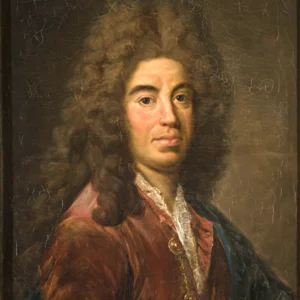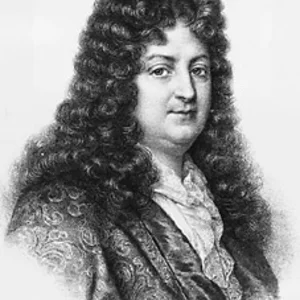

A French playwright of the 17th century, Racine is one of the masters of classical tragedy. Author of masterpieces such as Phaedra and Andromache, he embodies the balance between formal rigour and emotional intensity that defines French classical theatre.
Jean Racine(1639 — 1699)
Jean Racine
royaume de France
7 min read
Frequently asked questions
Famous Quotes
« Glory must endure forever.»
« All passions lie, except love.»
Key Facts
- 1664: First performance of Andromache, an immediate success that established his reputation
- 1677: Premiere of Phaedra, his greatest tragedy exploring passion and guilt
- 1672–1691: A highly productive period including the creation of Britannicus, Mithridates, Athaliah, and other tragedies
- 1677: Appointed royal historiographer to King Louis XIV
- 1699: Died in Paris; recognised as one of the greatest French playwrights
Works & Achievements
Racine's first great tragedy, inspired by Euripides and Virgil. It reveals his genius for portraying devastating amorous passions and the fatality that crushes his characters.
A Roman tragedy depicting the criminal youth of Nero. It illustrates the rise of tyranny to power and remains one of the most studied plays in French secondary schools.
A spare tragedy, almost without action, centered on the separation of the Roman emperor Titus and Queen Berenice. It embodies the classical ideal: drawing tears with the minimum of events.
Racine's absolute masterpiece, adapted from Euripides. The story of Phaedra, consumed by a forbidden passion for her stepson Hippolytus, is considered the pinnacle of French classical tragedy.
A biblical tragedy with choruses, written for the pupils of Saint-Cyr. It marks Racine's return to writing after twelve years of theatrical silence.
Racine's final play, drawn from the Old Testament (Kings). Considered by Voltaire and many critics to be his greatest masterpiece, it was not performed publicly until after his death.
Anecdotes
Racine was raised by the Jansenists of Port-Royal after the death of his parents, who instilled in him an austere vision of the world and of sin. Paradoxically, he chose theatre, an art then held in contempt by his mentors, which caused a painful break with his original community.
At the premiere of Phèdre in 1677, a cabal orchestrated by literary enemies arranged for a rival play on the same subject, written by Nicolas Pradon, to be performed simultaneously. Although Pradon's version was a resounding failure, the scandal deeply wounded Racine, who decided to abandon secular theatre.
Louis XIV so admired Racine's talent that he appointed him, along with Boileau, as royal historiographer in 1677. This prestigious position required both men to accompany the king on military campaigns to chronicle his victories — a mission far removed from playwriting.
Reconciled with Port-Royal, Racine wrote two plays on biblical subjects, Esther (1689) and Athalie (1691), at the request of Madame de Maintenon, for the young girls of the royal house of Saint-Cyr. These works were performed by the pupils themselves, in an educational and religious setting.
At his death in 1699, Racine asked to be buried at Port-Royal-des-Champs, alongside his Jansenist mentors, as a sign of final reconciliation. When the abbey was destroyed in 1711, his remains were transferred to the church of Saint-Étienne-du-Mont in Paris, where they still rest today.
Primary Sources
Here is another tragedy whose subject is taken from Euripides. I followed a somewhat different path from that of this author in the conduct of the action. I believed that slander had something too base and too dark to place in the mouth of a princess.
That is how I endeavored to make my action plausible. And that is what I most carefully strove to do in this tragedy, where I followed history much more closely than in the others.
I am glad that you write to me sometimes in Latin; it rests me from the French language, and puts me back in the taste for antiquity, without which I do not believe one can produce fine things.
I chose Britannicus as the subject of a tragedy because, being a less well-known character, I had less to fear of clashing with the ideas the reader may have formed of him.
Key Places
Jansenist abbey where Racine was educated after the death of his parents. This austere community shaped his worldview, marked by notions of grace, sin, and fatality that permeate his tragedies.
Parisian theatre where most of Racine's great tragedies were premiered, notably Andromaque and Phèdre. It was the most prestigious stage in Paris for tragedy.
Royal residence where Racine, in his capacity as historiographer to the king, frequented the court of Louis XIV. His plays were also performed there during grand royal festivities.
Institution founded by Madame de Maintenon for the education of impoverished young noblewomen. Racine had Esther and Athalie performed there, written specifically for the students.
Racine's final resting place, following the transfer of his remains from Port-Royal-des-Champs upon the destruction of the abbey in 1711.
Typical Objects

Racine's daily working instrument, with which he composed his tragedies in carefully weighed alexandrines. The quill symbolizes the meticulous labor of the classical writer, devoted to the perfection of every line.

Trained by the humanists of Port-Royal, Racine read the ancient authors in the original text. Euripides was his principal source of inspiration for Phèdre and Andromaque.

Deeply marked by his Jansenist education, Racine drew from sacred texts the material for his last plays, Esther and Athalie, taken directly from the Old Testament.

The lighting of apartments and theatres in the 17th century relied on tallow or wax candles. Racine worked and attended rehearsals by the light of these flickering flames.

An indispensable mark of social distinction at the court of Louis XIV, worn by Racine in his capacity as an official figure and historiographer to the king.

Racine's tragedies were published as small printed volumes, adorned with prefaces that the author himself wrote to defend his dramaturgical choices.
School Curriculum
Vocabulary & Tags
Key Vocabulary
Tags
Mouvement
Daily Life
Morning
Racine rose early and devoted the first hours of the day to reading and writing. Trained to read Greek and Latin by the masters of Port-Royal, he regularly reread the ancient tragedians, seeking in Euripides or Sophocles the material for his own plays.
Afternoon
Afternoons were often spent at rehearsals in the theatre or visiting Parisian literary salons, where he mingled with Boileau, La Fontaine, and the great minds of his time. After his appointment as royal historiographer, he sometimes accompanied Louis XIV during official ceremonies or military campaigns.
Evening
Evenings were marked by theatrical performances, which Racine followed from the auditorium or the wings, attentive to the audience's reception. At the court of Versailles, he attended royal dinners and entertainments organised by Louis XIV, where theatre held a central place.
Food
The cuisine of the seventeenth century for a Parisian man of letters of good standing included soups, roasted meats, white bread, and wine diluted with water. Meals in company were an opportunity for intellectual exchange as much as gastronomic pleasure, in a context where the table was an essential space of sociability.
Clothing
Racine wore the dress characteristic of a courtier during the reign of Louis XIV: a fine broadcloth justaucorps, rhingraves, silk stockings, a powdered wig, and a lace cravat. Sober in his personal tastes, he nonetheless dressed according to the codes of social distinction imposed by life at court.
Housing
Racine first lived in modest lodgings in Paris at the outset of his career, before gaining access to comfortable apartments through royal favour. After his marriage in 1677 to Catherine de Romanet, he settled in a bourgeois residence in Paris and stayed frequently at Versailles as part of his duties as historiographer.
Historical Timeline
Period Vocabulary
Visual Style
L'esthétique de l'univers de Racine oscille entre la rigueur austère de Port-Royal et la splendeur dorée de Versailles, incarnant le classicisme français dans ses couleurs profondes et ses drapés somptueux.
Sound Ambience
L'univers sonore de Racine mêle la solennité du théâtre classique parisien — vers scandés, silence de la salle tendue — au brouhaha des rues du Paris de Louis XIV et à la musique baroque des salons aristocratiques.