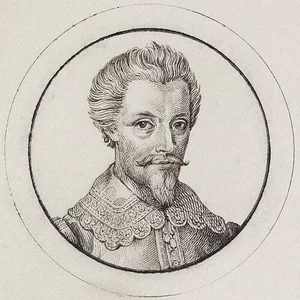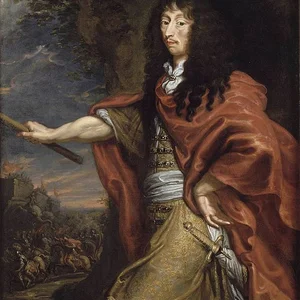

Nicknamed “the Great Condé,” this prince of the blood distinguished himself at the Battle of Rocroi (1643) by crushing the Spanish infantry. A key figure in the Fronde, he eventually reconciled with Louis XIV and remained one of the greatest military commanders of the Grand Siècle.
Louis II de Bourbon, prince de Condé
Louis II de Bourbon, prince de Condé
France
8 min read
Frequently asked questions
Key Facts
- 1621: Born in Paris, son of Prince Henri II de Condé, prince of the royal blood
- 1643: Brilliant victory at the Battle of Rocroi at age 21, ending the reputation for invincibility of the Spanish infantry
- 1648–1653: Ambiguous role in the Fronde of the Princes, taking up arms against Mazarin and Louis XIV
- 1651–1659: Exile and service in the Spanish army against France
- 1660: Reconciliation with Louis XIV, return to royal favor; patron of Molière, Racine, La Fontaine, and Bossuet from his estate at Chantilly
- 1686: Death at Fontainebleau, the subject of a celebrated funeral oration by Bossuet
Works & Achievements
By crushing the Spanish tercios, Condé ended Spain's military supremacy in Europe and delivered a decisive French victory in the Thirty Years' War. This battle was the founding act of his legend.
Fighting alongside Turenne, Condé led victorious campaigns in Germany that contributed to French successes during the Westphalia peace negotiations.
Condé's last great victory before the Fronde, Lens was a decisive blow against the Spanish in Flanders that strengthened France's hand in the ongoing peace negotiations.
A central figure in the civil war that shook the French monarchy, Condé played an ambiguous role that historians still analyze as a window into the tensions between the nobility and royal power.
Reconciled with Louis XIV, Condé took part in the Sun King's major wars of expansion, crowning his military career at the Battle of Seneffe (1674) against William of Orange.
In his final years, Condé made Chantilly a major cultural center, extending his patronage to Molière, Racine, La Bruyère, and Bossuet, and thereby contributing to the brilliance of French letters in the *Grand Siècle*.
Anecdotes
On **19 May 1643**, Louis II de Condé was just 21 years old when he won the Battle of Rocroi against the Spanish infantry, which had been considered invincible for a century. By launching his cavalry in a charge of startling boldness, he destroyed the famous *tercios* and brought an end to Spanish military supremacy in Europe. This stunning victory, achieved just days after the death of Louis XIII, immediately established him as one of the greatest commanders of his age.
During the Fronde of the Princes (**1650–1653**), Condé went from national hero to traitor in the space of a few years. Arrested on Mazarin's orders in January 1650, then freed by popular pressure, he ultimately took up arms against the king and even went so far as to command Spanish armies against France. This act of treason cost him years of exile, before a solemn reconciliation with **Louis XIV** in **1660**.
Condé was a passionate patron of the arts who transformed his château at **Chantilly** into a true cultural hub. He welcomed **Molière**, **Racine**, **Bossuet**, **La Fontaine**, and **La Bruyère** — who even served as his secretary — into his salons. His love of arts and letters earned him the admiration of the greatest minds of the Grand Siècle.
At the Battle of **Seneffe** in **1674**, Condé — then 53 years old and suffering from gout — still led a decisive charge against the armies of **William of Orange**. It was his last great feat of arms. **Louis XIV** paid him a personal tribute by coming to visit him, acknowledging him as the greatest military commander of his reign.
Upon his death in December **1686**, **Bossuet** delivered one of the most celebrated funeral orations in French literature. In this address, the Bishop of Meaux extolled the military genius of the Grand Condé while framing it within divine glory, following the rhetorical conventions of the Grand Siècle. The text is still studied in French secondary schools today as a model of the genre.
Primary Sources
God alone is great, my brethren; and since those final hours when I saw so closely, and in so illustrious a person, how vain and fleeting human greatness is, I have had but one thought.
The Prince possessed a natural gift for war that even the greatest commanders acquire only with time; he grasped at a glance what others sought through long reflection.
The Duke of Enghien has won a complete victory over the Spanish at Rocroi; the enemy infantry has been cut to pieces and their generals are prisoners.
The Prince of Condé, weary of Cardinal Mazarin's persecutions and the ingratitude of the court, resolved to take up arms in defence of his liberty and the honour of his house.
The King paid a visit to the Prince at Chantilly, and expressed particular esteem for the services he had rendered to France and to the King's personal glory.
Key Places
The Grand Condé's principal residence, which he transformed into a thriving artistic and intellectual hub. He welcomed the greatest writers of the century there and assembled a remarkable library.
A small town in the Ardennes where Condé, aged 21, won the victory in 1643 that definitively cemented his reputation by annihilating the supposedly invincible Spanish infantry.
The Parisian residence of the princes of Condé, near the Palais du Luxembourg. It was here that much of Louis II's political and social life unfolded during the early years of the Fronde.
The royal residence where Louis II de Condé died on 11 December 1686, attended by the king and his court, bringing to a close a life defined by battles and political reversals.
During his exile after the Fronde, Condé commanded the Spanish armies from Brussels. This ambiguous chapter of his life illustrates the tension between personal ambition and national loyalty.
Liens externes & ressources
Références
Œuvres
Victoire de Rocroi
19 mai 1643
Campagnes d'Allemagne (Fribourg, Nördlingen)
1644-1645
Victoire de Lens
20 août 1648
Participation à la Fronde des princes
1650-1653
Campagnes de la guerre de Dévolution et de la guerre de Hollande
1667-1675
Mécénat à Chantilly
1675-1686