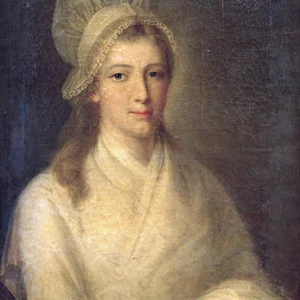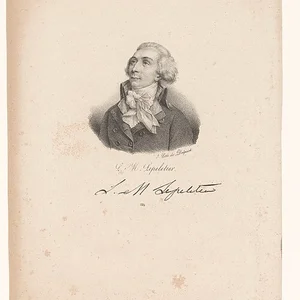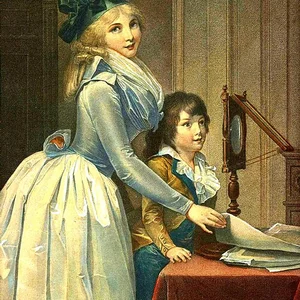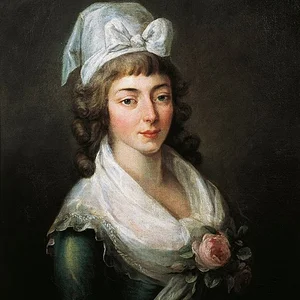

Salon hostess and Girondin political figure, Manon Roland (1754–1793) exerted considerable influence over the Girondin party during the French Revolution. Arrested during the Terror, she was guillotined in 1793, uttering her famous words about liberty.
Madame Roland(1754 — 1793)
Manon Roland
France
8 min read
Frequently asked questions
Famous Quotes
« O Liberty, what crimes are committed in thy name!»
Key Facts
- 1754: born in Paris, daughter of an engraver, receives a careful education
- 1780: marries Jean-Marie Roland de la Platière, inspector of manufactures
- 1791–1792: hosts an influential political salon in Paris, the true center of the Girondin party
- 1792: her husband becomes Minister of the Interior; she herself drafts many of his official letters
- 1793: arrested after the fall of the Girondins, guillotined on 8 November 1793
Works & Achievements
Written in prison during the final weeks of her life, these Memoirs are at once an autobiography and a political testimony on the Revolution and the Girondins. Composed with eloquence and lucidity, they stand as a major historical document.
A text written in prison in which Manon Roland defends herself against the charges levelled at her and at the Girondins, addressing herself directly to future generations. It bears witness to her sharp political awareness right up to the end.
This official letter, signed by Minister Roland but drafted by Manon, demands that Louis XVI uphold the Constitution and the revolutionary laws. Its forcefulness provoked the king to dismiss Roland and made the document a widely noticed political statement.
Manon Roland maintained an extensive political and personal correspondence with François Buzot and other Girondin leaders. These letters, partially preserved, reveal both her political thinking and the depth of her personal feelings.
Anecdotes
From the age of nine, Marie-Jeanne Phlipon was reading Plutarch in her father's engraving workshop on the Quai de l'Horloge in Paris. These tales of great men of Antiquity left a deep mark on her: she dreamed of living in an ancient Republic, and would later declare that it was Plutarch who had 'prepared her soul for liberty.' This passion for books made her an exceptional self-taught scholar at a time when girls' education was extremely limited.
At the salon she hosted in Paris, Manon Roland often wrote herself the letters and speeches that her husband, minister Jean-Marie Roland, would sign. Brissot, Vergniaud, and other Girondin leaders were regular visitors, to the point that her enemies nicknamed her 'the éminence grise of the Girondins' or even 'the real minister Roland.' She thus wielded genuine political power without ever officially holding the title.
Imprisoned at Sainte-Pélagie in June 1793, Manon Roland used her weeks of detention to write her Memoirs with remarkable energy. She wrote under difficult conditions, knowing she risked death, yet wanting to leave an honest testimony to posterity. These memoirs, written with talent and candor, are today a primary historical source on the Revolution.
On November 8, 1793, at the scaffold on the Place de la Révolution, Manon Roland reportedly addressed a statue of Liberty with words that would become famous: “O Liberty, what crimes are committed in thy name!” This phrase captures the disillusionment of a woman who had believed in the ideals of the Revolution and died watching them perverted by the Terror. Her husband Jean-Marie Roland, upon learning of her death, took his own life a few days later.
Manon Roland maintained an intense and passionate correspondence with Girondin deputy François Buzot, whom she met in 1791. She wrote about this love with rare candor in her prison Memoirs, while maintaining that she had never been unfaithful to her husband. This story illustrates the complexity of the private lives of women during the Revolution, torn between moral convictions and deep personal feelings.
Primary Sources
I was born in Paris on 17 March 1754 […] My father was a skilled craftsman whose talent and industry earned him a comfortable living. My mother combined a fine appearance with the most estimable qualities. I was their only child, and they cherished me as much as one can cherish what one has but once.
If ever my writings reach the public, let them seek there the story of a woman who never wished to deceive, and who believed that truth was the first duty owed to her fellow citizens and to herself.
Sire, France is covered with priests and monks who openly correspond with our enemies and fan the flames of civil war. […] If the affairs of your reign end badly, history will call you to account for it.
Your image accompanies me everywhere; I think of you with a tenderness I shall make no effort to fight, for I am persuaded it is as pure as my soul and that it could never compromise my virtue.
Key Places
Manon Roland was born on March 17, 1754 in her father's engraving workshop, on the Quai de l'Horloge on the Île de la Cité. It was here that she spent her childhood surrounded by books, developing her passion for reading and philosophy.
In Paris, Manon Roland hosted an influential political salon where the leading Girondist figures — Brissot, Vergniaud, Buzot — regularly gathered. It served as the true intellectual headquarters of the Girondist party during the years 1791–1793.
Following her arrest on June 1, 1793, Manon Roland was first imprisoned at the Abbaye prison in the Saint-Germain district. There she began organizing her defense and collecting her thoughts.
Transferred to Sainte-Pélagie (rue de la Clef, 5th arrondissement), Manon Roland wrote the bulk of her *Mémoires* and correspondence there. It was from this prison that she prepared the testament she intended to leave for posterity.
Manon Roland was guillotined on November 8, 1793 at the Place de la Révolution, before a statue of Liberty. It was here that she uttered her celebrated words about liberty and the crimes committed in its name.
Typical Objects

Manon Roland wrote ceaselessly: letters, political speeches, memoirs, salon notes. Her quill was her most formidable weapon — she kept writing even in prison, drafting her *Memoirs* until the eve of her execution.

This collection of biographies of ancient Greeks and Romans was the book that shaped Manon from childhood. It forged her republican ideals and her admiration for civic heroes willing to die for their country.

A cultured woman, Manon Roland played the harpsichord — the instrument typical of bourgeois salons in the 18th century. Mastery of a musical instrument was a mark of refined education among the Parisian middle class.

Encoded or secret political correspondence was the lifeblood of Girondin networks. Manon drafted and organised these epistolary exchanges, which formed the backbone of the party — including underground after June 1793.

During the revolutionary period, middle-class women like Manon adopted simple cotton or white muslin gowns, abandoning the corsets and finery of the *Ancien Régime*. This sartorial plainness was a sign of commitment to republican values.

Revolutionary newspapers circulated through political salons. Manon Roland read the press avidly to follow debates at the Convention and the Jacobin Club, and to sharpen her political positions.
School Curriculum
Vocabulary & Tags
Key Vocabulary
Daily Life
Morning
Manon Roland rose early and devoted the first hours of the day to reading and political correspondence. A woman of great intellectual discipline, she would answer letters before breakfast, coordinating the Girondin party's positions from her desk.
Afternoon
The afternoon was reserved for the salon: Girondin deputies, journalists, and intellectuals would come to debate at her home. Manon led the discussions with energy, took notes, and sometimes drafted summaries or position statements on the topics raised.
Evening
In the evening, after her visitors had left, Manon would review and revise the texts and speeches prepared during the day. She also devoted time to philosophical reading — Rousseau, the Encyclopédistes, Montesquieu — before retiring for the night.
Food
Like most bourgeois Parisians of her time, Manon Roland ate frugally: bread, vegetables, broth, and occasionally meat or poultry. Meals were simple and regular, without the ostentation of the Ancien Régime aristocracy she despised.
Clothing
Manon wore dresses in cotton or muslin, in muted colors, with none of the extravagant ornamentation of the nobility. In the revolutionary era, simplicity in dress was a mark of republican virtue — a conviction she held sincerely.
Housing
In Paris, the Rolands lived in a rented bourgeois apartment that served as both family home and political workplace. Their living arrangements were comfortable but without ostentatious luxury, reflecting their republican convictions and the provincial bourgeois tradition from which they came.
Historical Timeline
Period Vocabulary
Liens externes & ressources
Références
Œuvres
Mémoires
1793 (publiés en 1795)
Appel à l'impartiale postérité
1793 (publié posthume)
Lettre de Roland à Louis XVI
10 juin 1792
Correspondance avec Buzot et les Girondins
1791-1793