Imaginary interview with Manuela Sáenz
by Charactorium · Manuela Sáenz (1797 — 1856) · Politics · Military · 6 min read
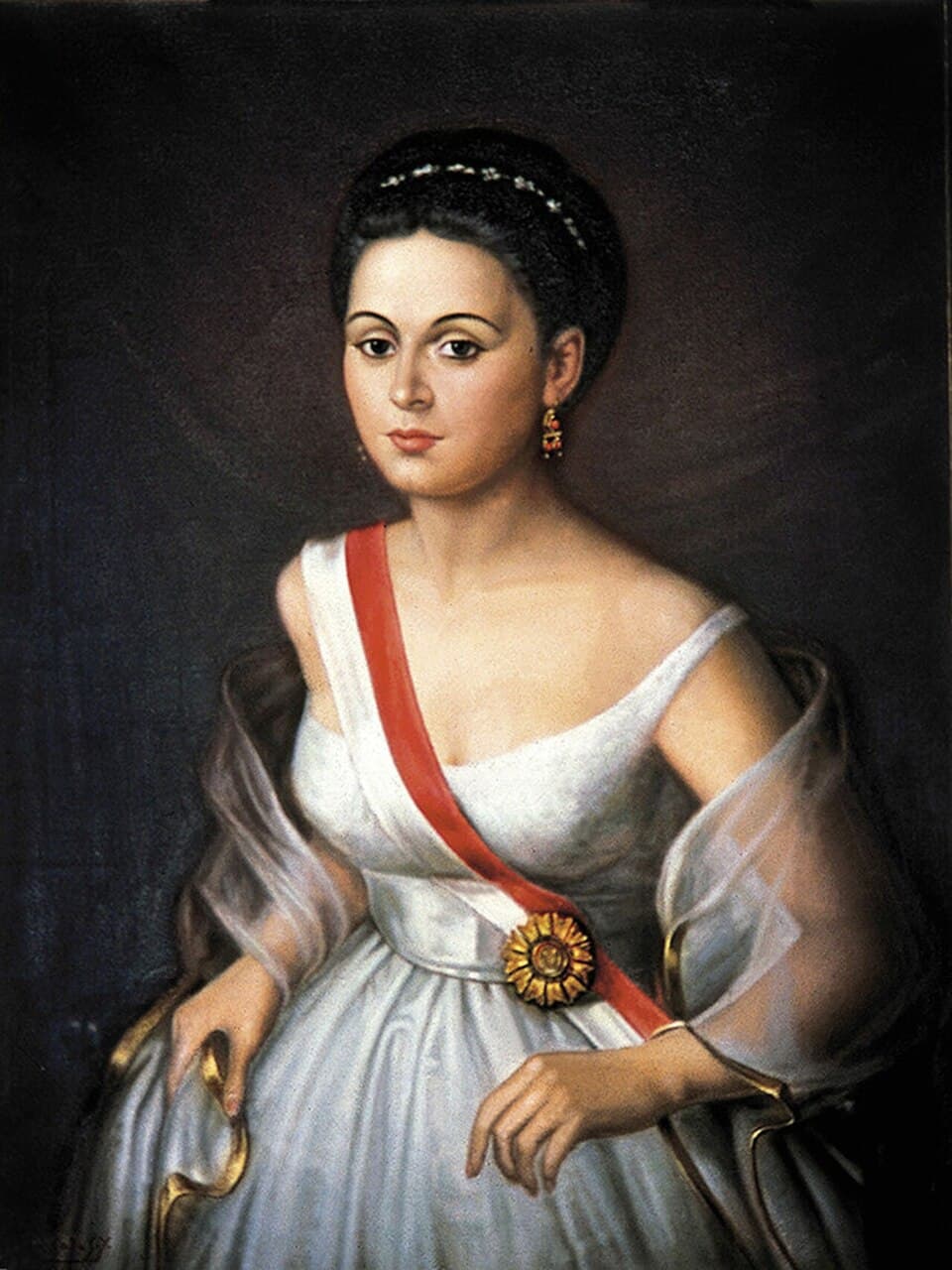
Paita, on the dusty coast of Peru, a morning in 1850. In a low adobe house open to the Pacific winds, a woman with a firm gaze rolls cigars between her fingers, an old chest of letters at her feet. Manuela Sáenz, whom some called a heroine and others a scandal, agrees to speak.
—How did a young woman from Quito find herself on a battlefield?
You think one chooses? I was raised to host a salon, marry a suitable man — I did marry Dr. James Thorne, an Englishman as polite and cold as Lima rain. But on May 24, 1822, on the slopes of Mount Pichincha, above Quito, propriety no longer mattered. I carried ammunition, I bandaged boys calling for their mothers as they died, I held the camp together by sheer will. When the gunpowder cleared, General Sucre personally awarded me the rank of capitana of the hussars. A woman, captain! The Creole ladies swooned. I knew that day that my life would no longer be played out in patios.
A woman, captain! The Creole ladies swooned.
—What did that medal you received at Pichincha mean to you?
A piece of metal, you might say. To me, it was proof that the blood I wiped away counted as much as that of men. I kept it with Bolívar's correspondence, in the same chest — my two treasures. Understand me: in this world of haciendas and inherited titles, a woman owned only what a father or husband deigned to leave her. That Pichincha medal, no one gave it to me out of charity or marriage: I earned it under fire. The defeated realistas, the liberated Audiencia of Quito, and me standing in my blue uniform. I was reproached for that rank all my life. I wore it as others wear their name.
No one gave it to me out of charity: I earned it under fire.
—Tell us about the night of September 25, 1828, in Bogotá.
It was late, it was raining on Bogotá. Simón was asleep when I heard the dogs, then boots on the palace stairs. I shook him: Salta, salta por la ventana! He hesitated, my god he was proud, he wanted his saber and to face the conspirators. I pushed him toward the window and I walked, myself, to meet the assassins in the corridor. They struck me, they screamed 'where is the tyrant?', and I lied, I bought minutes, each second a life. When they realized, he was already in the street, safe. That night he named me Libertadora del Libertador. General O'Leary wrote it in his memoirs: I held them long enough.
I pushed him toward the window and walked to meet the assassins.
—Were you never afraid that night, facing the conspirators?
Fear? It comes after, when everything is over and your hands tremble. In the moment, you are a blade, you don't think. I had my dueling pistol — I never parted with it, even in salons, because plots grew in Bogotá like moss on old walls. That night, the weapon didn't serve; it was my words and my body blocking the corridor. Consider the irony: they called me 'the madwoman' for my uniform and audacity, and yet that madness saved the Republic. Simón told me, in his letters from Bucaramanga, that he could not live without me. That night, it was he who would not have lived without me.
Fear comes after, when everything is over and your hands tremble.
—Why were you so determined to wear men's clothing?
Because a muslin dress doesn't ride a horse like a hussar. My blue frock coat with frogs, my belt, my saber — it was the garb of work, not a disguise. The Creole elites of Lima and Bogotá shuddered in horror: a woman in cavalry trousers, what indecency! But the soldiers, they looked at me as one of their own when I reviewed the horses at dawn. You see, in this century, they wanted a woman to be a silent ornament, a well-bred criolla who pours chocolate. I preferred boots to embroidery. They hated me for that more than for my ideas. Trousers frightened those gentlemen more than a pronunciamiento.
I preferred boots to embroidery, and they hated me for it.
—That British husband you mention, what place did he hold in this life of combat?
Poor Thorne wrote me pleas to return home, to become a respectable wife again. I answered him once — I remember it well: Tú eres un excelente hombre, pero no eres sino un hombre común. Bolívar es un dios. Cruel? Perhaps. But true. How could I go back to keeping house in Lima when I had smelled gunpowder and seen a nation born? He offered me the security of an hacienda, comfort, a name. I wanted History. A common man does not understand that a woman might prefer the uproar to domestic peace. I chose the god over the honest man, and I never regretted it, even in poverty.
He offered me security; I wanted History.
—Less is said about your role in salons. What really went on there?
Ah, people imagine ladies' salons with gossip and fans! My tertulias, in Lima and later Bogotá, were workshops of conspiracy. In the afternoon, patriots, officers, writers came to drink and talk; I listened more than I spoke. A careless phrase from a realista, a note slipped under a cup, and I knew before anyone where the next blow would come from. The men thought they were discussing philosophy; in truth I was untangling their intrigues like a skein of wool. Intelligence, sir, is gathered as much in a salon as on a battlefield. I defended Simón's name against those who wanted to erase him from History, with words as much as with saber blows.
The men thought they were discussing philosophy; I was untangling their intrigues.
—You speak of 'defending his name.' Against whom, exactly?
Against a whole world that, as soon as Simón weakened, began to spit on what he had built. The Gran Colombia he had dreamed of — Colombia, Venezuela, Ecuador united — was already tearing apart in his lifetime. The ambitious, the pronunciamientos, the petty provincial chiefs smelled carrion. From Lima, I wrote, I warned, I denied the calumnies. I was his sentinel. They found me excessive, meddlesome — a woman dabbling in politics! But someone had to hold the door while they tried to assassinate his memory as they had tried to assassinate his body. I never tired of that fight. Defending a man brought down by ingratitude had become my only campaign.
I was his sentinel, holding the door while they assassinated his memory.
—After Bolívar's death in 1830, how did you end up in this port of Paita?
I was driven out. Expelled from Bogotá, wandering between Ecuador and Peru, unwanted everywhere because I remained the Liberator's woman when it was fashionable to disown him. Paita — this dusty port where the wind carries sand and salt — was my last refuge. Simón died on December 17, 1830, in Santa Marta, ruined, abandoned by almost everyone. And I, the capitana of the hussars, friend of the powerful, reduced to selling tobacco and sweets to passing sailors. Twenty years of that. But in my adobe house, under the hammock, there was the chest — the hundreds of letters from Simón. As long as I kept them, he was not entirely dead.
As long as I kept his letters, he was not entirely dead.
—They say an American sailor, a certain Melville, met you. What do you remember?
A young sailor passing through, in 1841, with curious eyes. He looked at me as one looks at a noble ruin — this once-powerful woman now selling her sweets under the Paita sun. They say he never forgot my pride; it was all I had left, pride, you can't sell it at market. People came to see 'the Libertadora' like a curiosity, a living relic of the wars of independence. I let them look. They didn't know that in my chests slept the true soul of that epic — the words Simón had written me in his hand. I lost everything: fortune, homeland, uniform. I had memory left, and I guarded it like a sentinel at his post.
Pride can't be sold at market; it was all I had left.
—If you imagined people would read you a century from now, what would you want them to remember?
What a strange thought. If they are to remember me in a hundred years — me who ended up forgotten in a fishing port — I would want them not to reduce me to the Liberator's lover. Yes, I loved Simón as one loves a god, and I saved his life that September night in Bogotá. But I also wore the uniform, earned my rank at Pichincha, stood up to salons and conspirators. A woman can be a soldier, a spy, an archivist, and faithful unto the poverty of Paita. If my letters burn after me — and I fear they will — let at least this remain: I lived free in a century that forbade it to women. That was my true battle.
I lived free in a century that forbade it to women.
This imaginary interview was generated by artificial intelligence from sources documented in Manuela Sáenz's profile. It dramatises what the figure might have said based on what we know about them, but does not constitute attested historical testimony. For primary sources and factual documentation, refer to the full profile.