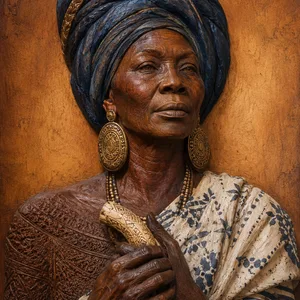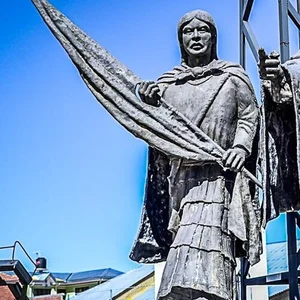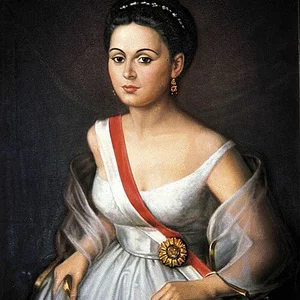

Ecuadorian revolutionary born in Quito around 1797, of mixed heritage (Creole mother, Spanish father), Manuela Sáenz was a central figure in the Spanish American wars of independence and the companion of Simón Bolívar. She saved the Liberator's life in 1828 and was nicknamed the "Libertadora del Libertador."
Frequently asked questions
Famous Quotes
« "I was born beneath the equinoctial line, but my spirit was never bound by any meridian."»
Key Facts
- Born around 1797 in Quito (Viceroyalty of New Granada), illegitimate daughter of a Spanish father and a Creole mother — written sources (partial colonial registers)
- Actively participated in the Quito uprisings (1809–1822) and joined the patriot armies before meeting Bolívar in 1822 — written sources and oral popular tradition
- On September 25, 1828, in Bogotá, she protected Bolívar during an assassination attempt, allowing him to escape — documented by contemporary written sources
- After Bolívar's death (1830), she was banished and spent the rest of her life in exile in Paita, Peru, where she died in 1856 — written sources (correspondence, accounts from visitors including Garibaldi)
- Symbolically rehabilitated by Ecuador and Colombia in the 20th–21st centuries; enshrined in Latin American collective memory as a figure of female resistance — oral tradition and popular memory
Works & Achievements
Manuela Sáenz organized the supply of ammunition, tended to the wounded, and kept up troop morale during this decisive battle that freed Quito from Spanish rule.
A heroic act acknowledged by Bolívar himself: Manuela warned and shielded the Liberator during the assassination plot, saving his life and potentially altering the course of South American history.
Manuela held clandestine political gatherings (tertulias) in her salons that spread republican ideas and united independence supporters among the Creole elites.
During her years of exile in Paita, Manuela kept and safeguarded hundreds of Bolívar's personal letters and documents — a unique record of the Liberator's life, until their destruction at the time of her death.
From exile, Manuela continued an active correspondence with political figures across South America, keeping alive the memory of Bolívar and the ideals of Gran Colombia.
Anecdotes
On the night of September 25, 1828, conspirators stormed the palace in Bogotá to assassinate Simón Bolívar. Manuela Sáenz, who was sleeping beside him, woke him just in time and ordered him to jump from the window while she held off the attackers. Bolívar escaped unharmed — which is why he gave her the nickname "Libertadora del Libertador" (Liberator of the Liberator).
Manuela Sáenz regularly wore military uniform, rode on horseback like a hussar, and took part in campaigns alongside the independence forces. This masculine attire and her presence at the front scandalized the conservative Creole elite, but earned her the admiration of soldiers who saw her as an equal on the battlefield.
After Bolívar's death in 1830, Manuela was expelled from several cities and ended up exiled in Paita, a small dusty port town in Peru. She lived there in poverty for more than twenty years, selling sweets and tobacco to survive, all while carefully preserving Bolívar's letters and papers. The writer Herman Melville, passing through Paita in 1841, met her and was struck by her undiminished pride.
At the Battle of Pichincha in 1822, Manuela organized the supply of ammunition and tended to the wounded under fire. After the patriot victory, General Antonio José de Sucre personally awarded her a medal and the rank of captain of hussars, in recognition of her active role in the liberation of Quito.
Manuela Sáenz died in Paita in December 1856 during a diphtheria epidemic, having never been able to return to her homeland. Her belongings, including part of Bolívar's correspondence, were burned by local authorities to prevent the spread of disease. This act destroyed an irreplaceable portion of the documentary memory of the independence wars.
Primary Sources
Tú eres la más encantadora mujer que he conocido… Yo no puedo estar sin ti, mi Manuela.
No, no, no más, hombre, por Dios. ¿Por qué me haces reír a carcajadas con tus súplicas? […] Tú eres un excelente hombre, pero no eres sino un hombre común. Bolívar es un dios.
La señora Sáenz, con una serenidad admirable, detuvo a los conspiradores el tiempo suficiente para que el Libertador pusiera a salvo su vida saltando por la ventana.
En reconocimiento a los servicios prestados a la causa de la independencia durante la batalla de Pichincha, se otorga a doña Manuela Sáenz el grado de Capitana del Ejército Libertador.
Estoy aquí sola, defendiendo tu nombre contra los que quieren borrarte de la historia. No me cansaré jamás.
Key Places
Manuela Sáenz's birthplace and capital of the Audiencia of Quito under Spanish rule. It was here that she met Bolívar in June 1822 after the victory of Pichincha, during a popular celebration where she tossed him a laurel crown.
The city where Manuela lived with her husband James Thorne and where she moved in Peruvian patriot circles. She carried out intense political activity there in support of independence before joining Bolívar in Gran Colombia.
Capital of Gran Colombia, where Manuela lived alongside Bolívar from 1826 to 1830. It was in the presidential palace of this city that she saved the Liberator during the conspiracy of September 25, 1828.
The slopes of the Pichincha volcano, near Quito, where the decisive battle that liberated Ecuador took place on May 24, 1822. Manuela took part in a logistical support and medical role, tending to the wounded, and earned her rank of captain there.
A small, dusty port on the northern coast of Peru where Manuela was exiled after Bolívar's death. She lived there for more than twenty years in poverty and died in 1856 during a diphtheria epidemic.
Typical Objects

Manuela wore a braided jacket, military belt, and saber — an outfit that symbolized her concrete military commitment and her rejection of the conventional feminine roles of the era.

She was known for handling weapons with precision and always carried a pistol, even in the political salons of Bogotá and Lima where conspiracies were commonplace.

Manuela carefully preserved hundreds of Bolívar's personal letters and documents until her death; this archive was her pride and most intimate treasure.

Awarded by General Sucre after the Battle of Pichincha (1822), this military medal was the tangible recognition of her official status as a fighter for independence.

In her modest home in Paita, these furnishings typical of coastal Peru made up the daily life of an exile, far from the palaces of Bogotá and Lima where she had once held court.

To support herself in exile, Manuela sold tobacco and sweets to sailors and passing travelers in Paita — a poignant testament to her material decline.
School Curriculum
Vocabulary & Tags
Key Vocabulary
Tags
Daily Life
Morning
Manuela rose at dawn, the hour when military camps came to life. During campaigns, she would inspect the horses and equipment, gather intelligence on troop movements from officers, and prepare the dispatches that Bolívar sometimes dictated to her.
Afternoon
Afternoons in the city were devoted to tertulias — salon gatherings where patriots, officers, and intellectuals debated politics and strategy. Manuela played a central role in these, decoding intrigues and passing information along to republican circles.
Evening
In the evenings, she wrote or copied correspondence by candlelight, maintained her archives, and received discreet messengers bearing news from the fronts or the capitals. She also read philosophical texts and patriot gazettes circulating clandestinely.
Food
Her table reflected Andean Creole cuisine: corn soups (locro), potatoes prepared every which way, dried meat (charqui), cornbread, and tropical fruits. On campaign, meals were reduced to military rations — hardtack, chicha, and smoked meat.
Clothing
Manuela moved between two worlds of dress: the white muslin gown with gold sash worn by Creole ladies in the salons, and the patriot hussar uniform — a blue braided jacket, cavalry trousers, boots, and sword belt — which she wore proudly, to the great scandal of social convention.
Housing
In Bogotá, she lived in a colonial home built around a central courtyard, with thick walls, stone arches, and mahogany furniture. In Paita, during her exile, she occupied a low adobe house simply furnished with a hammock and chests holding Bolívar's archives, open to the Pacific winds.
Historical Timeline
Period Vocabulary
Visual Style
Style peinture à l'huile dramatique inspiré du portrait néo-classique et romantique hispano-américain : lumières contrastées, décors andins et coloniaux, uniforme patriote sur fond de volcans et de cathédrales baroques.
Sound Ambience
Une ambiance mêlant le fracas des batailles andines, le brouhaha des salons politiques créoles de Bogotá et Lima, et le vent mélancolique du port péruvien de Paita où s'acheva la vie de Manuela.
Liens externes & ressources
Références
Œuvres
Participation à la bataille de Pichincha
24 mai 1822
Sauvetage de Simón Bolívar (Noche Septembrina)
25 septembre 1828
Animation des tertulias patriotes à Lima et Bogotá
1817–1830
Préservation des archives de Bolívar
1830–1856
Correspondance politique depuis Paita
1833–1856