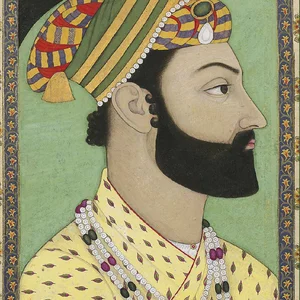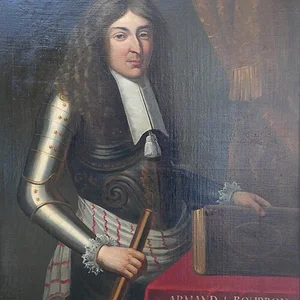

A prince of the blood and the youngest child of Henri II de Bourbon-Condé, Armand de Bourbon-Conti (1629-1666) was one of the leaders of the Fronde of the Princes before rallying to Louis XIV. Having become governor of Languedoc and Count of Pézenas, he was Molière's first patron.
Armand de Bourbon-Conti(1629 — 1666)
Armand de Bourbon-Conti
France
7 min read
Frequently asked questions
Key Facts
- Born in 1629, the third child of Henri II de Bourbon-Condé and younger brother of the Grand Condé
- Took part in the Fronde of the Princes (1648-1653), first against Mazarin and then alongside him
- Became Count of Pézenas and governor of Languedoc in 1651
- Protected Molière's troupe from 1653 to 1656, which took the name “Troupe of Monseigneur the Prince of Conti”
- Converted to Jansenism and, in 1666, the year of his death, published a Treatise on Comedy condemning the theater
Works & Achievements
Conti was one of the nominal leaders of the princes' revolt against Mazarin, appointed generalissimo of the Fronde armies in Paris and then leader of the party in Bordeaux.
As governor, he presided over the province's estates and administered one of the wealthiest regions of the kingdom, establishing his court at Pézenas.
Molière's first great patron, Conti gave his name to the company and provided it with the means to turn professional before its Parisian success.
Having rallied to the king, Conti led the French troops during the final campaigns of the Franco-Spanish War.
A Jansenist-inspired text condemning the theatre and actors; it became a major piece in the moral controversy over the stage during the Grand Siècle.
A short moral and political treatise in which Conti, now converted, set out the Christian obligations of princes and governors.
Anecdotes
Like all younger sons of great houses, the young Armand is destined for the Church: from childhood he is granted wealthy abbeys and called “the Abbé de Conti.” But he would set aside the cassock without ever having been a priest, swept up first by the civil war of the Fronde and then by a political marriage.
In 1650, Cardinal Mazarin has the three great Frondeurs arrested in a single stroke: the Grand Condé, the Duke of Longueville, and the young Conti. All three are imprisoned in the keep of Vincennes, then at Marcoussis and Le Havre. This spectacular arrest of princes of the blood lights the fuse and reignites the Fronde.
As governor of Languedoc, Conti takes under his protection a troupe of travelling actors led by a certain Jean-Baptiste Poquelin, known as Molière. From 1653 to 1656, the company proudly bears the name “Troupe of His Highness the Prince of Conti” and performs in Pézenas, at the château of La Grange-des-Prés.
In 1654, to seal his reconciliation with the court, Conti marries Anne-Marie Martinozzi, a niece of Mazarin. The former rebel thus becomes the nephew by marriage of the very minister he had fought with weapons in hand.
Converted to Jansenism at the end of his life, Conti turns against the theatre he had once protected. He writes a *Treatise on Comedy and Spectacles* that severely condemns actors — published in 1666, the very year of his death, at only 36 years old.
Primary Sources
Comedy, even when considered according to the rules of poetry, is a most dangerous occasion of sin, since its only aim is to please by arousing the very passions that religion commands us to suppress.
The Prince of Conti had wit; but it was a wit made for intricacy and not for great matters, and there was something awkward about his body.
Monsieur le Prince and Messieurs de Conti and de Longueville were taken to Vincennes, which greatly surprised all of Paris and marked the beginning of the troubles that followed.
The Prince of Conti, young and discontented, let himself be easily drawn into the party of his brother and the malcontents.
Key Places
Conti's birthplace and the stage for the days of the Fronde, where the princes challenged royal authority.
Royal fortress at the gates of Paris where Conti was imprisoned with his brother Condé and Longueville in 1650.
Small town in Languedoc of which Conti was count; he held his court there and died there in 1666. It was here that Molière's troupe found refuge and protection.
Conti's residence near Pézenas, where the Estates of Languedoc were held and where Molière's troupe performed.
Capital of Guyenne where Conti led the Fronde party, backed by the popular Ormée movement in the early 1650s.
Typical Objects

A bladed weapon worn at the side by every prince and noble, at once an instrument of combat and a mark of rank. Conti girded it during his campaigns of the Fronde and in Italy.

A wide blue ribbon and cross worn by the knights of the kingdom's most prestigious order. Reserved for princes and great lords, it signalled membership in the very top of the court.

A notebook of pages in which Conti, at the end of his Jansenist life, set down his condemnation of the theatre. The text was printed after his death under the title Traité de la comédie et des spectacles.

A demountable stage on which the troupe protected by Conti performed from town to town. These boards, set up in real-tennis courts or castle courtyards, carried the travelling theatre of the 17th century.

A closed, richly decorated horse-drawn carriage, a sign of the dignity of a prince of the blood. In it Conti travelled across his governorship of Languedoc between Pézenas, Montpellier and Toulouse.

A short baton held by the commander-in-chief to signify his authority over the army. Conti carried it when he commanded the royal troops in Catalonia and in Italy.
School Curriculum
Vocabulary & Tags
Key Vocabulary
Daily Life
Morning
A prince of the blood, Conti began his day surrounded by servants and gentlemen during the *lever*, the codified ritual of the high nobility. After Mass, mandatory for a man of his rank, he received secretaries and stewards to handle the affairs of his province.
Afternoon
The afternoon was divided between audiences, reading correspondence, and working with his advisers on the administration of Languedoc. In times of war, he reviewed his troops and held council with his officers.
Evening
In the evening, a prince's court offered card games, conversation, music and — during his lavish period at **Pézenas** — theatrical performances by the troupe he patronized. Once he became a Jansenist, he replaced these entertainments with prayer and pious reading.
Food
At a prince's table, meats were served in abundance — poultry, game, pâtés — accompanied by Languedoc wines, in a cuisine still heavily spiced. On the lean days imposed by the Church, fish replaced meat, a rule the devout Conti would follow with increasing strictness.
Clothing
Conti wore the costume of a 17th-century gentleman: doublet, breeches, cloak, lace collar and cuffs, all in precious fabrics, with a sword at his side and the sash of the royal orders. His figure was marked by a slight deformity of the back, noted by the memoirists.
Housing
He resided in private mansions in Paris and above all at the château of **La Grange-des-Prés**, near **Pézenas**, a vast residence surrounded by gardens where he held his provincial court. These residences combined comfort, splendor and the great halls suited to receptions and performances.
Historical Timeline
Period Vocabulary
Liens externes & ressources
Références
Œuvres
Direction militaire de la Fronde des princes
1648-1653
Gouvernement du Languedoc
à partir de 1651
Protection de la troupe de Molière
1653-1656
Commandement de l'armée d'Italie
1657
Traité de la comédie et des spectacles selon la tradition de l'Église
1666 (posthume)
Les Devoirs des grands
publié en 1666 (posthume)