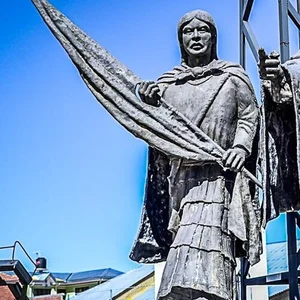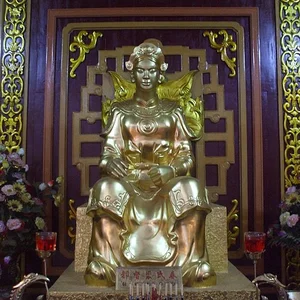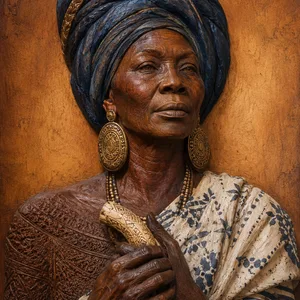

Queen of the kingdom of Zazzau (present-day Zaria, Nigeria) in the 16th century, Bakwa Turunku founded the city of Zaria around 1536. She is the mother of the famous warrior queen Amina of Zaria, a symbol of female power in West Africa.
Bakwa Turunku(1468 — 1566)
Bakwa Turunku
8 min read
Frequently asked questions
Key Facts
- Reigned over the kingdom of Zazzau (Zaria) c. 1536–1566
- Founded the city of Zaria, which still bears her mark today
- Mother of Queen Amina of Zaria, a legendary military figure
- Represents a tradition of female rulers in the Hausa states
- Her reign predates the deep Islamization of the region
Works & Achievements
Bakwa Turunku's greatest achievement was the founding or rebuilding of the city of Zaria, which became the permanent capital of the kingdom of Zazzau and one of the most important urban centers in what is now northern Nigeria.
Bakwa Turunku is credited with structuring the administration of her kingdom through official titles, a taxation system, and a network of regular markets, laying the foundations of a centralized state.
Under her reign, exports of tanned leather, textiles, and other goods to North African markets reached a scale that brought lasting wealth to the kingdom and strengthened its regional influence.
By involving her eldest daughter Amina in the affairs of the kingdom from an early age, Bakwa Turunku prepared the succession and shaped the woman who would become the most celebrated warrior in Hausa history.
Anecdotes
Around 1536, Bakwa Turunku built a new capital for her kingdom, which she initially named Zazzau. According to Hausa oral tradition, she gave the city the name Zaria in honor of her youngest daughter Zariya — a name that lives on to this day in the city of Zaria, in Nigeria.
Bakwa Turunku ruled at a time when certain women could rise to supreme power in the Hausa kingdoms under the title of Sarauniya, meaning fully sovereign queen regnant. Her reign, renowned for its administrative wisdom and diplomatic skill, stood in contrast to that of her eldest daughter Amina, who would become a legendary warrior — demonstrating that female power could take very different forms.
The kingdom of Zazzau under Bakwa Turunku was a major commercial crossroads in West Africa, exporting tanned leather, textiles, and kola nuts to great cities such as Kano and as far as the trans-Saharan trade routes. The queen is said to have personally overseen the markets and diplomatic exchanges with neighboring states, making Zazzau one of the dominant economic powers of the region.
Oral tradition attributes a remarkable longevity to Bakwa Turunku: she is said to have lived nearly a century, reigning over Zazzau for several decades. This exceptional length of rule allowed her to train her daughter Amina in the arts of governance and military strategy before passing power on to her.
Bakwa Turunku is one of the few women in pre-colonial Hausa history to have held the title of Sarauniya as a sovereign head of state, rather than merely as a regent. Her reign is preserved in the oral chronicles of the griots (*marok'a*) and in the Tarikh of Zazzau, making it a key reference in the history of women in power across West Africa.
Primary Sources
The Kano annals mention the relations between the kingdom of Zazzau and the other Hausa states in the 16th century, referring to commercial and diplomatic exchanges under the successive rulers of Zazzau, including its reigning queens.
This chronicle of the kings and queens of Zazzau, transmitted orally and later partially transcribed, places Bakwa Turunku among the rulers who reigned over the kingdom and credits her with founding the city of Zaria.
In this work by the Sultan of Sokoto, written in the early 19th century, the Hausa kingdoms and their dynasties are discussed along with their governance traditions, some of which included women rising to supreme power.
The oral traditions collected by this British colonial administrator record accounts of Bakwa Turunku, the founding of Zaria, and her relationship with her daughter Amina, testifying to the vitality of Hausa collective memory.
Key Places
The capital founded or rebuilt by Bakwa Turunku around 1536, Zaria is today a major city in Kaduna State, Nigeria, whose oral tradition keeps alive the memory of its founding queen.
A major neighboring Hausa city-state and Zazzau's principal trading partner, Kano was the regional marketplace with which Bakwa Turunku maintained diplomatic relations and intensive exchanges of goods.
A crossroads of trans-Saharan trade routes, Agadez was the waypoint for caravans carrying Zazzau's goods north toward the Maghreb and North Africa — a vital hub in the commercial network in which Bakwa Turunku's kingdom played an active role.
An intellectual and commercial center of the Songhai Empire, contemporary with Bakwa Turunku's reign, Timbuktu embodied the cultural and religious power of Sahelian Islam in the 16th century.
A contact zone between the Hausa states and the forest peoples to the south, the Jos Plateau was a strategically important region for Zazzau's trade and military expeditions.
Typical Objects

Carved wooden seat reserved for the sovereign during official audiences, a symbol of dynastic legitimacy and royal authority in the Hausa courts.

A prestige commodity and ritual currency, kola nuts were offered during diplomatic audiences and sealed commercial and political alliances under the reign of Bakwa Turunku.

Hausa leatherwork was renowned throughout the Sahel; craftsmen from Zazzau produced sandals, satchels, and harnesses exported as far as North Africa, making it one of the kingdom's primary sources of wealth.

Large cowhide drums reserved exclusively for Hausa sovereigns, whose sound announced the queen's presence and symbolized her authority during official ceremonies.

A long indigo-dyed cotton robe, richly embroidered with geometric patterns at the collar and sleeves in the Hausa tradition, worn by Bakwa Turunku during public audiences.

A symbolic weapon carried during royal ceremonies, evoking the warrior tradition of Zazzau's sovereigns and the military prestige that Bakwa Turunku had inherited.
School Curriculum
Vocabulary & Tags
Key Vocabulary
Tags
Daily Life
Morning
Bakwa Turunku began her day with the dawn prayer (Fajr), following the Muslim tradition adopted by the Hausa elite. She then held a morning audience in her mud-brick palace, receiving neighborhood chiefs, merchants, and emissaries from neighboring kingdoms.
Afternoon
Afternoons were devoted to overseeing the great market of Zaria and supervising its artisans — tanners, weavers, blacksmiths — whose work formed the kingdom's primary source of wealth. The queen also served as supreme judge, presiding over significant disputes.
Evening
In the evenings, Bakwa Turunku withdrew to the inner apartments of the palace (gida), surrounded by her ladies-in-waiting and her daughters Amina and Zariya. Griots recited royal genealogies and sang the great deeds of the ancestors, transmitting the kingdom's memory through oral tradition.
Food
The court of Zazzau's diet was built around millet, sorghum, and rice, accompanied by thick soups (miyar taushe) made from squash, peanuts, and dried meat. Kola nuts, offered during ceremonies, and cow's milk rounded out a diet rooted in the resources of the savanna.
Clothing
Bakwa Turunku wore long robes (riga) of indigo-dyed cotton, richly embroidered at the collar and sleeves in the Hausa tradition. A light veil covered her head during public audiences, and jewelry of copper, brass, and cowrie shells adorned her wrists and headdress.
Housing
The royal palace of Zazzau was a large compound of mud-brick structures (banco — clay and straw) with thick walls, organized around inner courtyards. The audience halls were decorated with geometric relief patterns on the walls, typical of Hausa architecture, and covered with woven mats on packed-earth floors.
Historical Timeline
Period Vocabulary
Visual Style
Portrait majestueux d'une reine haoussa du XVIe siècle : robes en coton indigo brodé, architecture en banco aux motifs géométriques, palette ocre et bleu profond.
Sound Ambience
Ambiance de la cour royale de Zazzau au XVIe siècle : tambours royaux, louanges des griots, rumeur du grand marché et tintement des caravanes sahariennes.
Liens externes & ressources
Références
Œuvres
Fondation de la cité de Zaria
vers 1536
Organisation administrative du royaume de Zazzau
XVIe siècle
Développement du commerce trans-saharien de Zazzau
XVIe siècle
Formation de la princesse Amina aux arts du gouvernement
vers 1536–1552