Imaginary interview with Margaret Knight
by Charactorium · Margaret Knight (1838 — 1914) · Technology · Sciences · 5 min read
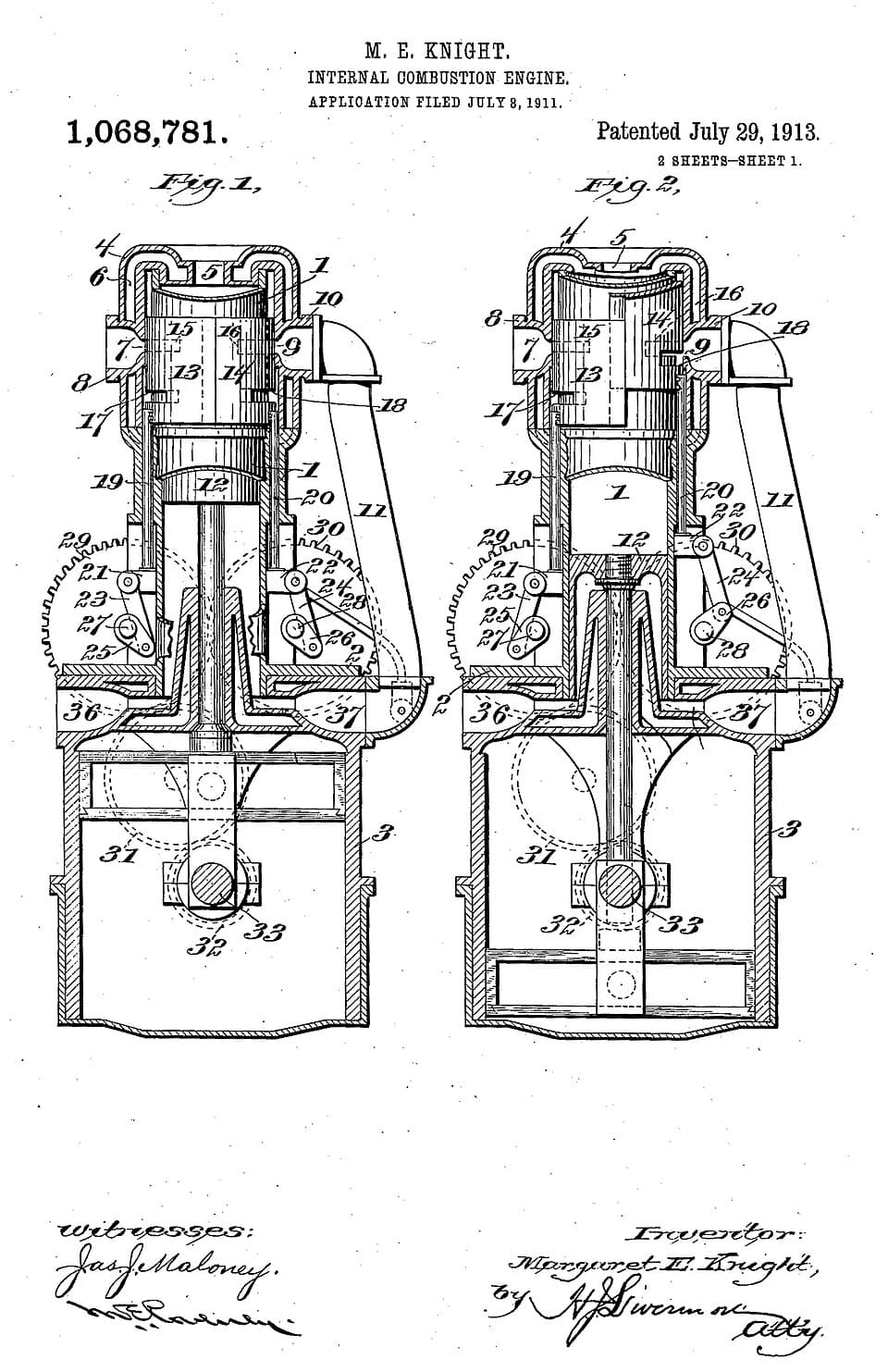
Framingham, Massachusetts, an autumn afternoon in 1913. In a rented room strewn with files, springs, and dog-eared notebooks, a seventy-five-year-old woman receives us without ceremony, her hands still stained with grease. She speaks softly, with the precision of a well-tuned mechanism.
—Do you remember the moment you realized a machine could injure a man?
I was twelve years old, in Manchester, New Hampshire. The din of a mill, you know, is not a noise; it is a substance: it gets into your bones. One day the shuttle of a loom came loose, that piece launched like a little iron boat between the threads, and it struck a worker. The blood on the unbleached cotton, I still see it. Within a few days I imagined an automatic stop: as soon as the shuttle left its path, the machine froze. It was installed in several mills in New England. No one paid me a cent, of course. A child, and a girl to boot, had no right to a patent. I learned that day that mechanics were just, and men were not.
Mechanics were just, and men were not.
—Was that mill a place where a young girl was expected to tinker with mechanisms?
They expected me to watch bobbins and keep my mouth shut. Machinery, understand, swallowed up women and children by the thousands within those brick walls. My comrades dreamed of a Sunday off; I watched the gears and wondered why such-and-such a lever fell at the wrong moment. I did not yet know that this had a name, invention. I only believed that things done poorly should be corrected, like a crooked hem. I grew up between cotton and lubricating oil, and I never had, in all my life, any other school than that uproar.
—How did you come to be interested in something as humble as a paper bag?
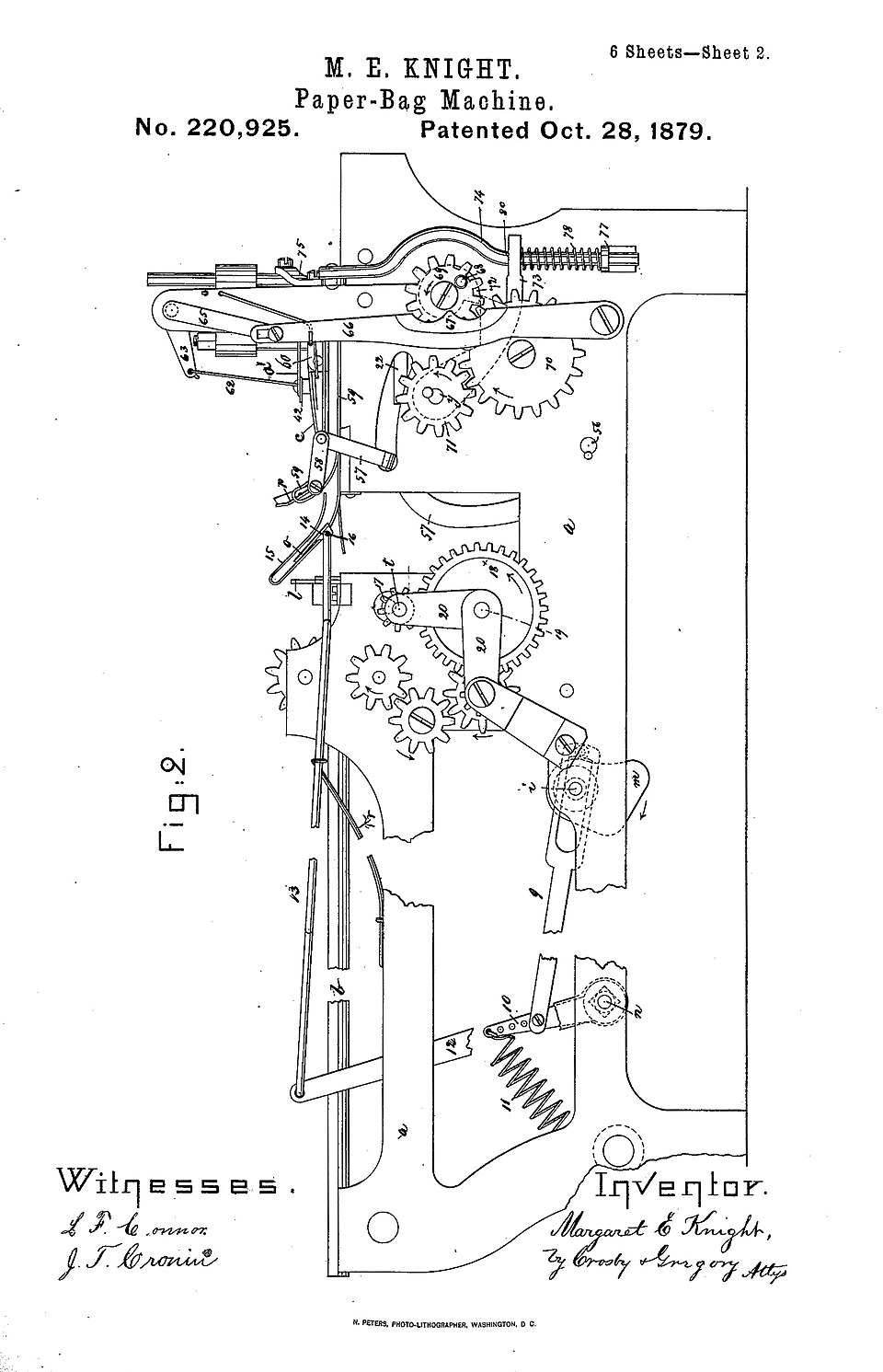
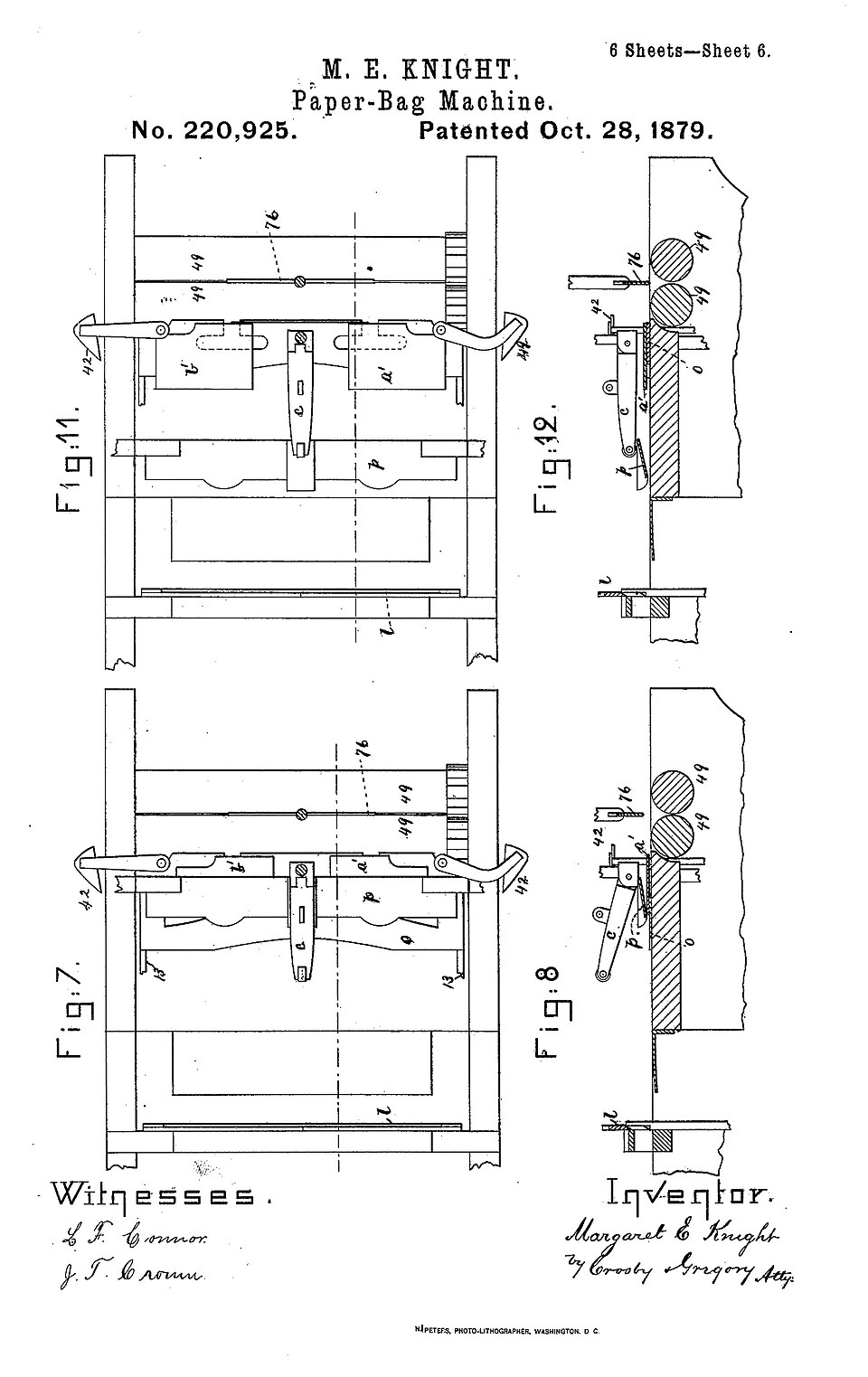
Out of anger at a stupid object. At the Columbia Paper Bag Company in Springfield, they made pointed-bottom bags, like cones: impossible to set them upright; you needed one hand to hold them and the other to fill them. An absurdity. I wanted a flat-bottomed bag, a square base that would stand alone on a counter. The whole difficulty was to have a single machine fold and glue that bottom, where thirty women were exhausting themselves by hand. I spent months cutting, measuring, starting over. When the first machine spat out its square bag, straight and tall, I knew I had made stand up what everyone believed was doomed to collapse.
I made stand up what everyone believed was doomed to collapse.
—Did you realize that this everyday object would span generations?
No, and that is the irony. Patent No. 116,842, filed in 1871, seemed to me only a matter of business. But think: the bag the shopkeeper fills with apples, the one the grocer hands across the counter, that is my square base. I replaced dozens of pairs of hands with a single movement of metal. Later I further perfected my folding and gluing machines for the Eastern Paper Bag Company that we had founded. I never sought to engrave my name on those bags; they go into the trash after a single use. And yet, if anything of me remains that people touch every day, it is that flat bottom, silent, whose author no one knows.
—They say a man tried to steal this invention from you. What happened?
Charles Annan. He had prowled around my prototype in the machine shop in Boston, spied on my adjustments, then ran to file the patent in his place. His argument before the office boiled down to a contemptuous sentence: a woman could not have conceived a mechanism of such complexity. I grabbed my notebooks, those books where each sketch bore its date, and I had the workers who had seen me file every part testify. The patent interference proceeding ruled: priority belonged to me, said the record, beyond reasonable doubt. I did not win against a man; I won against a prejudice.
I did not win against a man; I won against a prejudice.
—What did you feel when the verdict was rendered in your favor?
Less triumph than fatigue, truthfully. 1871, in Washington: the victory was there, but I had had to prove, sketch in hand, that my own brain belonged to me. Consider the absurdity: a man would only have had to present his patent; I had to summon witnesses to my own intelligence. Those dated notebooks, which I had been filling for years out of mere habit of order, became my only defenders. I believe that day many women who invented in silence, without daring to claim anything, breathed a little easier. Not that the law changed a word; but it had been seen that a working woman could stand up to a thief and win.
—These notebooks seem to have counted for more than mere notes. What did they represent to you?
My memory and my proof, all together. I am self-taught: the door of an engineering school was never opened to me; they were closed to women. So I learned alone, at the lathe and with the file, making my prototypes with my own hands in machine shops. In the morning, before the machines started again, I recorded the defects seen the day before and sketched their remedy. In the evening, I noted the results of the trials, with the date, always the date. Those books of dimensioned sketches were not vanity: it was the only way, for a woman without a diploma or fortune, to tell the world 'this, I thought it, at this hour, on this side of my skull'.
This, I thought it, at this hour, on this side of my skull.
—What was one of your days like, between the workshop and the workbench?
Hard and unglamorous. I rose early, often before dawn in winter, to catch the light. The afternoon belonged to trials: I adjusted the parts myself on the lathe, I discussed with the mechanics who assembled my models, I turned a recalcitrant spring twenty times. I wore a dark dress and a sturdy apron, my hair in a bun; no crinoline, you cannot work a file in a crinoline. I lived in a boarding house near the factories, a single working woman's lifestyle. Evening brought the notebook, again. I was hardly social; I preferred a well-adjusted mechanism to an evening in town. A soup, cornbread, baked beans, and back to my sketches.
—The world nicknamed you 'Lady Edison'. What does that comparison inspire in you?
A somewhat bitter smile. Thomas Edison and I are nearly the same age, and people liked to link our names. But see the contrast: he built an empire, and I am about to die almost penniless. I filed more than twenty-seven patents — packaging, textiles, footwear, even a rotary engine in my later years. Each cost me nights; none made me rich. I never knew how to turn an idea into fortune, no doubt because I loved the idea for itself. I am compared to a man crowned with gold; I keep my notebooks and my calloused hands. Posterity, if it exists, will judge which of us lived better.
He built an empire, and I am about to die almost penniless.
—You lived through an era when women were beginning to demand their rights. Did you feel part of that struggle?
I never mounted a platform. The great convention at Seneca Falls in 1848 demanded the vote for women when I was still a kid in the mills. The suffragettes waged the battle of laws; I waged mine at a workbench and in a courtroom. Yet I believe these are the same weft threads of a single fabric. Every time a woman proves, sketch in hand, that she has invented a machine that men thought beyond her understanding, she advances a pawn on the same chessboard. I did not vote; I would not have had the right. But I forced a patent office to write my name, and that too was a way of counting.
I forced a patent office to write my name, and that was a way of counting.
Read further
This imaginary interview was generated by artificial intelligence from sources documented in Margaret Knight's profile. It dramatises what the figure might have said based on what we know about them, but does not constitute attested historical testimony. For primary sources and factual documentation, refer to the full profile.