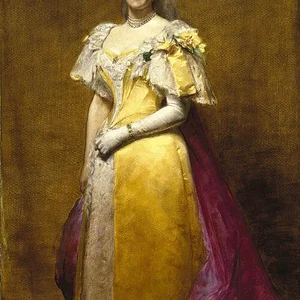

Emily Warren Roebling was an American pioneer of civil engineering. When her husband, chief engineer Washington Roebling, was struck by caisson disease, she took over the technical supervision of the Brooklyn Bridge construction until its completion in 1883.
Emily Warren Roebling(1843 — 1903)
Emily Warren Roebling
États-Unis
6 min read
Frequently asked questions
Key Facts
- Born in 1843 in Cold Spring, New York State
- Married Washington Roebling in 1865, whose father John A. Roebling designed the Brooklyn Bridge
- Supervised the Brooklyn Bridge construction for more than ten years after her husband's illness
- First person to cross the Brooklyn Bridge at its opening in 1883
- Died in 1903
Works & Achievements
Daily technical supervision of the construction site during her husband's incapacitation: relaying calculations, liaising with engineers and contractors, all the way to the 1883 opening.
Emily symbolically opened the bridge to the public by being the first to cross it, a public acknowledgment of her decisive role.
An award-winning essay denouncing the legal limits imposed on married women, a sign of her commitment to women's rights.
The culmination of a late course of study that extended her role as a pioneer in fields long reserved for men.
A mastery of mathematics, cable calculations, and the strength of materials, acquired on her own so she could direct the construction site.
Anecdotes
When her husband Washington was paralyzed by caisson disease and confined to his bedroom, Emily became his link to the construction site. She taught herself advanced mathematics, the calculation of cable curves, the strength of materials, and steel construction in order to pass instructions on to the engineers and answer their questions.
On opening day, May 24, 1883, Emily was given the honor of being the first person to cross the Brooklyn Bridge by horse-drawn carriage. According to tradition, she carried a live rooster on her lap as a symbol of victory.
For years, many workers and officials believed she was secretly the chief engineer of the project, so thoroughly did she master the technical details and negotiate with the contractors and elected officials of New York.
During the opening ceremony, the politician Abram Hewitt paid tribute to Emily in his speech, presenting her as an example of feminine devotion and intelligence in the service of a great work.
Far from stopping after the bridge, Emily resumed her studies and in 1899 earned a law degree from New York University, even winning a prize for an essay titled “A Wife's Disabilities.”
Primary Sources
Dedicated to the memory of Emily Warren Roebling, 1843-1903, whose faith and courage helped her ailing husband, Colonel Washington A. Roebling, complete the construction of this bridge.
The bridge is thus a monument raised to the self-sacrifice and capacity of woman, as much as to the genius of man.
An award-winning legal essay in which Emily Roebling criticizes the legal restrictions placed on the rights of married women in the America of her time.
Letters in which the couple discussed the progress of the construction site, the calculations, and the difficulties they faced, with Emily acting as an intermediary with the engineers.
Key Places
Village in northern New York State where Emily Warren was born in 1843, on the banks of the Hudson River.
Suspension bridge connecting Manhattan to Brooklyn, completed in 1883. Emily oversaw much of the construction and was the first to cross it.
Neighborhood in Brooklyn Heights where the Roebling couple lived; from their window, Washington could watch the construction site through a telescope while Emily shuttled back and forth.
Institution where Emily Roebling pursued legal studies and earned her law degree in 1899, in the women's law class.
City home to the Roebling wire rope factories and where Emily died in 1903.
Typical Objects

Enormous cable made of thousands of twisted steel wires, manufactured by the Roebling company. Four of these cables support the suspended deck of the Brooklyn Bridge.

Large watertight box filled with compressed air, lowered to the riverbed to allow workers to dig the foundations. It was while working inside them that many men, including Washington Roebling, contracted “caisson disease.”

Notebooks in which Emily recorded calculations, plans, and instructions passed between her bedridden husband and the engineers on the construction site. They bear witness to the technical mastery she acquired through study.

A live rooster that Emily is said to have carried during the first crossing of the bridge, a traditional symbol of victory and good omen.

An outfit worn by women of late nineteenth-century American high society, with a corset, bustle, and long skirt, which Emily wore to receive and negotiate with notable figures.

Compasses, rulers, set squares, and logarithmic tables used by nineteenth-century engineers to draw plans and verify the soundness of structures.
School Curriculum
Vocabulary & Tags
Key Vocabulary
Tags
Daily Life
Morning
In the morning, Emily would take detailed instructions from her husband Washington, who was bedridden in their home in Brooklyn Heights. Armed with notes and plans, she would then head to the construction site to relay the directions to the engineers.
Afternoon
In the afternoon, she would inspect the progress of the work, discuss technical problems with the foremen, and sometimes negotiate with contractors or city officials. She took precise notes to report back to Washington.
Evening
In the evening, back home, she would give her husband an account of the day and study engineering and mathematics texts to better understand the next day's challenges. The couple also corresponded with the engineers by letter.
Food
Like the New York bourgeoisie of the late 19th century, the Roeblings ate hearty meals: meats, fish, bread, vegetables, and desserts, served in a household staffed with servants. Tea and coffee often accompanied their meals.
Clothing
Emily wore the long, structured dresses of Victorian fashion: corset, bustle, silk or wool fabrics, gloves, and hats for going out. Her carefully chosen attire reflected her social standing when she received notables and engineers.
Housing
The family lived in a comfortable house in Columbia Heights, Brooklyn, from which the bridge construction site could be seen. Washington followed the work through a spyglass from his window while Emily served as the liaison.
Historical Timeline
Period Vocabulary
Liens externes & ressources
Références
Œuvres
Achèvement du pont de Brooklyn
1872-1883
Première traversée officielle du pont
24 mai 1883
« A Wife's Disabilities » (essai juridique)
1899
Diplôme de droit de l'université de New York
1899
Apprentissage autodidacte de l'ingénierie
années 1870