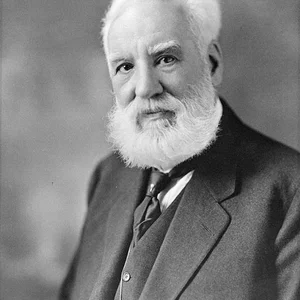

A Scottish-born inventor who became a naturalized American citizen, Alexander Graham Bell is best known for filing the patent for the telephone in 1876. He also conducted research on hearing and communication, particularly to help people who were deaf.
Alexander Graham Bell(1847 — 1922)
Alexander Graham Bell
États-Unis, Royaume-Uni de Grande-Bretagne et d'Irlande
8 min read
Frequently asked questions
Famous Quotes
« Mr. Watson, come here, I want to see you.»
Key Facts
- Born on March 3, 1847, in Edinburgh, Scotland
- Filed the telephone patent on February 14, 1876
- First successful voice transmission on March 10, 1876
- Co-founder of the Bell Telephone Company in 1877
- Died on August 2, 1922, in Canada
Works & Achievements
The first official patent for a device transmitting the human voice via electric current. This founding document is one of the most valuable and most contested patents in industrial history.
The first commercial company dedicated to telephony, co-founded by Bell with his partners Gardiner Hubbard and Thomas Sanders. It became the starting point of the worldwide telephone network.
A device transmitting sound over a distance using modulated light, patented with his collaborator Charles Sumner Tainter. Bell considered this invention his most original scientific contribution.
An instrument for measuring hearing acuity, designed to assess and monitor the hearing abilities of deaf or hard-of-hearing individuals. It remains a fundamental tool in modern audiology.
Funded by the Volta Prize awarded by the French government, this laboratory produced significant improvements to Edison's phonograph, most notably the graphophone using a wax cylinder.
Designed under the auspices of Bell and the Aerial Experiment Association he had founded, the Silver Dart completed Canada's first powered flight on February 23, 1909, reflecting the breadth of Bell's scientific interests.
Anecdotes
Alexander Graham Bell filed his patent for the telephone on February 14, 1876, just a few hours before his rival Elisha Gray, who submitted a similar application. This striking coincidence sparked one of the most famous intellectual property disputes in the history of science, with Bell ultimately winning the legal battle.
On March 10, 1876, Bell achieved the first intelligible vocal transmission in history. From his workroom, he called his assistant Thomas Watson in the next room through their experimental device: “Mr. Watson, come here, I want to see you.” Watson clearly heard his employer’s voice — a sentence that would change the world.
Although he invented the telephone, Bell refused to have one in his office. He found it too intrusive and disruptive to his concentration. He much preferred his quiet laboratory where he could work without interruption — a paradox, to say the least, for the man who had put this device in the hands of the entire world.
Bell was deeply affected by deafness: his mother and his wife Mabel were both deaf. It was this personal experience that led him to study acoustics and sound transmission. He saw his work as an inventor as an extension of his educational mission to help people with hearing loss.
In 1880, Bell invented the photophone, a device capable of transmitting the voice through a modulated beam of light. He was convinced it was his most important invention, far more significant than the telephone. This device remarkably foreshadowed fiber-optic communications of the twentieth century, but it would be decades before technology caught up with his vision.
Primary Sources
The method of, and apparatus for, transmitting vocal or other sounds telegraphically, as herein described, by causing electrical undulations, similar in form to the vibrations of the air accompanying the said vocal or other sounds.
I then shouted into M the following sentence: 'Mr. Watson, come here — I want to see you.' To my delight he came and declared that he had heard and understood what I said.
I have discovered a new method of transmitting sounds by electricity. The undulatory current produced by the human voice causes a continuous vibration of the receiving plate which reproduces the sound faithfully.
My God, it talks! — these words attributed to Dom Pedro II, Emperor of Brazil, after hearing Bell's voice transmitted by telephone during the public demonstration, as reported in the American press of the time.
It is possible to transmit simultaneously, upon a single wire, as many messages as there are musical notes perceptible to the human ear, without any interference with one another.
Key Places
Bell's birthplace on March 3, 1847. His family lived in an intellectual and scientific environment; his father Melville Bell was a renowned professor of phonetics.
The Bell family settled here in 1870. It was in the family home in Brantford that Bell conceived the fundamental idea for the telephone, taking advantage of the quiet Canadian countryside to develop his thinking.
The city where Bell taught deaf students and conducted his crucial experiments with Thomas Watson between 1871 and 1876. It was in his Boston laboratories that the first telephone call in history took place.
Site of the International Centennial Exhibition in 1876, where Bell publicly demonstrated the telephone before scientists from around the world, earning immediate international recognition.
Bell's summer and later permanent residence from 1885 onward. He set up his Beinn Bhreagh laboratory there, where he pursued research into aeronautics and hydrofoils until the end of his life.
Typical Objects

Bell's original experimental device used a membrane stretched over a metal frame connected to an electrical circuit. The vibration of the membrane converted sound waves into a varying electric current, which was then reconstructed at the other end of the wire.

Bell used tuning forks and vibrating strings to study the nature of sound and understand how acoustic waves could be reproduced electrically. These acoustical instruments were the everyday tools of his earliest experiments.

A device borrowed from physiology that could visually record sound vibrations on a smoke-blackened surface using a membrane and a stylus. Bell used it to analyze the waveforms produced by the human voice.

Bell kept meticulous notebooks documenting every experiment, result, and idea. These notebooks, now held at the Library of Congress in Washington, proved decisive during intellectual property trials.

An instrument invented by Bell in 1879 to measure hearing acuity with precision. Originally designed to diagnose and monitor deafness in his students, it remains the foundation of modern hearing tests.

Bell's 1880 invention, this device transmitted the voice over a distance using a beam of light modulated by sound vibrations. Bell regarded it as his greatest achievement, foreshadowing the optical communications of the twentieth century.

Like any gentleman of the Victorian middle class, Bell wore a dark suit, waistcoat, and tie when appearing in public or giving official demonstrations, in sharp contrast to the more relaxed attire he favored in his laboratory.
School Curriculum
Vocabulary & Tags
Key Vocabulary
Tags
Daily Life
Morning
Bell woke up late, around nine or ten in the morning, as he often worked well into the night. His breakfast was simple — tea, toast, and sometimes eggs — taken with the family in the dining room of his home. He devoted his mornings to reading scientific journals and to the abundant correspondence that his fame brought him.
Afternoon
The afternoon was the heart of his working day. Bell would head to his laboratory, discuss ongoing experiments with his assistants, handle the equipment himself, and fill his notebooks with meticulous precision. He also welcomed fellow scientists or journalists who came to visit his facilities.
Evening
Bell dined with his family, often late, and enjoyed long conversations at the table about the ideas of the day. After dinner, he would frequently return to the laboratory, where he could work until two or three in the morning — a period he considered most conducive to reflection and creativity.
Food
Bell ate in a fairly typical manner for the Victorian Anglo-Saxon middle class: roasted meats, cooked vegetables, puddings. He enjoyed tea at all hours and was never particularly mindful of his weight, which he gained with age and which sometimes concerned him, according to his personal letters.
Clothing
In his laboratory, Bell wore a work apron over a high-collared shirt and dress trousers. For official occasions, he wore the customary dark Victorian three-piece suit with tie and waistcoat, and sported the full, neatly trimmed beard that became his trademark in the international press.
Housing
Bell lived in comfortable middle-class homes, first in Boston and then in Washington D.C. His most iconic residence was Beinn Bhreagh, his estate in Nova Scotia overlooking the Bras d'Or Lake, where he had a large laboratory built adjoining the villa. It was in this splendid natural setting that he spent the last decades of his life.
Historical Timeline
Period Vocabulary
Liens externes & ressources
Références
Œuvres
Brevet du téléphone — US Patent n° 174 465
14 février 1876
Fondation de la Bell Telephone Company
1877
Le Photophone
1880
L'Audiomètre
1879
Volta Laboratory — recherches sur l'enregistrement du son
1880–1886
Silver Dart — premier avion motorisé canadien
1909