Imaginary interview with Nichiren
by Charactorium · Nichiren (1222 — 1282) · Spirituality · Philosophy · 6 min read
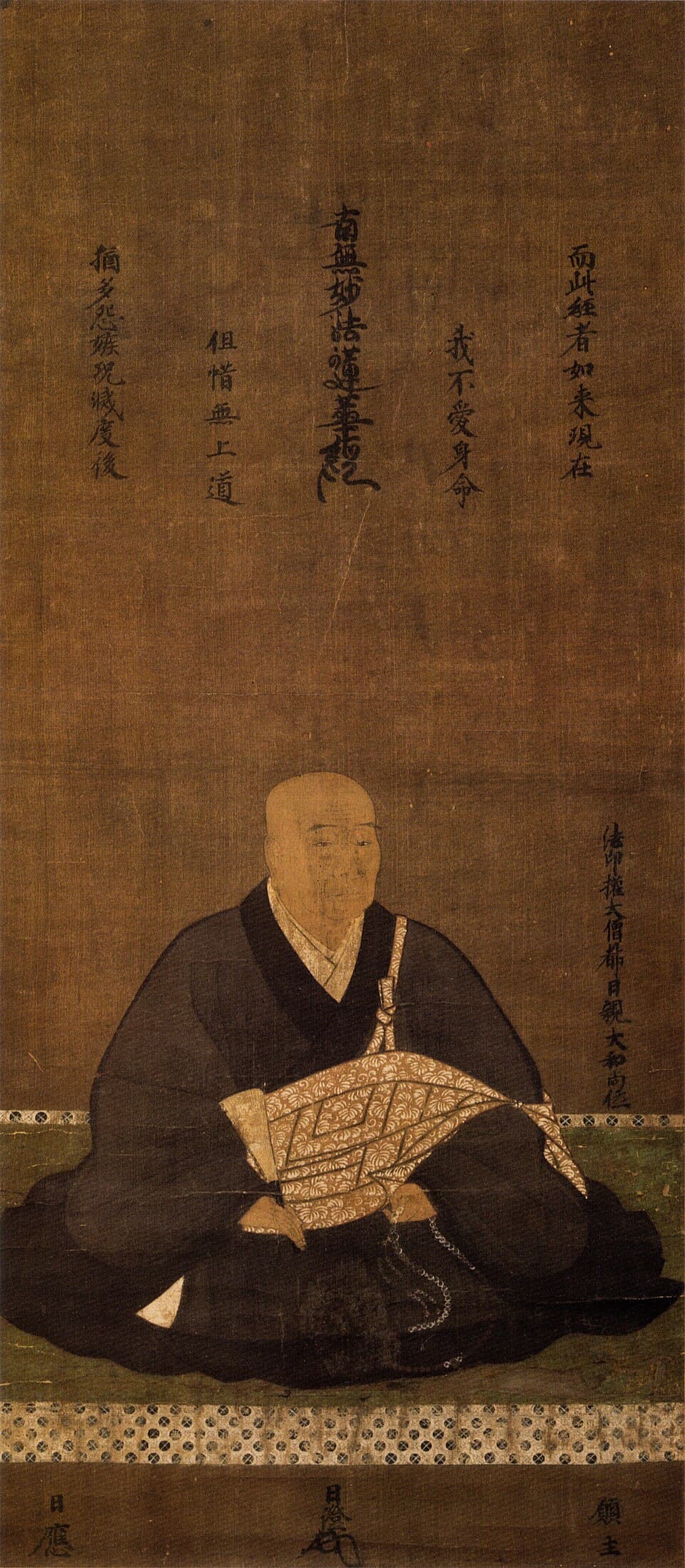
Autumn 1281, at Mount Minobu, in a wooden retreat surrounded by forests where the old master has withdrawn to teach. The rumor of the second typhoon that has just swallowed the Mongol fleet still rises from the valleys when Nichiren, his voice hoarse and his patched kesa on his shoulders, agrees to look back on a life of storms. Around him, a dried brush, a scroll of the Sutra, and that black-ink mandala he calls his object of veneration.
—How was this formula you never stop reciting, this 'Namu Myōhō Renge Kyō,' born?
It was at Mount Seichō, in the year 1253, at dawn. I climbed to the summit, turned my face toward the rising sun, and for the first time I let these words rise from my chest: Namu Myōhō Renge Kyō. Understand me well: I invented nothing. The title of the Lotus Sutra already contains, folded within itself like the flower in the seed, the entire teaching of the Buddha. To recite it is to embrace in a single breath what generations of monks thought they had locked away in their libraries. We live in the time of mappō, the End of the Dharma, when subtle paths no longer carry anyone to salvation. A straight path was needed. I received this path, and I proclaimed it to the face of all.
—Why did so many monks reproach you for opening this practice to ordinary people?
I was accused of stripping the doctrine, of delivering it to the fishermen of Kominato as to my own father. But tell me: what good is a remedy that only the doctor can swallow? The daimoku requires neither the knowledge of the learned nor the fortunes demanded by the great monasteries. An illiterate old man, the beads of a juzu slipping between his calloused fingers, recites the formula and touches the very essence of the Law — as surely as the abbot wrapped in silk. That is what the elite cannot forgive me: I opened the door that others jealously kept closed. The Buddha did not teach for a select few. He taught for all beings, without exception.
What good is a remedy that only the doctor can swallow?
—Do you remember that night at Tatsunokuchi, when your head was to be cut off?
Tatsunokuchi, the night of the twelfth month of 1271. They had dragged me there to execute me in secret, far from sight, on a wind-beaten beach. The executioner raised his sword — I still see it, the blade high and cold against the black sky. And then a light split the night, a ball of fire rolling from one end of the firmament to the other, so blinding that the soldiers screamed and threw themselves face down on the sand. The hand never fell. Will you say it was the chance of a meteor? I know what Law I had wed, and what bodhisattvas watch over the one who embraces it. You do not cut down the pillar that Heaven has chosen.
You do not cut down the pillar that Heaven has chosen.
—What earned you such relentless persecution from the authorities of Kamakura?
It all began in 1260, when I submitted my Risshō Ankoku Ron to Regent Hōjō. I said a simple and terrible thing: if earthquakes, famines, and epidemics ravage our country, it is because it has turned its back on the true teaching to chase after the nenbutsu and its illusions. Dare to say that to the powerful of Kamakura, and see what happens: they burn your hermitage in the night, they throw you onto the roads of exile, first to Izu, then into the ice. I wrote that one must seek the origin of troubles before praying for the peace of the realm. They preferred to try to silence me. A man who loves his country tells it its faults; the flatterer, on the other hand, gently leads it to its ruin.
—How did you endure those three years of exile on Sado Island?
They threw me onto Sado, that island at the end of the northern sea, in the dead of winter 1271. My dwelling? A broken-down hut, set up in the middle of a burial ground, where snow entered through the hole-ridden roof and settled on my robe while I slept. The patched kesa was not enough to keep me from dying of cold; provisions were scarce, and I survived only on what a few faithful dared to bring me, defying the guards. Many bet I would leave my bones there. But I tell you: these trials did not break me, they confirmed me. The snow and hunger were proof that I walked in the truth, for the Lotus Sutra promises persecution to anyone who dares to uphold it.
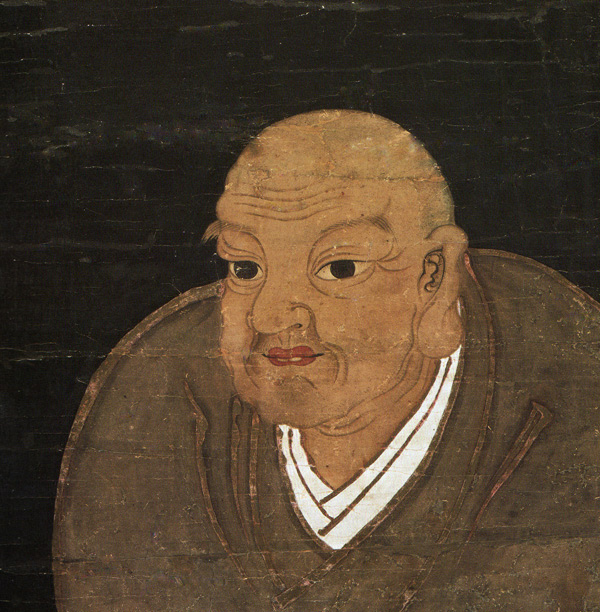
—What drove you to write, in such destitution, one of your major works?
In that hut on Sado, by the light of a smoky wick, my fingers numb with cold, I wrote the Kaimoku Shō, 'Opening the Eyes.' I traced my characters so that those who doubted might finally know who I was and why I endured all this without wavering. It was there, at the lowest point of my life, that I formulated the vow I still repeat today at Mount Minobu: 'I will be the pillar of Japan, I will be the eyes of Japan, I will be the great ship of Japan: such is my vow, and I will never break it.' Understand this wonder: a man stripped of everything, frozen, starving, can carry within himself the burden of an entire nation. That is what exile revealed to me.
I will be the pillar of Japan, I will be the eyes of Japan, I will be the great ship of Japan.
—Tell us about that object you traced with your own hand, the Gohonzon.
Around 1273, still detained on Sado, I took my brush and my sumi ink, and I traced what no master before me had dared: the Gohonzon. Not a bronze statue, not a painted image, but a mandala made of characters. At the center, the daimoku standing like a pillar; all around, arranged like a celestial court, the buddhas, bodhisattvas, and deities that populate the Lotus Sutra. Whoever sits before it contemplates in a single glance the entire universe of the Law. I explained this practice in my Kanjin no Honzon Shō. A man need not climb a thousand mountains to find awakening: from now on, it suffices to hold it before his eyes.
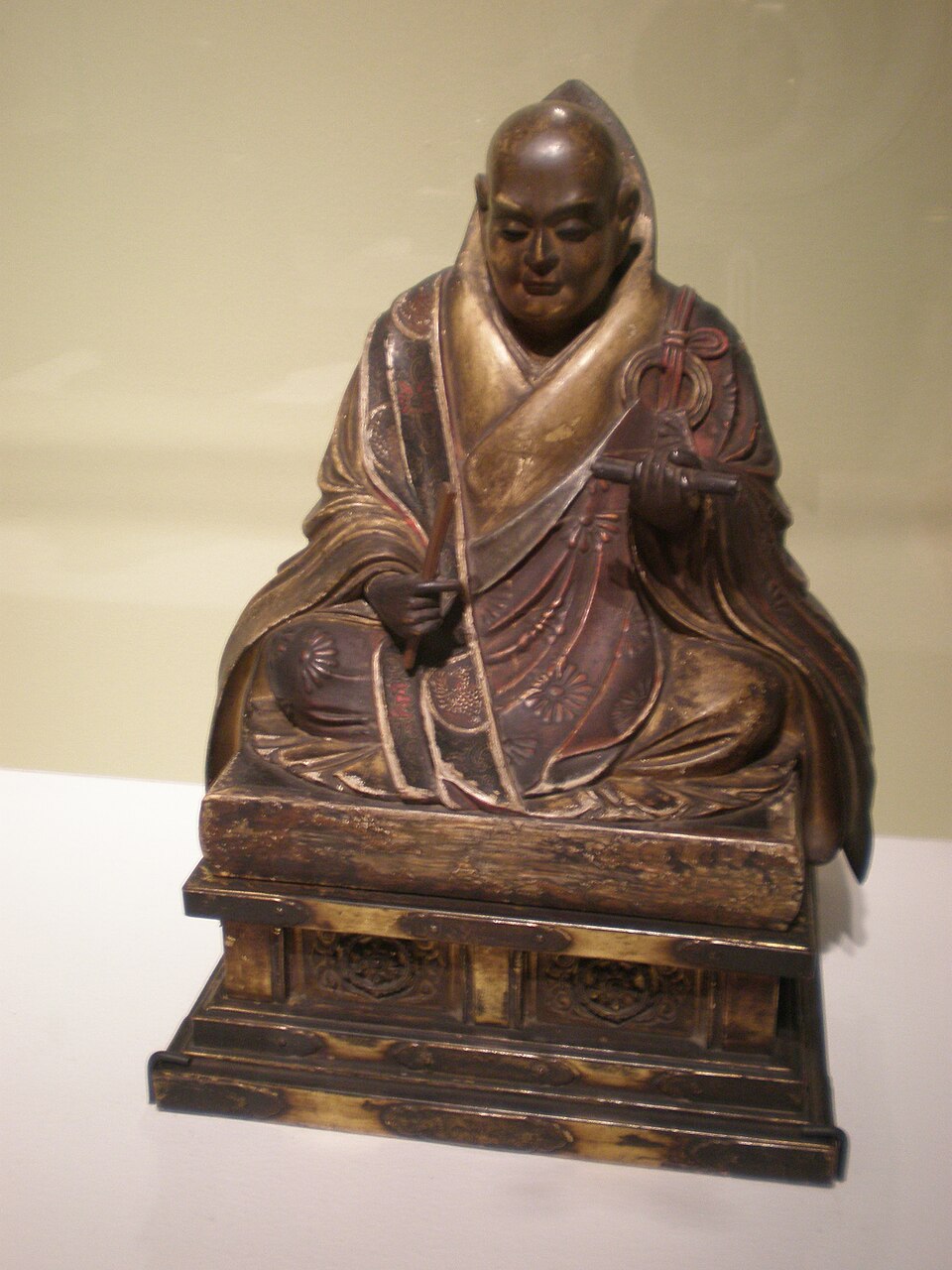
—What exactly should one see when kneeling before this mandala?
What one sees on the Gohonzon is not a distant god one prays to with lip service. It is the reflection of one's own heart. This mandala is a mirror: the worlds it unfolds — that of hell, that of hungry beasts, that of buddhas — already dwell within each of us, at every moment of the day. When a person recites the daimoku before this calligraphy, he awakens in himself the buddha nature that was sleeping there. That is why I call it an object of veneration: not because one should worship it like a wooden idol, but because it shows a person what he truly is. The entire doctrine of the Buddha is contained in this rectangle of paper blackened with ink.
—It is said that you predicted the invasion from the seas. How did that happen?
I had warned, as early as my Risshō Ankoku Ron, that two calamities threatened our country: revolt within and invasion from without. They laughed in my face, called me a prophet of doom. Then, in 1268, emissaries of Kublai Khan landed, bearing a letter demanding that Japan submit to the great Khan of the Mongols. Faces paled even in the councils of Kamakura. What I had announced years earlier was now knocking at our door. Understand: I am no fortune-teller. I simply read in the Lotus Sutra what becomes of a kingdom that persecutes its defenders and scorns the true Law. Nations, like men, reap what they have sown.
Nations, like men, reap what they have sown.
—And when the divine winds twice annihilated those fleets, what did you feel?
Twice the Khan's ships covered our coasts, in 1274 and then in 1281, more numerous than the waves. And twice a kamikaze, a divine wind, arose to break them and return them to the bottom of the sea. My disciples saw in this the confirmation of all I had taught: that a Japan returned to the true Law would be defended by the very deities that guard the Lotus Sutra. I, retired at Mount Minobu among the forests, felt no triumph. Only this calm certainty: the country was saved neither by its arms nor by its walls, but by a protection it had hardly merited. May it, this time, finally learn the lesson.
This imaginary interview was generated by artificial intelligence from sources documented in Nichiren's profile. It dramatises what the figure might have said based on what we know about them, but does not constitute attested historical testimony. For primary sources and factual documentation, refer to the full profile.