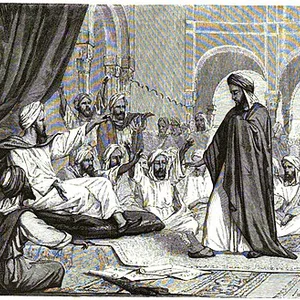

The second Almohad caliph (not Almoravid), he reigned from 1163 to 1184 over the Maghreb and al-Andalus. A man of letters and a patron of scholars, he brought the philosophers Ibn Tufayl and Averroes (Ibn Rushd) to his court. He died during the siege of Santarém in Portugal.
Abu Yaqub Yusuf
Abu Yaqub Yusuf I (Abū Yaʿqūb Yūsuf ibn Abd al-Mu'min)
5 min read
Frequently asked questions
Key Facts
- Becomes Almohad caliph in 1163 upon the death of his father Abd al-Mu'min
- Brings the philosopher Ibn Tufayl, and later Averroes (Ibn Rushd), to his court around 1169
- Encourages Averroes to write his commentaries on Aristotle
- Establishes Seville as a major center of Almohad power in al-Andalus
- Dies in 1184 from wounds suffered at the siege of Santarém (Portugal)
Works & Achievements
By inviting these thinkers to his court, the caliph enabled the writing of the great commentaries on Aristotle, which would have a lasting influence on medieval Europe.
A vast architectural program; the Almohad minaret served as the base for the famous bell tower that now stands at Seville Cathedral.
A gathering of scientific and philosophical works that made his court a major center of learning in the western Mediterranean.
The construction of canals and aqueducts to supply the city with water, a sign of a policy of urban beautification.
Maintaining the unity of the vast empire spanning the Maghreb and al-Andalus through military campaigns and a centralized administration.
Anecdotes
Abu Yaqub Yusuf was a passionate scholar: it is said that he knew many poems by heart and discussed philosophy with his learned men. It was he who asked Ibn Tufayl to find him someone to comment on the difficult works of Aristotle — and Ibn Tufayl introduced him to the young Averroes.
During their first meeting, Averroes was terrified when the caliph questioned him about the eternity of the world, a dangerous topic that could be seen as heresy. But seeing the immense learning of the ruler, the philosopher relaxed and was able to speak freely: this was how the great series of commentaries on Aristotle began.
The caliph launched the construction of the great mosque of Seville, whose minaret served as the base for the famous Giralda, still standing today. He also brought in engineers to improve the city's water supply.
He died in 1184 from wounds received during the siege of Santarém, in Portugal, a military campaign that went badly wrong. His body was brought back to Tinmel, in the High Atlas, near the tomb of the founder of the Almohad movement, Ibn Tumart.
Although he protected philosophers, Abu Yaqub Yusuf had to accommodate the rigorist religious jurists of his empire. Philosophy was therefore often practiced in private, at court, away from the eyes of the strictest theologians.
Primary Sources
The Commander of the Faithful asked me: “What is their opinion (that of the philosophers) about the heavens? Are they eternal or created?” Fear gripped me, but seeing his learning, I began to speak.
Abu Yaqub Yusuf loved the sciences and gathered a considerable library; he drew to himself scholars from every discipline.
The caliph ordered the building of the great mosque of Seville and had canals dug to bring water to the city.
Key Places
Capital of al-Andalus under Abu Yaqub Yusuf, where he established his court and had the great mosque built along with its minaret, the future Giralda.
Capital of the Almohad empire in the Maghreb, center of caliphal power and a hub of activity for scholars such as Averroes.
Fortified town in Portugal that the caliph besieged in 1184; he was mortally wounded there.
Almohad sanctuary in the High Atlas mountains, housing the tomb of Ibn Tumart and the burial place of the Almohad caliphs.
A great intellectual center of al-Andalus, the birthplace of Averroes, who was protected by the caliph.
Typical Objects

Hand-copied works bringing together Greek thought and the commentaries of Averroes, kept in the caliph's library. A symbol of **Abu Yaqub Yusuf**'s passion for learning.

Banner of the Almohad movement carried during military campaigns and ceremonies of the caliphate. It proclaimed the oneness of God (*tawhid*), the heart of the movement's doctrine.

A seal used to authenticate the caliph's deeds and letters, a mark of his sovereign power over the Maghreb and al-Andalus.

Weapon of the warrior sovereign, carried during military expeditions in Spain and Portugal. The caliph indeed died from wounds suffered at a siege.

Scientific instrument used by the court's scholars for astronomy and the measurement of time. It bears witness to the scientific ferment of Almohad al-Andalus.

A refined vessel used at court for water and ablutions, illustrating the Andalusian decorative art of the Almohad era.
School Curriculum
Vocabulary & Tags
Key Vocabulary
Daily Life
Morning
The caliph began his day with the dawn prayer, in keeping with the religious rigor of the Almohads. He then received his secretaries and reviewed the letters arriving from the provinces of the Maghreb and al-Andalus.
Afternoon
The afternoon was devoted to audiences, justice, and military affairs. The sovereign might also inspect construction sites, such as that of the great mosque of Seville.
Evening
In the evening, Abu Yaqub Yusuf liked to gather his scholars to discuss poetry, medicine, and philosophy. It was in this intimate setting that he questioned Averroes on the most difficult problems in Aristotle.
Food
The diet of the Almohad court combined wheat bread, lamb and poultry, dried fruits, dates, and citrus from al-Andalus. Wine was officially banned by religious rigor, replaced by drinks made from scented water and honey.
Clothing
The caliph wore loose garments of fine wool and linen, sometimes silk, in sober tones reflecting Almohad austerity. The turban and the cloak marked his rank as Commander of the Faithful.
Housing
He resided in the fortified palaces of Seville and Marrakesh, adorned with courtyards, gardens, and fountains. These residences blended Andalusian luxury with the sobriety characteristic of Almohad ideology.
Historical Timeline
Period Vocabulary
Liens externes & ressources
Références
Œuvres
Mécénat des philosophes Ibn Tufayl et Averroès
vers 1169-1184
Grande mosquée de Séville et son minaret (future Giralda)
à partir de 1172
Constitution d'une grande bibliothèque
règne 1163-1184
Travaux hydrauliques à Séville
années 1170
Consolidation de l'empire almohade
1163-1184