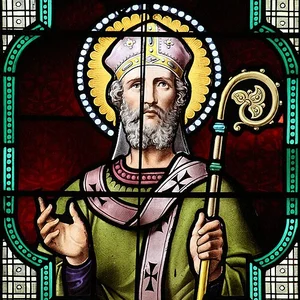

An Italian-born Benedictine monk who became Archbishop of Canterbury, Anselm is one of the foremost thinkers of early scholasticism. He is famous for his ontological argument, which seeks to demonstrate the existence of God through reason alone.
Anselm of Canterbury(1033 — 1109)
Anselm of Canterbury
Royaume de France
7 min read
Frequently asked questions
Famous Quotes
« I do not seek to understand in order that I may believe, but I believe in order that I may understand.»
« Faith seeking understanding.»
Key Facts
- Born around 1033 in Aosta, in the Kingdom of Burgundy (present-day Italy)
- Entered the Benedictine abbey of Bec in Normandy in 1060, becoming its abbot in 1078
- Wrote the Proslogion (around 1077-1078), in which he formulated the ontological argument for the existence of God
- Became Archbishop of Canterbury in 1093 and opposed the kings of England during the Investiture Controversy
- Died in 1109; canonized and later proclaimed a Doctor of the Church in 1720
Works & Achievements
A meditation in which Anselm attempts to prove the existence and nature of God through reason alone, without appealing to the authority of Scripture.
His major work, containing the ontological argument: God, “that than which nothing greater can be thought,” must necessarily exist.
A treatise on logic and dialectic, reflecting his interest in language and rigorous reasoning.
Three dialogues on truth, free will, and the origin of evil, exploring the relationship between freedom and sin.
A foundational treatise on the Incarnation and the Redemption, setting out the satisfaction theory to explain the atonement for sins.
A defense of the Latin doctrine on the procession of the Holy Spirit, written after the Council of Bari.
A collection of deeply fervent prayers, widely read in the Middle Ages, which renewed the genre of spiritual meditation.
Anecdotes
As an adolescent, Anselm is said to have dreamed of climbing a mountain to enter the palace of God: when he awoke, he was convinced of his religious vocation. Yet his father **Gundulf** long opposed his becoming a monk.
After his mother's death, his relationship with his father became so unbearable that Anselm left his native **Piedmont** to cross the Alps. After three years of wandering through **Burgundy** and **France**, he joined the abbey of **Bec** in Normandy, drawn by the reputation of his teacher **Lanfranc**.
Anselm twice refused the office of Archbishop of Canterbury, which was forced upon him almost against his will in **1093**: it is said that his fingers had to be pried open to slip the bishop's crosier into his hand while he protested.
His quarrels with the kings **William Rufus** and then **Henry I** of England, over the power to appoint bishops (the Investiture Controversy), forced him into exile on two occasions. He used the time to travel as far as Rome and to take part in councils.
Anselm said he preferred to seek God through reason rather than through authority alone: his motto “faith seeking understanding” (*fides quaerens intellectum*) sums up his whole method.
Primary Sources
And certainly that than which nothing greater can be thought cannot exist in the understanding alone. For if it exists even in the understanding alone, it can be thought to exist in reality as well, which is greater.
I do not seek to understand in order to believe, but I believe in order to understand. For this too I believe: that unless I believe, I shall not understand.
You have not yet considered how heavy the weight of sin is. No one can render to God a satisfaction sufficient for sin except one who is at once true God and true man.
There necessarily exists a supreme nature, which is through itself all that it is, and through which exists everything that is anything at all.
He taught that nothing should be asserted without reason, and he loved for his disciples to question him, for through questions the truth becomes clearer.
Key Places
A town in the Alps where Anselm was born in 1033, into a noble family of the Kingdom of Burgundy. He spent his childhood there before crossing the mountains.
A Benedictine monastery in Normandy where Anselm became a monk, then prior and abbot, and where he composed his great philosophical treatises.
The seat of the Primate of the Church of England, of which Anselm was archbishop from 1093 until his death. He died there on 21 April 1109.
The capital of the papacy, which Anselm reached during his exiles to defend the rights of the Church before Pope Urban II and later Paschal II.
A port in southern Italy where the council of 1098 was held, during which Anselm defended the doctrine of the Holy Spirit against the Greek theologians.
A city where Anselm stayed during his exiles, welcomed by Archbishop Hugh, and where he continued writing his works.
Liens externes & ressources
Références
Œuvres
Monologion
vers 1076
Proslogion
vers 1078
De grammatico
vers 1080
De veritate, De libertate arbitrii, De casu diaboli
vers 1080-1086
Cur Deus homo (Pourquoi Dieu s'est fait homme)
1098
De processione Spiritus Sancti
vers 1102
Orationes sive meditationes (Prières et méditations)
fin du XIe siècle