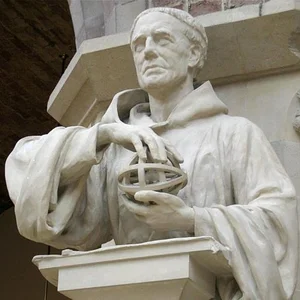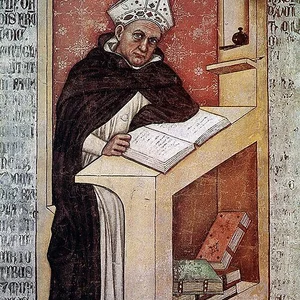

A German Dominican of the 13th century — philosopher, theologian, and naturalist. Teacher of Thomas Aquinas in Paris and Cologne, he introduced the works of Aristotle into Christian thought and observed nature with an almost experimental spirit.
Albert the Great(1200 — 1280)
Albert the Great
Saint-Empire romain germanique
6 min read
Frequently asked questions
Key Facts
- Born around 1200 in Lauingen (Swabia) in the Holy Roman Empire
- Having entered the Dominican order around 1223, he taught in Paris and then founded the studium of Cologne in 1248
- Teacher of Thomas Aquinas, whose thought he shaped in Paris and Cologne
- Bishop of Regensburg from 1260 to 1262
- Died in 1280 in Cologne; canonized and proclaimed a Doctor of the Church in 1931, patron saint of the natural sciences
Works & Achievements
A vast undertaking that made the whole of Aristotle's philosophy accessible to the Latin Christian world, founding the scholastic method.
A zoological encyclopedia based on direct observation, one of the most complete of the Middle Ages.
A pioneering botanical treatise describing plants and crops with a naturalist's eye.
A study of stones and metals blending observation, geology, and the theory of minerals.
A major theological synthesis, reflecting Albert's effort to unite faith and reason.
A decisive institutional achievement: a high-level Dominican school that shone across all of Germania.
A metaphysical treatise on the origin and order of the universe, marked by Aristotelian and Neoplatonic thought.
Anecdotes
Born around 1200 in Lauingen, in Swabia, Albert joined the Order of Preachers (the Dominicans) despite the opposition of his noble family. He became one of the few scholars of his time to travel on foot across Europe to teach, which earned him the nickname “Albert the Great” during his own lifetime.
In Paris and then in Cologne, he had as a student a silent, heavyset young man whom his classmates nicknamed “the dumb ox.” Albert predicted: “This ox will one day make his teaching bellow throughout the whole world.” This student was Thomas Aquinas, who became the greatest theologian of the Middle Ages.
Passionate about nature, Albert dissected animals, observed plants, and described minerals with a care rare for his era. He criticized those who were content to merely repeat the Ancients and asserted that “in the natural sciences, one must seek not what God could do, but what nature actually does.”
His reputation as a universal scholar gave rise to legends: it was said that he had built a talking bronze head (an “automaton”) and that he had mastered alchemy. Long after his death, apocryphal books of magic circulated under the title “Grand Albert,” bearing no relation to his genuine writings.
Already elderly, Albert made the long journey from Cologne to Paris in 1277 to defend the memory and thought of his former student Thomas Aquinas, who had died three years earlier and was then the target of condemnations. He was canonized and proclaimed a Doctor of the Church in 1931, then declared the patron saint of scholars and naturalists.
Primary Sources
In these matters, the aim of natural science is not simply to accept what others have said, but to investigate for ourselves the causes that are at work in nature.
I have myself verified through observation what I put forward, for in these matters experience alone yields certainty.
Philosophy does not contradict faith, for truth cannot oppose truth; both come from God, the single source of all that is true.
Plants live, feed, and grow; observing how each one behaves according to the seasons and the soils is the true work of the naturalist.
Key Places
Albert's birthplace, on the Danube, in the Swabian duchy of Bavaria. A statue there now honors its most illustrious son.
The great intellectual center of the West, where Albert taught and earned his master's degree in theology around 1245, training Thomas Aquinas.
The city where Albert founded the Dominican studium generale in 1248 and taught for many years. He died there in 1280.
The diocese of which Albert was bishop from 1260, an office he gave up two years later to return to his studies.
The city in Italy where Albert was studying when he joined the Dominican order, around 1223.
Liens externes & ressources
Références
Œuvres
Commentaires sur les œuvres d'Aristote
vers 1250-1270
De animalibus (Sur les animaux)
vers 1258-1262
De vegetabilibus et plantis (Sur les végétaux)
vers 1256-1260
De mineralibus (Sur les minéraux)
vers 1250-1263
Summa theologiae (Somme de théologie, inachevée)
vers 1270-1280
Fondation du studium generale de Cologne
1248
De causis et processu universitatis
vers 1264-1271