Imaginary interview with Nzinga Mbandi
by Charactorium · Nzinga Mbandi · Politics · Military · 5 min read
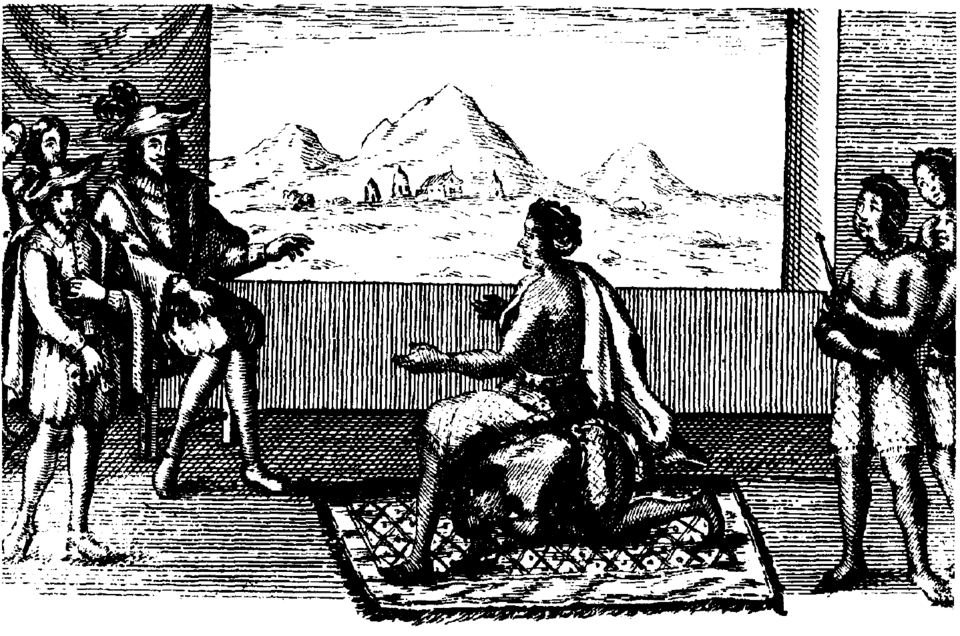
Matamba, an evening in the dry season, near the end of her reign. Under the thatched roof of the great royal enclosure, the drums have just fallen silent, and an octogenarian queen, still upright, agrees to unroll the thread of her life. Around her, Mbundu dignitaries and two Capuchin missionaries listen in silence.
—How did your first meeting with the Portuguese governor in Luanda really go?
It was in 1622. I had come to Luanda in my brother's name to discuss peace, and Governor João Correia de Sousa received me in a room where only one armchair had been set up — his own. I was left standing, as one leaves a captive standing who waits for her price. I understood it was not an oversight but a message. So I signaled one of my attendants to kneel on all fours, and I sat on her back, my gaze level with his. I did not want a chair lent to me: I wanted him to understand that a sovereign of Ndongo does not borrow her dignity; she brings it with her.
A sovereign of Ndongo does not borrow her dignity; she brings it with her.
—You were baptized during that same journey. What did that sacrament really mean to you?
On the day of my baptism, I was named Ana de Sousa, and my godfather was none other than the governor himself. Many thought they saw a conquered soul; they were mistaken. The water poured on my forehead was a key, not a conversion. To speak as equals with men who swore only by their God and their king, I had to enter their language, take their name, wear their rosary. I accepted that name as one accepts a weapon to be turned later. And a few years later, I did indeed turn it, weapons in hand. Displayed faith was first a door I opened and closed according to the needs of my people.
The water poured on my forehead was a key, not a conversion.
—You are described leading your troops in battle dress. Why choose to fight yourself, weapon in hand?
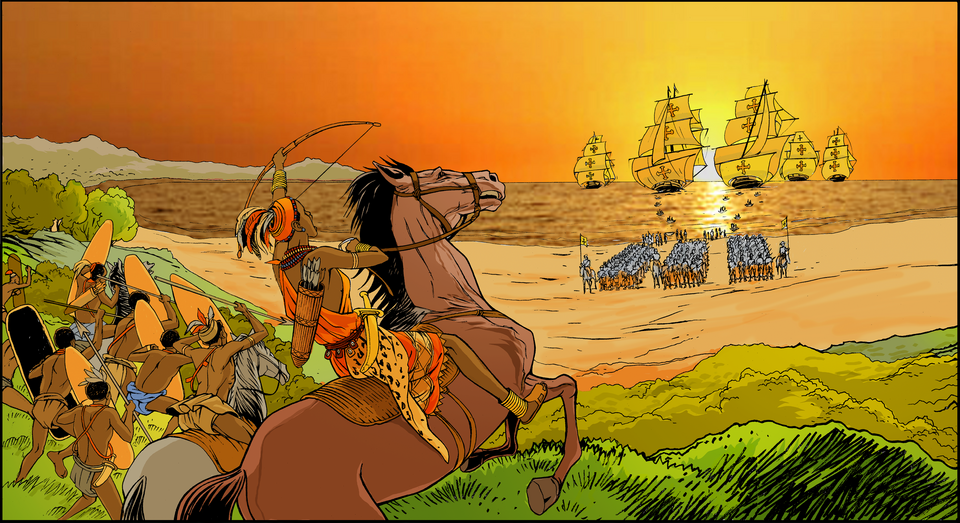
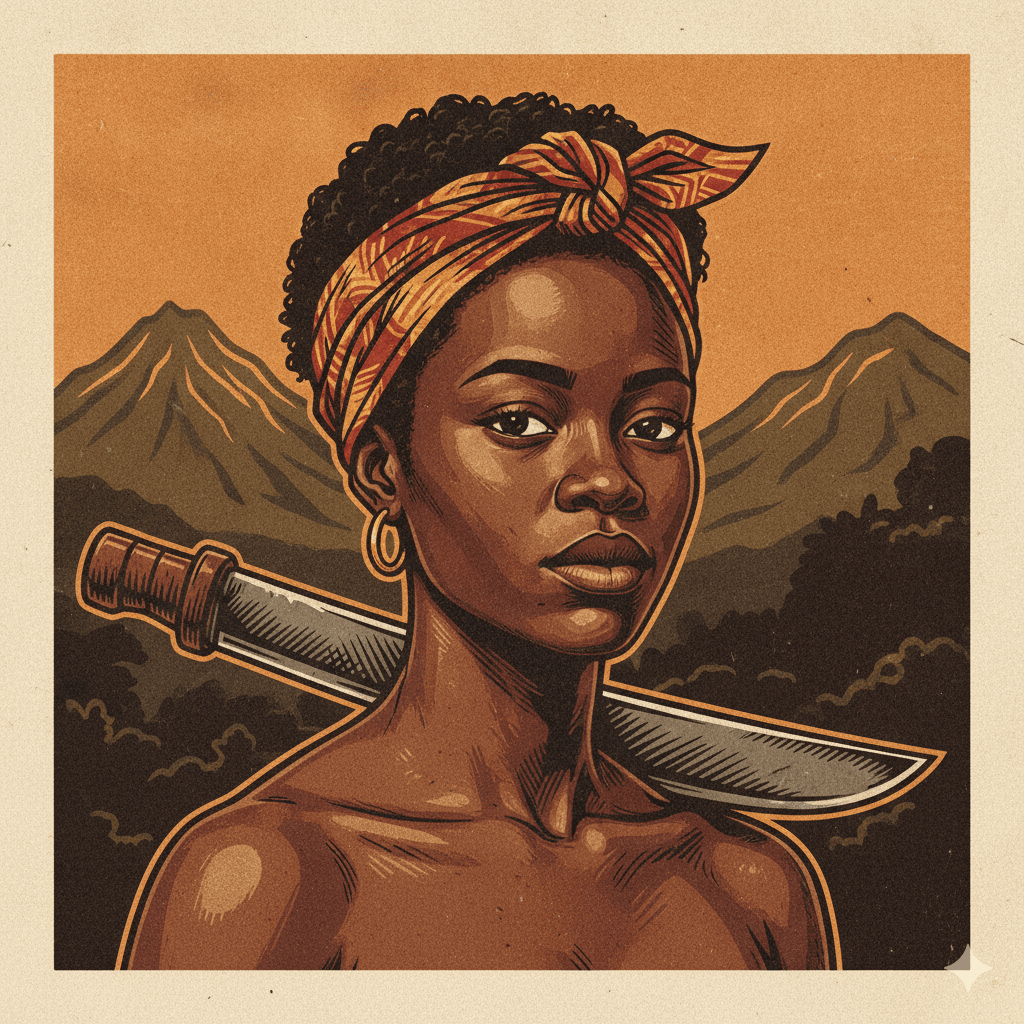
Because a queen who sits while her people bleed is just an ornament. When I marched against the enemy, I shed the raffia cloth dyed with ochre and indigo for the warrior's garb, bow and quiver slung across my shoulder, and the old war axe of our kings at my belt — the one the Mbundu call by the same name as the royal title, ngola. My soldiers saw me wield the same weapon as them, sleep in the dust like them. I still commanded my men in battle past sixty, when other queens would long have entrusted their sword to a nephew. Power, among us, is proven in the mud before it is proclaimed under thatch.
A queen who sits while her people bleed is just an ornament.
—Driven from Ndongo, you turned the kingdom of Matamba into something far more than a mere refuge. What did you have in mind?
Around 1629, the Portuguese tore me away from Kabasa, the home where I had grown up, and I seized neighboring Matamba. I could have hidden there and waited for death as an exile. I chose to make it a forge. I opened my doors to all whom the slave trade cast onto the roads: slaves escaped from convoys, deserters fleeing Portuguese forts, warriors without a king. In my domain, a fugitive regained a name and a lance. What I built there lasted over thirty years, not as a hiding place, but as a state standing upright in the midst of a continent being emptied of its living.
In my domain, a fugitive regained a name and a lance.
—You speak of soldiers who came from everywhere. How did you hold together such a disparate army?
Through the kilombo. That is a word you should remember: a fortified camp where one enters not by blood but by oath. I mixed sons of chiefs and slaves of yesterday, Mbundu and defectors from the enemy camp, all subject to the same discipline, all fed the same sorghum pombe during great ceremonies. A man was judged not by the womb that bore him but by his courage before the Portuguese presídio. That is what made my resistance so hard to break: you can defeat a lineage, but you cannot so easily defeat a family you have chosen to become. The drum, the ngoma, regulated our marches as it beat for our dances.
A camp where one enters not by blood but by oath.
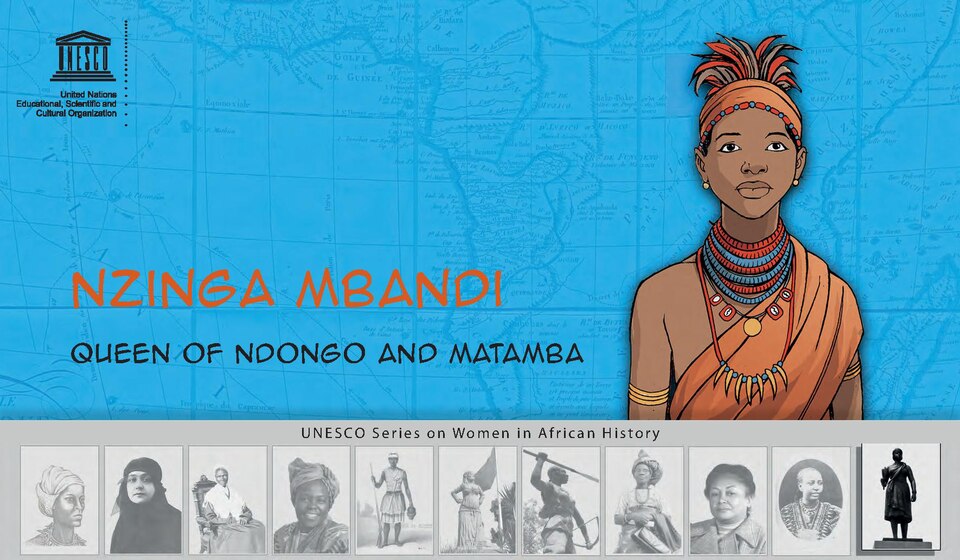
—What would you say about that surprising alliance you forged with the Dutch?
When the Dutch West India Company took Luanda from the Portuguese in 1641, I saw a breach open that I had been waiting for twenty years. These Dutch were Christians of another kind, enemies of Lisbon — and my enemy's enemy was worth a treaty. We decided to strike the Portuguese from both sides at once: them from the coast, me from the interior, with my kilombo warriors. Some at my court wondered that a Mbundu queen would reach out to men from the North Sea. I answered that you do not choose your allies in a besieged kingdom: you choose those who hold the other end of the rope that strangles your adversary.
My enemy's enemy was worth a treaty.
—Yet that alliance did not last. How did you experience the Dutch withdrawal?
In 1648, the Portuguese retook Luanda with ships and men from their Brazil, and my allies from the sea packed up without a backward glance. In one summer, I found myself alone, the breach closed, the rope slackened. That is the bitterest lesson of my long life: a distant power never fights for you; it fights beside you as long as it serves its trade, then it boards ship again. I did not lay down arms, however. I resumed guerrilla warfare from Matamba, sole mistress of my land, and continued to harass those who thought they had finally isolated me.
A distant power fights beside you as long as it serves its trade, then it boards ship again.
—At the end of your reign, you recalled the missionaries and wrote all the way to Rome. Are you disavowing the strategist of old?
Not at all. The woman who had a chapel built in Matamba and invited the Capuchins to her court is the same who sat on a servant's back in Luanda. I sent a letter to Pope Innocent X declaring myself a Christian sovereign and ally of Rome — and, in the same breath, denouncing the Portuguese merchants who violated our agreements and raided my people. You see, writing to Rome was to place a king above the King of Portugal, someone before whom his colonists had to answer. The cross on my chest never ceased to be an instrument of government as much as an object of prayer. I die reconciled, yes, but lucid.
The cross on my chest was an instrument of government as much as an object of prayer.
—You reigned and waged war in a man's world. Did you ever feel challenged as a woman in power?
Always. When my brother died in 1624, the Portuguese refused to recognize me as queen and went to find a man, a rival, to dispute the throne. Among us, legitimacy rests on ancient insignia, like the lukano, that bracelet of the kings of Ndongo; I was long told I had no place at their head. My response was to govern better than them and to fight longer than them. I wore the battle dress of men, not as disguise, but because power has no gender in the hand that firmly holds the axe. Those who doubted me died before I did.
Power has no gender in the hand that firmly holds the axe.
—If one image of you were to be preserved for a century, which would you want it to be?
If I could imagine being read long after my death, in this winter 1663 when I feel my strength leaving me, I would not ask that they remember the Christian Ana de Sousa, nor even the warrior with axes. I would want them to remember the woman who, in Luanda, refused to remain standing. Our Mbundu storytellers already sing that I did not flee before the red-haired men, that I held the land of my fathers. Let that image remain: a queen who, lacking a seat, fashioned one from her own will, and who spent forty years refusing that anyone sit on the back of her people.
A queen who, lacking a seat, fashioned one from her own will.
This imaginary interview was generated by artificial intelligence from sources documented in Nzinga Mbandi's profile. It dramatises what the figure might have said based on what we know about them, but does not constitute attested historical testimony. For primary sources and factual documentation, refer to the full profile.