Imaginary interview with Pauli Murray
by Charactorium · Pauli Murray (1910 — 1985) · Society · Politics · Spirituality · 5 min read
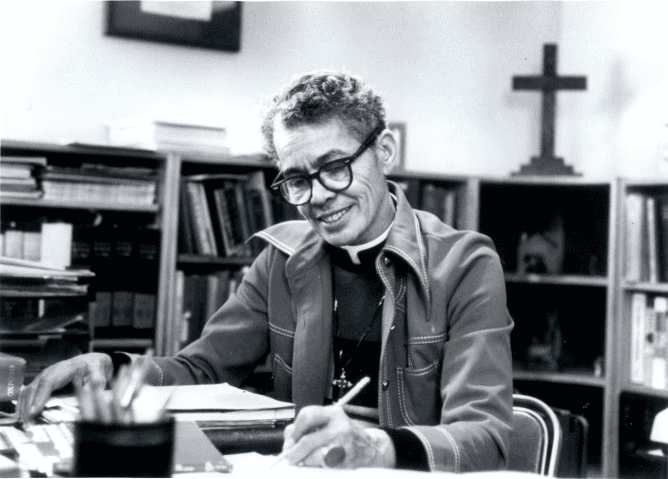
Autumn 1978. In a small New Haven apartment cluttered with legal files and theology collections, a sixty-eight-year-old woman receives us near an old portable typewriter. A priest for a year, a lawyer forever, Pauli Murray speaks softly, but every sentence lands like a closing argument.
—Do you remember the day the University of North Carolina rejected your application?
1938. I had gathered my transcripts, my letters of recommendation, everything a deserving candidate could offer. The reply came from Chapel Hill: rejected. Not for incompetence — for the color of my skin. I took my pen and wrote them what I still think today: "I am unable to understand why a state university, supported by public taxation, should deny admission to any qualified citizen solely on account of race." A university paid for by everyone's taxes, closed to some because of their birth. That humiliation did not break me; it organized me. I began writing to Eleanor Roosevelt, to understand that this wall was not an accident but an architecture — an architecture that could be dismantled stone by stone, with the law.
That humiliation did not break me; it organized me.
—How did this rejection become, six years later, a legal argument?
At Howard University, in 1944, I graduated first in my class — the only woman, often the voice no one expected. A professor had said, almost jokingly, that the 'separate but equal' doctrine was untouchable. I drafted a memo to prove otherwise: that Plessy v. Ferguson was constitutionally indefensible, that segregation by its very nature harmed. They looked at me like a dreamer. Ten years later, in 1954, the Supreme Court ruled exactly that way in Brown v. Board of Education, and Thurgood Marshall had drawn on those arguments. I did not argue before the Court that day. But I had laid a brick under the edifice, and that was enough for me to know.
—Tell us about what Thurgood Marshall called your 'bible.'
It was the work of an ant, and of cold anger. For States' Laws on Race and Color, in 1951, I wanted to gather in a single volume all the discriminatory laws of the forty-eight states — every provision, every court decision that separated one citizen from another by color. Hundreds of texts, annotated by hand, typed on my portable typewriter until my fingers could take no more. Marshall called it the 'bible' of the movement, and nothing pleased me more: because a lawyer who wants to tear down Jim Crow laws must first be able to hold them all in his hand. You can only fight well what you have first fully mapped.
You can only fight well what you have first fully mapped.
—What were your days like during that long inventory work?
I rose early, always with prayer and a time of silence — this habit stayed with me all my life. Then the first hours were for writing, before the world demanded its due. The afternoon belonged to libraries: I copied statutes, checked references, compared one article from Mississippi to that of Alabama. In the evening I read — theology, jurisprudence, philosophy — and kept my journal, as I had since childhood. I lived in rented rooms, modest, often alone, eating simply as one eats in the South: beans, cornbread. Hardship never left me, but it taught me that the mind does not need comfort to work, only constancy.
—You coined a strange expression, 'Jane Crow.' What did you want to name?
In 1965, with Mary Eastwood, I wrote Jane Crow and the Law. We all lived under Jim Crow, the regime that separated races. But Black women bore a second yoke, more discreet, never named: that of their sex. I called it Jane Crow. I wrote it in black and white: "The similarities between the operation of 'Jane Crow' and Jim Crow are striking." Two discriminations that do not add up, they intertwine. I knew it in my flesh: too much a woman for the world of lawyers, too Black for many rooms. To name is already to resist — because an injustice without a name hides, and what hides cannot be judged.
An injustice without a name hides, and what hides cannot be judged.

—What does it mean to you that Ruth Bader Ginsburg cited you as co-author?
In 1971, a young lawyer named Ruth Bader Ginsburg was preparing a landmark brief for the Supreme Court on gender equality. She insisted on listing my name as co-author, even though I had not written a line of that text. It was her way of saying that ideas have a genealogy, that the arguments she carried had been thought before her. I had argued, as early as the Civil Rights Act of 1964, that Title VII should also prohibit discrimination based on sex — and we had won. To see a new generation take up the torch and name those who had lit it is perhaps the only immortality an activist can honestly claim.
—In Proud Shoes, you write of carrying 'two strands' of history in your blood. How does one live that?
Proud Shoes, in 1956, was my effort to look at my own lineage without turning away. I wrote it thus: "I was the granddaughter of a woman who had been a slave, and the great-granddaughter of a slave owner." The two strands ran in my veins, and I could deny neither. Racial America did not just surround me; it shaped me from within. I grew up in Durham, North Carolina, in daily segregation, raised by my grandparents. To tell this mixed-race family, slaves and masters intertwined, was to refuse the simple fable of a people of one blood. We are all, in America, heirs to a history we were taught to silence.
—You are often described as an 'anomaly.' Does that word belong to you?
Yes, and I claimed it. I once wrote that I was "an anomaly in almost every group I entered — too dark-skinned to be white, too light-skinned to feel entirely at home in the Black community, a woman in a world of male lawyers, a priest in a church unaccustomed to women at the altar." I often wore pants when women were expected to wear dresses; I questioned, very early, what others took for granted in the division of the sexes. They wanted to put me in a box, and none held me entirely. For a long time I suffered from it. Then I understood that this uncomfortable place, at the seam of everything, was precisely where one sees best the injustices others do not notice.
This uncomfortable place, at the seam of everything, is where one sees best the injustices.
—In 1977, at age sixty-seven, you were ordained a priest. How did you experience that day?
The world had known me as a lawyer, poet, professor. That day, at Washington National Cathedral, I donned the alb and stole, and became the first Black woman ordained a priest in the Episcopal Church. Women's ordination had only been permitted there for a year. After a lifetime of fighting walls in courtrooms, I crossed one last one, before the altar. It was not a break from my earlier struggles: morning prayer had always accompanied me, through legal briefs and nights of writing. Simply, the same quest for justice had finally found its oldest language, that of vocation.
—It is said your first mass had a very special setting. What did it mean to you?
I wanted to celebrate my first Eucharist in a small church in North Carolina — the one where my grandmother, born a slave, had been baptized a century earlier. Think of it: a woman reduced to slavery had received the water of baptism on a bench reserved for her kind; and her granddaughter returned to hold the chalice, as a priest. Between these two women, a century of America, of Jim Crow laws, of rejections and trials. That day, I did not just say mass: I closed a loop, sealed a wound open since slavery. My whole life I had sought justice in texts; there, I held it in my hands, in the form of bread.
That day I did not just say mass: I sealed a wound open since slavery.
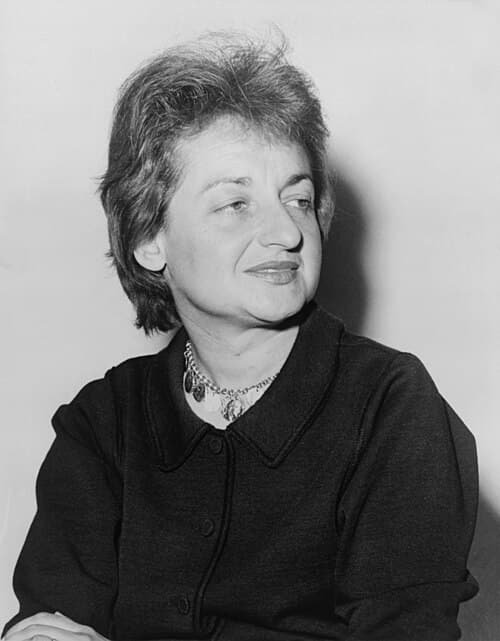
This imaginary interview was generated by artificial intelligence from sources documented in Pauli Murray's profile. It dramatises what the figure might have said based on what we know about them, but does not constitute attested historical testimony. For primary sources and factual documentation, refer to the full profile.