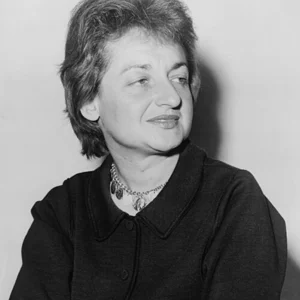

American essayist and feminist activist (1921–2006), Betty Friedan transformed society with her book The Feminine Mystique (1963), which ignited the second wave of feminism in the United States. Co-founder of the National Organization for Women (NOW), she fought for equal rights for women.
Frequently asked questions
Famous Quotes
« The problem that has no name.»
« Woman is not born, she is made.»
Key Facts
- 1921: Born in Peoria, Illinois
- 1963: Publication of The Feminine Mystique, a founding text of second-wave feminism
- 1966: Co-founded the National Organization for Women (NOW)
- 1970: Organized the Women's Strike for Equality
- 2006: Died in Washington D.C.
Works & Achievements
A landmark essay analyzing how American society in the 1950s condemned women to an alienating domestic life by convincing them it was their natural vocation. Selling over three million copies, it sparked the second wave of feminism in the United States and across the Western world.
Co-founding of the leading American feminist organization, which campaigns for equal pay, abortion rights, and the fight against discrimination. Friedan served as its first president until 1970, steering it in a resolutely political and pragmatic direction.
A collection of writings and speeches tracing ten years of feminist activism following *The Feminine Mystique*. Friedan examines the movement's advances and setbacks, offering a critical and personal perspective on the evolution of American society.
A controversial essay in which Friedan calls on the feminist movement to move beyond the sterile opposition between family and career, and to bring men into the conversation about equality. The book drew criticism from some feminists but reflects her constant concern for pragmatism.
An exploration of aging in America, in which Friedan applies to old age the same critical method she used for the condition of women: rejecting stereotypes and social assignments to assert the fullness of life at every age.
A memoir in which Friedan traces her life from her childhood in Peoria to her role as a global figure of feminism. She offers an unflinching portrait of her battles, her mistakes, and the profound transformation she helped set in motion in American society.
Anecdotes
Betty Friedan died on the very day of her 85th birthday, February 4, 2006. This striking coincidence was noted by many newspapers as a symbolic sign: she had lived exactly the number of years she had chosen to live fully, in complete defiance of the model of the self-effacing woman she had fought against her entire life.
The idea for *The Feminine Mystique* was born from a simple questionnaire. In 1957, Friedan sent a survey to her former Smith College classmates at their 15th reunion. The responses astounded her: educated, intelligent women described a profound existential emptiness despite their apparently perfect family lives. This “problem that has no name” became the central thread of her book.
A brilliant student, Betty Friedan graduated from Smith College summa cum laude in 1942, majoring in psychology. She received a fellowship to pursue a doctorate at Berkeley, but gave it up — under social and romantic pressure — a decision she would long regret and that would directly fuel her thinking on the sacrifices imposed on women.
The National Organization for Women (NOW) was founded in 1966 at a government conference on women’s status in Washington. Friedan scribbled the organization’s first bylaws on a napkin during dinner, alongside a group of women determined to take concrete action. NOW still counts several hundred thousand members today.
For years before publishing her book, Betty Friedan worked as a freelance journalist while raising her three children. She was fired during her second pregnancy — a common and legal practice at the time — which convinced her that professional discrimination against women was not an isolated case but an organized system that needed to be dismantled.
Primary Sources
The problem lay buried, unspoken, for many years in the minds of American women. It was a strange stirring, a sense of dissatisfaction, a yearning for something more. Each suburban wife struggled with it alone.
The time has come for a new march toward true equality for all women in America, and toward a fully equal society for women and men.
I never imagined that this book would change my life, and yet it changed the lives of millions of women, and in turn, my own.
A feminism that denies the reality of family, care, and love — that feminism betrays its own humanistic values and cannot win.
I knew I had to write this book. Not for glory, but because millions of women were living trapped in a role that left no room for their intelligence or their aspirations.
Key Places
Betty Friedan's hometown, where she was born on February 4, 1921, into a middle-class Jewish family. Her father was an immigrant jeweler, and her mother, a former journalist who resented having given up her career, directly inspired her daughter's thinking about the professional sacrifices women were forced to make.
The prestigious women's college where Friedan completed her undergraduate studies from 1938 to 1942, graduating summa cum laude in psychology. It was to her former Smith classmates that she sent, in 1957, the founding questionnaire that would become *The Feminine Mystique*.
Friedan was awarded a fellowship for a doctoral program in psychology there after graduating from Smith, but gave it up under social and personal pressure. That painful decision fed directly into her thinking about the impossible choices forced upon the intellectual women of her generation.
The city where Friedan lived and worked as a freelance journalist, raised her children, and wrote *The Feminine Mystique*. New York was also the setting for the landmark Women's Strike for Equality on August 26, 1970, which she helped organize and which drew 50,000 demonstrators.
The federal capital where Friedan co-founded NOW in 1966 and led numerous lobbying efforts before Congress in support of the Equal Rights Amendment and reproductive rights. She delivered some of her most important speeches there before congressional committees.
Typical Objects

Friedan used a typewriter to draft her freelance journalism articles and the thousands of pages of research that would eventually become The Feminine Mystique. This tool symbolizes both her intellectual work and the tension between her professional life and the homemaker role that society assigned to her.
📷 Wikimedia · Wikimedia Commons ↗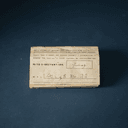
The questionnaire she sent to her Smith College classmates for their 15th reunion is the object that triggered the book that changed feminism. The handwritten responses she received revealed the deep malaise of an entire generation of educated women trapped in their domestic role.

Publications such as McCall's and Ladies' Home Journal, which Friedan studied meticulously, projected an idealized image of the perfect housewife. She analyzed them as tools of propaganda that locked women into the “feminine mystique” she set out to expose.

According to well-documented legend, Friedan scribbled the first lines of the National Organization for Women's bylaws on a napkin during a dinner in Washington in 1966. This ordinary object symbolizes the spontaneous birth of an organization that would go on to transform American politics.
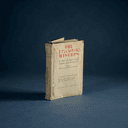
The book itself, published by W.W. Norton, is the central object of Friedan's body of work. Selling more than three million copies within a few years, it was often treasured — or, conversely, hidden — by women who saw themselves in its pages but feared the judgment of those around them.
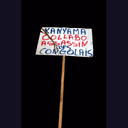
Friedan actively took part in feminist marches, most notably the August 26, 1970 march in New York, carrying signs demanding equal pay and the right to abortion. These objects of collective protest mark her transition from intellectual work to grassroots political action.
📷 CC BY-SA 4.0 · Wikimedia Commons ↗School Curriculum
Vocabulary & Tags
Key Vocabulary
Tags
Daily Life
Morning
During the years she spent writing The Feminine Mystique (1957–1963), Friedan would begin her mornings by getting her three children ready for school at their home in Rockland County, a suburb of New York. She would then head to the library or settle at her desk with her notes and questionnaires, working in the pockets of time that domestic life as a mother left her.
Afternoon
Afternoons were devoted to research and interviews with housewives, psychologists, and sociologists to document the "problem that has no name." She also dug through magazine archives and advertisements to analyze how the media constructed the image of the ideal woman. From 1966 onward, these hours were increasingly taken over by NOW meetings and political negotiations.
Evening
During her marriage (1947–1969), evenings were often marked by tensions between her intellectual ambitions and the expectations of married life. After her divorce, she led an active social life in New York, moving through intellectual and journalistic circles, hosting political meetings in her apartment, and working late into the night on her writing and speeches.
Food
From an American Jewish middle-class family, Friedan ate much like others of her time and social background. She frequented New York restaurants as part of her professional and political activities, and appreciated shared meals at activist gatherings where political discussion and good company went hand in hand.
Clothing
Friedan dressed in a functional, bourgeois style, rejecting both the hyper-femininity prescribed by magazines and the austerity of the committed activist. She typically wore tailored suits or simple dresses for public appearances and congressional testimony, aiming to be taken seriously in male-dominated spaces without disowning her femininity.
Housing
During her marriage, Friedan lived in a suburban house in Grand View-on-Hudson in Rockland County, New York — paradoxically embodying the very domestic setting she analyzed and critiqued in her book. After her divorce in 1969, she moved into a Manhattan apartment and split her time between New York and Washington depending on her commitments, adopting a more urban and independent way of life.
Historical Timeline
Period Vocabulary
Liens externes & ressources
Références
Œuvres
La Mystique féminine (The Feminine Mystique)
1963
Fondation de la National Organization for Women (NOW)
1966
It Changed My Life: Writings on the Women's Movement
1976
The Second Stage
1981
The Fountain of Age
1993
Life So Far (autobiographie)
2000