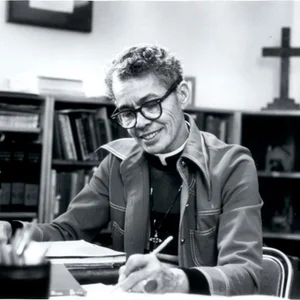

Lawyer, civil rights activist, and African American feminist, Pauli Murray fought simultaneously against racial segregation and gender discrimination. In 1977, she became the first Black woman ordained as a priest in the American Episcopal Church.
Frequently asked questions
Famous Quotes
« When my brothers try to draw a circle to exclude me, I shall draw a larger circle to include them.»
« I intend to destroy segregation by positive and embracing it and living it.»
Key Facts
- 1944: graduated from Howard University School of Law, the only woman in her class
- 1950: published States' Laws on Race and Color, a reference work used by Thurgood Marshall in Brown v. Board of Education
- 1961: appointed by JFK to the President's Commission on the Status of Women
- 1966: co-founded the National Organization for Women (NOW) with Betty Friedan
- 1977: first Black woman ordained as a priest in the American Episcopal Church
Works & Achievements
An exhaustive legal inventory of all discriminatory racial laws in force across the 48 American states. Thurgood Marshall called it the 'bible' of the civil rights movement.
An account of Murray's family history, weaving together enslaved ancestors and white plantation owners. This pioneering memoir explores how racial America shaped her identity.
An article co-written with Mary Eastwood in the George Washington Law Review, the first legal text to address racial discrimination and gender discrimination simultaneously as interconnected issues.
A collection of engaged poetry in which Murray gives lyrical voice to the suffering of double discrimination and the hope for justice. A work that reflects her dual calling as both artist and activist.
A posthumously published autobiography tracing her remarkable journey as lawyer, activist, poet, and priest. Considered one of the great memoirs of the civil rights movement.
Anecdotes
In 1938, Pauli Murray wrote a bold letter to the University of North Carolina requesting admission — she was rejected solely because of the color of her skin. This humiliation drove her to develop a legal strategy to dismantle racial segregation, well before the 1954 Brown v. Board of Education ruling.
A brilliant lawyer at Howard University Law School, Pauli Murray drafted a legal memo in 1944 demonstrating that the "separate but equal" doctrine was constitutionally indefensible. Thurgood Marshall, who would argue victoriously before the Supreme Court a decade later, drew heavily on her arguments.
In 1965, alongside Mary Eastwood, she published the article 'Jane Crow and the Law', coining the term 'Jane Crow' to denounce the double discrimination faced by Black women — both racist and sexist. This pioneering analysis foreshadowed what Kimberlé Crenshaw would theorize as intersectionality twenty years later.
Ruth Bader Ginsburg, future Justice of the United States Supreme Court, insisted on crediting Pauli Murray as co-author in her landmark brief on gender equality filed before the Supreme Court in 1971. For Ginsburg, Murray deserved to be counted among the intellectual architects of equal rights law.
At 67, in 1977, Pauli Murray was ordained as a priest of the Episcopal Church at Washington National Cathedral — becoming the first Black woman to receive holy orders. She celebrated her first Eucharist at the church in North Carolina where her enslaved grandmother had been baptized, symbolically closing a century of family history.
Primary Sources
The similarities between the operation of 'Jane Crow' and Jim Crow are striking. Yet, while the legal battle against Jim Crow has been won, the law remains silent on the discrimination against women.
I was the granddaughter of a woman who had been a slave, and the great-granddaughter of a slave owner. I carried both strands of that history in my blood, and I could not ignore either.
I am unable to understand why a state university, supported by public taxation, should deny admission to any qualified citizen solely on account of race.
I was an anomaly in almost every group I entered — too dark-skinned to be white, too light-skinned to feel entirely at home in the Black community, a woman in a world of male lawyers, a priest in a church unaccustomed to women at the altar.
This volume attempts to assemble in one place all laws, constitutional provisions, and court decisions which in any way discriminate on the basis of race or color.
Key Places
Pauli Murray's birthplace in 1910. Her mother died shortly after and she was raised by her maternal grandparents in Durham.
The city where Murray grew up under the segregation of the Deep South. Her childhood in this segregated city shaped her political consciousness and fueled her fight against Jim Crow laws.
Murray earned her law degree here in 1944, graduating first in her class. This historically Black university was the intellectual crucible of her legal thinking on segregation.
Murray defended her doctoral dissertation in law here in 1965, becoming the first Black person to earn that degree from Yale. This institution opened the doors of high-level legal scholarship to her.
It was here that Pauli Murray was ordained as a priest on January 8, 1977, becoming the first Black woman to receive that sacrament in the American Episcopal Church.
Home of the University of North Carolina, which denied Murray admission in 1938 because of her race. That rejection was a turning point in her activist life.
Liens externes & ressources
Références
Œuvres
States' Laws on Race and Color
1951
Proud Shoes: The Story of an American Family
1956
Jane Crow and the Law: Sex Discrimination and Title VII
1965
Dark Testament and Other Poems
1970
Song in a Weary Throat: An American Pilgrimage
1987