Imaginary interview with Rajeshwari Chatterjee
by Charactorium · Rajeshwari Chatterjee (1922 — 2010) · Technology · Sciences · 5 min read
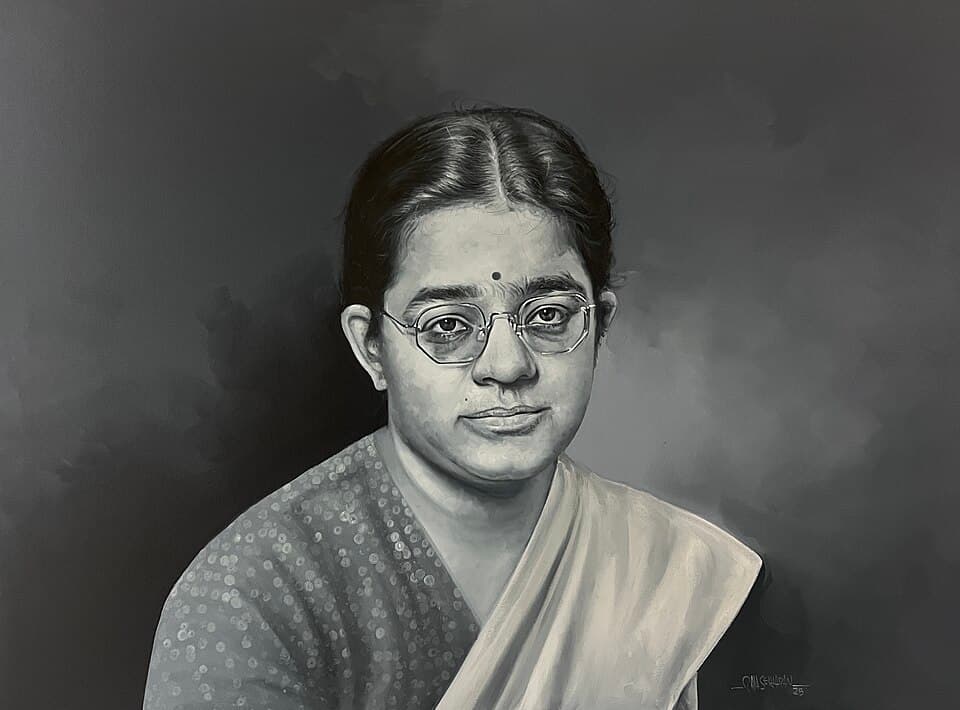
Bangalore, a monsoon afternoon. On the lush campus of the Indian Institute of Science, a woman in a sari welcomes us near a bench cluttered with waveguides and an old oscilloscope. Her voice is calm, precise, that of an engineer who spent forty years measuring the invisible.
—Before antennas and microwaves, there was a woman in your childhood. Who was she?
My grandmother, Kamalamma Dasappa. Widowed very young, at a time when a widow was expected to fade away, she did exactly the opposite: she educated herself, then fought so that other girls could be educated in turn. She, more than anyone, raised me. I grew up with the idea that a girl from Bangalore could aim for the highest studies, not out of arrogance, but because nothing in nature forbade it. Much later, once retired, I took the time to write her story and that of the women of my region. People think an engineer only tells equations; I wanted us not to forget where my audacity came from.
Nothing in nature forbade a girl from Bangalore from aiming for the highest studies.
—How did a young Indian woman in the late 1940s end up as a student in the United States?
Through a scholarship. India had just become independent in 1947, and this young state had decided to invest in its engineers and scientists. I received government aid, and in 1948 I packed my bags for the University of Michigan, in Ann Arbor. Imagine the vertigo: leaving alone, crossing an ocean, entering lecture halls where I looked like no one. I earned a master's there, then a doctorate in electrical engineering in 1953. People sometimes looked at me as a curiosity — a woman, from India, in an electronics lab. I answered with my results. A scholarship is not just money; it is a nation telling you it counts on you.
A scholarship is not just money; it is a nation telling you it counts on you.
—You returned from America in 1953, diploma in hand. What awaited you at IISc?
Almost nothing. I came back with a doctorate and a head full of ideas, and at the Indian Institute of Science, the microwave lab I imagined simply did not exist. We had to build it. With Sisir Kumar Chatterjee, my husband, also an engineer, we set up the test benches almost with our own hands, searched for components, assembled the waveguides, tamed a recalcitrant oscilloscope. It was the work of founders as much as researchers. Every device that finally worked meant a future generation of engineers could train on it. Building a lab is not as glorious as a discovery, but without that patient work, no discovery would have happened.
—What did a concrete day in that lab look like?
In the morning, I crossed the campus, still damp with dew, to prepare my classes and welcome my doctoral students — we discussed their experiments before the first coffee. The afternoon belonged to microwaves: I supervised measurements, adjusted a test bench, bent my ear and eyes toward the oscilloscope screen where waves traced luminous curves. A misaligned waveguide, and an entire experiment went wrong. In the evening, I graded papers, prepared our publications. The sari never left the lab; you can measure microwaves without renouncing who you are. This regularity may seem austere, but precision is born from that rhythm.
—Those microwaves you studied, where did they come from? They say they have a warlike history.
That's true. When World War II broke out in 1939, radar became a decisive weapon: detecting a plane, a ship, at a distance, using the echo of very high frequency radio waves. Microwaves emerged from that military urgency. My job was to make them change sides. The same wave used to track a bomber could, once tamed, carry the voice and signals of an entire country. My research on antennas and wave propagation aimed at the telecommunications of an India seeking to connect to itself. I loved that idea: taking knowledge born on the battlefield and turning it toward what brings people together rather than what targets them.
Taking knowledge born on the battlefield and turning it toward what brings people together.
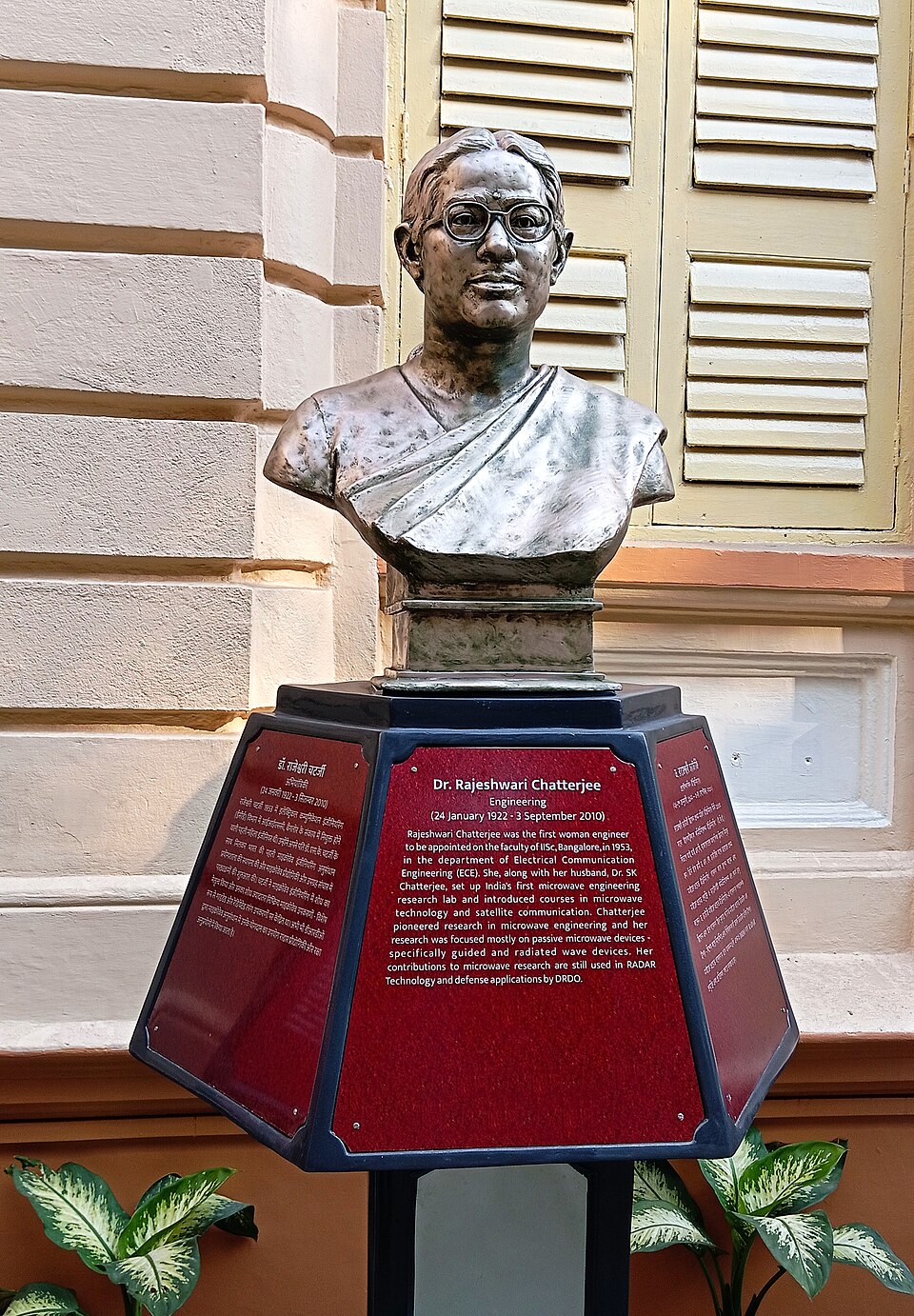
—How would you explain to a layperson what an antenna is, and why you devoted so many years to it?
An antenna is a translator. It takes an electric current and releases it into space as waves, or does the reverse: it catches passing waves and makes them intelligible to a machine. The whole difficulty lies there — the shape, size, orientation decide whether the signal goes straight or gets lost. I spent the years from 1960 to 1980 designing, measuring, understanding this radiation. It seems abstract, but every radio set, every link between two Indian cities rested on these laws of wave propagation. Devoting one's life to an invisible object requires a certain faith: you never see the wave, only its trace on a screen, yet it carries voices across hundreds of kilometers.
—You are often presented as the first woman engineer from Karnataka. How did you experience this pioneering role?
With more work than titles. I was the first woman appointed teacher in the Electrical Communication Engineering department at IISc, and I stayed there for nearly four decades. 'First' is a word people attach to you; at the time, you don't think about that, you think about the class you have to teach and the thesis you have to supervise. I supervised dozens of doctoral students, men and women. The sari amid the equipment sometimes intrigued people. But I believe being first only makes sense if you are not the last — if, behind you, other women find the door already ajar. That is the true measure of a pioneer.
Being first only makes sense if you are not the last.
—You speak of your students with tenderness. What did you hope to pass on to them beyond formulas?
Rigor, and the courage to build. Many of my doctoral students arrived brilliant on paper but intimidated by the subject: a waveguide does not forgive sloppiness. In front of the blackboard, chalk in hand, I drew equations, then I took them to touch the equipment, because an antenna is understood as much with the fingers as with the head. With Sisir, we co-wrote microwave engineering textbooks precisely for that: to leave Indian students books to draw from, in their language of science. A teacher who leaves leaves nothing if he has not transmitted; what I wanted to bequeath was not my name, but a method.
—The India of your lifetime transformed at a dizzying pace. Which moment of this scientific rise struck you most?
The creation of the space agency, ISRO, in 1969, moved me more than I would have expected. Seeing a country that, at my birth in 1922, was still under British Raj, begin to aim for the sky… The first five-year plans, from the mid-1950s, had bet on science and industry, and IISc was at the heart of that training. Our work on antennas, modest as it seemed, was part of that great movement: a nation learning to transmit and receive its own signals. I didn't build a rocket, but I trained some of those who, perhaps, made their instruments speak from a distance. You then feel like a link in a chain larger than yourself.
—At the end of your career, in 1981, you turned to writing rather than new equations. Why this shift?
Because a life is not only in oscilloscope curves. After my retirement from teaching in 1981, I felt the need to tell — the memory of my grandmother Kamalamma Dasappa, the story of those pioneering women from my region who are so quickly erased from books. I had devoted my life to waves you cannot see; it remained for me to make visible those who had opened the way for me. A microwave textbook trains engineers; a family story, on the other hand, transmits a conviction. Both are equal. If I were to imagine being read a century from now, I would like people to remember the grateful granddaughter as much as the antenna engineer.
I had devoted my life to waves you cannot see; it remained for me to make visible those who had opened the way for me.
This imaginary interview was generated by artificial intelligence from sources documented in Rajeshwari Chatterjee's profile. It dramatises what the figure might have said based on what we know about them, but does not constitute attested historical testimony. For primary sources and factual documentation, refer to the full profile.