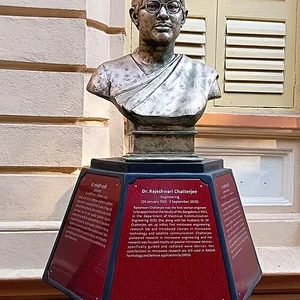

Rajeshwari Chatterjee was an Indian engineer and scientist, a pioneer of microwave and antenna engineering. The first woman engineer from the state of Karnataka, she taught for decades at the Indian Institute of Science in Bangalore.
Rajeshwari Chatterjee(1922 — 2010)
Rajeshwari Chatterjee
Inde, Raj britannique, Union indienne
5 min read
Frequently asked questions
Key Facts
- Born in 1922 in Bangalore, in British India
- Earned a doctorate in engineering from the University of Michigan in the United States in 1953
- First woman engineer from the state of Karnataka and the first woman professor of engineering at the Indian Institute of Science
- A specialist in microwave and antenna engineering, author of numerous research works
- Died in 2010 in Bangalore
Works & Achievements
A thesis completed in the United States that made her one of the first Indian women to earn a doctorate in electrical engineering.
Together with her husband, she equipped and organized one of India's first microwave engineering laboratories.
Pioneering work that trained dozens of researchers and contributed to the development of telecommunications in India.
Technical books co-authored with S. K. Chatterjee that became standard references in Indian higher education.
Texts written after her retirement to pass on the memory of her reformist grandmother and the education of women.
Anecdotes
Rajeshwari Chatterjee was raised largely by her grandmother Kamalamma Dasappa, a social reformer who, widowed at a very young age, had defied convention to educate herself and campaign for women's education. This family example instilled in her early on the conviction that an Indian girl could aim for the highest levels of scientific study.
A brilliant student, she earned a scholarship from the newly independent Indian government in the late 1940s to study in the United States. At the University of Michigan, in Ann Arbor, she obtained a master's degree and then a doctorate in electrical engineering — a path that was exceptional at the time for a woman from India.
When she returned to the Indian Institute of Science in Bangalore in 1953, there was no microwave laboratory. Together with her husband Sisir Kumar Chatterjee, also an engineer, she had to build almost from scratch the equipment and test benches that would train generations of Indian engineers.
She was the first woman appointed as a faculty member in the Electrical Communication Engineering department at the IISc, where she worked for nearly four decades, supervising dozens of theses on antennas and wave propagation.
Often described as the first woman engineer of the state of Karnataka, she continued to write after her retirement, notably to preserve the memory of her grandmother and the history of the pioneering women of her region.
Primary Sources
A technical work based on their research at the Indian Institute of Science, intended to train Indian students in microwave engineering and waveguides.
Her research focused on the design and radiation of antennas, a field she helped teach and develop in India.
After retiring, she wrote texts devoted to her family, and in particular to her reformist grandmother, reflecting the role that women's education played in her own journey.
Key Places
City in southern India where she was born and spent most of her life. The country's future technology capital.
Prestigious institute where she studied, then taught and built the microwave laboratory for nearly forty years.
American university where she earned her master's degree and then her doctorate in electrical engineering thanks to a scholarship.
Typical Objects
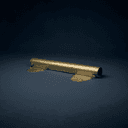
Hollow metal tube used to channel very high-frequency microwaves. It was the basic tool for the experiments she carried out at the IISc.

Device that emits or captures very high-frequency radio waves. The design and radiation of antennas were at the heart of her research.
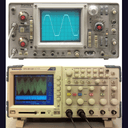
Device that displays electrical signals as glowing curves. Essential for visualizing and measuring the waves studied in the laboratory.
📷 CC BY-SA 3.0 · Wikimedia Commons ↗
Everyday tool of the teacher she was for decades. On it she traced equations and diagrams for generations of engineering students.
Technical book she co-authored to train Indian students in microwaves and antennas. These works became standard references in the country's universities.
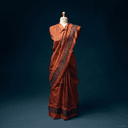
Traditional Indian garment she wore in the laboratory as well as at the university. A symbol of a cutting-edge scientist who remained rooted in her culture.
School Curriculum
Vocabulary & Tags
Key Vocabulary
Daily Life
Morning
In the morning, Rajeshwari Chatterjee would arrive at the leafy campus of the Indian Institute of Science. She prepared her lectures, reviewed antenna calculations, and welcomed her doctoral students to discuss their experiments.
Afternoon
The afternoon was spent in the microwave laboratory, among waveguides and oscilloscopes. She supervised the experiments, adjusted the test benches, and carried out her own measurements on wave propagation.
Evening
In the evening, she would return home to prepare her publications and grade her students' work. Family and scientific life blended together, as her husband was also an engineer and collaborator.
Food
Her diet was that of South India: rice, lentils (dal), vegetables, sambar, and chutneys, often vegetarian. Filter coffee from Karnataka was a welcome companion to meals.
Clothing
She wore the sari, the traditional Indian garment, even in the laboratory and teaching rooms, blending cultural elegance with scientific work.
Housing
She lived in Bangalore, a rapidly modernizing city, near the IISc campus, in a setting that combined colonial houses, gardens, and academic institutions.
Historical Timeline
Period Vocabulary
Liens externes & ressources
Références
Œuvres
Doctorat en ingénierie électrique (Université du Michigan)
1953
Création du laboratoire de micro-ondes de l'IISc
années 1950-1960
Recherches sur les antennes et la propagation des ondes
années 1960-1980
Manuels d'ingénierie des micro-ondes
années 1980
Écrits sur l'histoire des femmes et de sa famille
après 1981