Imaginary interview with Salomé
by Charactorium · Salomé (14 — 62) · Spirituality · Culture · 5 min read
Machaerus, Herod's fortress perched on its peak above the Dead Sea. The feast has fallen silent, the torches still smoke, and a young woman with loosened veils stands near the table where a silver platter gleams. She agrees to speak of that night which made her a legend.
—What really happened at that birthday banquet of Herod?
It was the night of his birthday, at Machaerus, and the guests — dignitaries from Galilee, officers from Rome — had drunk deep of Tiberias wine. My mother Herodias told me to dance, and I danced, as the daughters of our house are taught. The tetrarch, my stepfather, was so transported that he swore before all to grant me whatever I asked, up to half his kingdom. An oath made before the table cannot be taken back without losing face. I did not laugh, I did not triumph: I felt the weight of what was coming, and I left the hall to find my mother.
An oath made before the table cannot be taken back without losing face.
—Why did you specifically ask for the head of John the Baptist?
I did not want it of my own accord. I went out and asked my mother: what should I demand? It was she who spoke the name of the prophet kept chained in the dungeons, beneath the very hall where we feasted. The Baptist had publicly denounced Herodias's marriage to Antipas, called her outside the law of Moses, and a humiliated woman does not forget. I carried her words like an arrow another had nocked. Ask at once, I specified, here, on a platter — so that no night might give my stepfather time to regret his oath.
I carried her words like an arrow another had nocked.
—Do you remember the moment when that platter was brought to you?
The executioner went down to the dungeon — they called him Mannaeï in the house. Silence fell in the hall, that heavy silence that follows too-loud laughter. Then they set before me the silver platter, and the head lay upon it, still warm under the torches. I took it without trembling, for to tremble would have been to admit, and I carried it to my mother. That is the object that follows me everywhere now: not the diadem I wore, not the golden bracelets, but that cold metal dish. I have been reduced to that gesture, as if my whole life were contained in the length of my two outstretched arms.
I have been reduced to that gesture, as if my whole life were contained in the length of my two outstretched arms.
—Many are surprised that your name appears nowhere in the Gospels. How do you explain that?
Those who wrote the account of that night called me only 'the daughter of Herodias'. To them I was merely an instrument, a link between a mother's grudge and a righteous man's death; why name the tool? My name, Salomé, had to be saved by another — the historian Flavius Josephus, who recorded my lineage and marriages in his Jewish Antiquities. Strange fate: the texts that condemn me take away my name, and the one who judges me coldly gives it back. Without him, I would be only an anonymous dancer, a shadow at the edge of a table.
The texts that condemn me take away my name, and the one who judges me coldly gives it back.
—Does that dance associated with you, the Dance of the Seven Veils, match what you actually danced?
Seven veils? They attribute to me gestures I never made. I danced, yes, before Herod's guests — a court dance, learned with the music and manners taught to girls of our rank. No learned unveiling, no staging of the flesh. Those veils were woven long after me, in halls I will never know. I content myself with what I know: the wine, the music, the too-insistent gaze of an old man, and a mother waiting in the shadows. The rest belongs to those who dream of me without having seen me.
—People often forget that you were a princess. What was your place in Herod's house?
I was born into the dynasty that Herod the Great founded with Rome's support, and I grew up between the palaces of Galilee, at Tiberias, that city my stepfather built on the lake's shore to flatter the emperor Tiberius. Our mornings began with the ablutions and rites of Jewish law, which our house observed at least for show; our afternoons saw a parade of Jewish dignitaries and Roman officers. We lived on a razor's edge, between the Temple and the Empire, holding in one hand the kashrut of our fathers and in the other the refinements from Rome. A Herodian princess is never quite at home anywhere.
We lived on a razor's edge, between the Temple and the Empire.
—What became of your life and marriages after that famous night?
The night of the platter did not close my life, whatever those who imprison me there may think. I married Philip the Tetrarch, my great-uncle, who ruled Iturea and Trachonitis in the north; widowed, I remarried Aristobulus of Chalcis. Thus went the women of our blood: our weddings sealed alliances, they stitched together the pieces of a kingdom that Rome could undo with a word. The title of tetrarch that my husbands bore spoke plainly of our condition — ruling a quarter of a kingdom, under the procurator's eye. I was not only a dancer: I was a piece on the Herodian chessboard.
Our weddings stitched together the pieces of a kingdom that Rome could undo with a word.
—How did you experience the fall of your stepfather, exiled by Rome?
The power of the Herodians hung by a thread, and Rome cut that thread whenever it pleased. My stepfather Antipas, accused of plotting, was driven from Galilee and sent to end his days in Gaul; my mother Herodias, faithful to the last in her pride, went into exile with him. I saw the court where I had danced crumble, those palaces of Tiberias with Roman columns and mosaics. We thought we ruled, and we were only tolerated guests of the Empire. Those who, like the Baptist, denounced our marriages, judged a house already fragile — a breath from Rome, and all our splendor returned to dust.
We thought we ruled, and we were only tolerated guests of the Empire.
—What would you say to those who have made you a femme fatale, a deadly seductress?
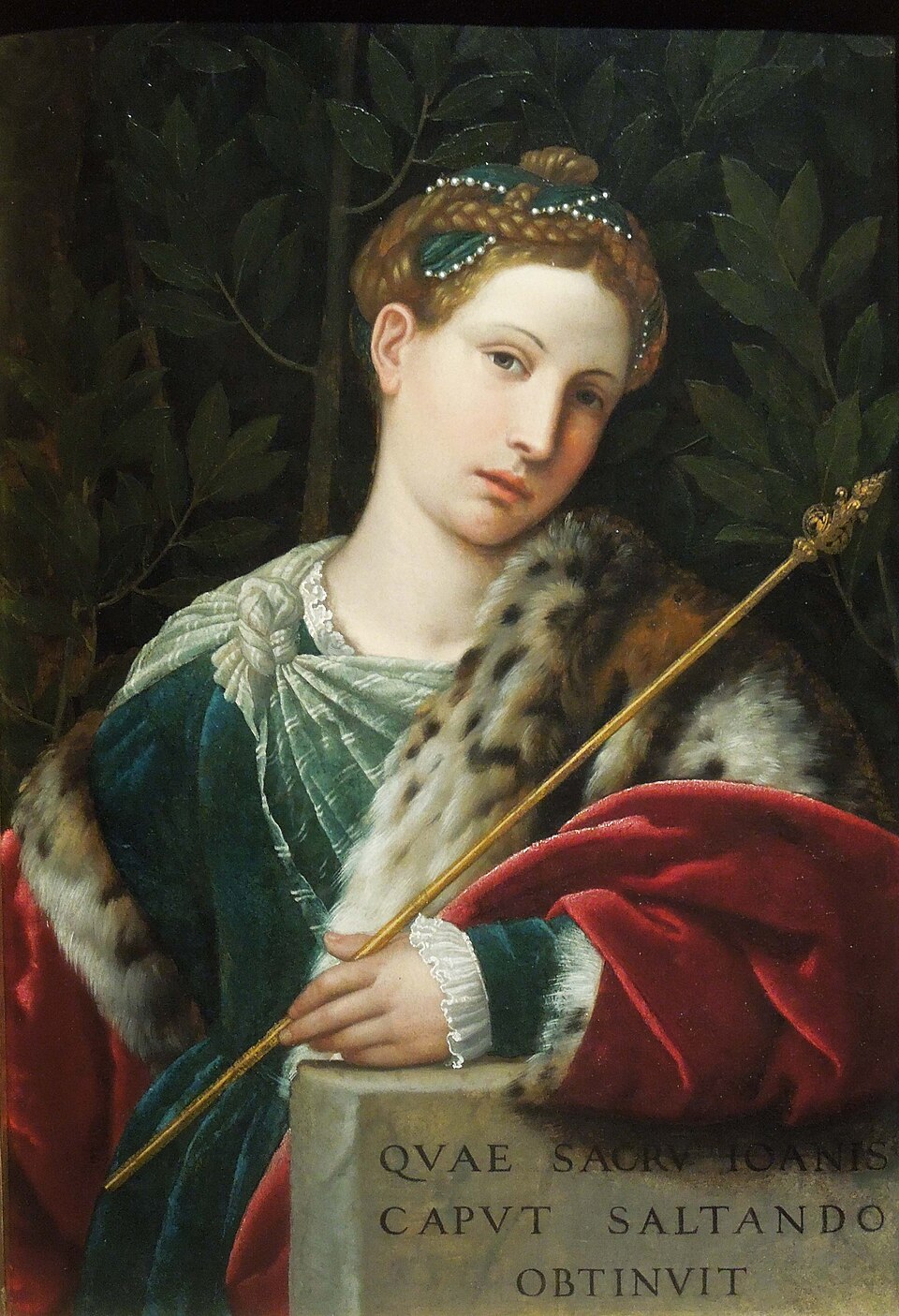
If I were told that one day, in centuries I will not see, I would be made the incarnation of the dangerous woman, I think I would laugh first, then be frightened. They would paint me holding a luminous head, imagine me in love with the prophet I had killed, attribute to me desires I never had. But I already sense it: men prefer a temptress to an obedient girl, because the temptress absolves them. It is sweeter to believe that a woman wanted blood out of passion than to admit that a mother ordered it out of calculation, and a child obeyed.
Men prefer a temptress to an obedient girl, because the temptress absolves them.
—Where do you think this image of you as a bewitching temptress comes from?
It comes from the same place as all legends: from the fear inspired by a woman who, for the space of a dance, held a king at her mercy. People need veils to drape what was only the brutality of a court and the ambition of a mother. So they covered me with oriental finery, golden jewels, they made my body the enigma and my silence a threat. The silver platter, they now retain only as an accessory to my triumph. Yet that is where the truth lies: not in my hips, but in that cold dish where the head of a just man rested.
People need veils to drape what was only the brutality of a court.
—If your name were to travel through the centuries, what would you like it to recall?
I would like them to remember that before being a myth, I was a girl in the house of the Herodians, caught between a drunkard's oath and my mother's grudge. Let them look less at my veils and more at the fortress of Machaerus, its dungeons, the law of Moses that a prophet defended unto death. If my name must endure, let it serve as a warning: see what becomes of a child trained to obey without ever being taught to refuse. The rest — the paintings, the music, the bewitching dancer — belongs to those who will come. As for me, I have never had anything but the cold of a silver platter in my hands.
See what becomes of a child trained to obey without ever being taught to refuse.
This imaginary interview was generated by artificial intelligence from sources documented in Salomé's profile. It dramatises what the figure might have said based on what we know about them, but does not constitute attested historical testimony. For primary sources and factual documentation, refer to the full profile.