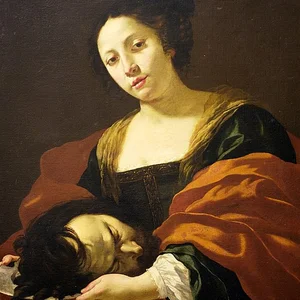

Salomé is the daughter of Herodias and stepdaughter of Herod Antipas, tetrarch of Galilee in the 1st century. According to the Gospels, her dance so pleased Herod that he granted her any request she wished: at her mother's urging, she asked for the head of John the Baptist.
Salomé(14 — 62)
Salomé
8 min read
Frequently asked questions
Key Facts
- 1st century AD: Salomé lives at the court of Herod Antipas in Galilee
- Her dance (mentioned in Matthew 14 and Mark 6) captivates Herod during a banquet
- She demands the head of John the Baptist on a platter, at the instigation of her mother Herodias
- Her name does not appear in the Gospels; it is provided by the historian Flavius Josephus (Jewish Antiquities, XVIII)
- In the 19th century she became an iconic figure of the femme fatale in art and literature
Works & Achievements
The earliest Gospel account of the episode of the dance and the beheading of John the Baptist. The foundational textual source for the character, although Herodias's daughter is not named in it.
The Romanized Jewish historian names 'Salome' for the first time and provides genealogical details about her marriages, lending historical reality to the Gospel figure.
A major Symbolist painting depicting Salome before the luminous severed head of John the Baptist. This work fixed in the collective imagination the image of Salome as an enchanting and dangerous figure.
A short story reconstructing with documentary precision the historical and political context of Herod's banquet. Flaubert portrays Salome as a mysterious dancer set against a meticulously researched Orient.
A Symbolist play written in French that reinvents Salome as a femme fatale desperately in love with John the Baptist. This work profoundly reshaped the modern European perception of the character.
A one-act opera adapted from Wilde's play, in which the "Dance of the Seven Veils" is set to music in dazzling fashion. It established Salome as an icon of twentieth-century operatic art.
Anecdotes
The name 'Salome' appears nowhere in the Gospels of Matthew and Mark, the only two biblical texts that recount the episode of the dance. She is referred to there solely as 'the daughter of Herodias.' It is the Jewish historian Flavius Josephus who, in his *Jewish Antiquities* written around 93 AD, names her 'Salome' for the first time, thereby confirming her historical existence.
The famous 'Dance of the Seven Veils' associated with Salome appears nowhere in the Bible. The Gospels simply speak of a dance that pleased Herod Antipas and his guests. This veiled dance is a 19th-century invention, popularized by the play of Irish writer Oscar Wilde in 1891, then enshrined by Richard Strauss's opera in 1905.
The beheading of John the Baptist took place at the fortress of Machaerus, an impregnable citadel built by Herod the Great on a rocky promontory overlooking the Dead Sea. It was in its dungeons that the prophet was imprisoned, and it was there that the head was, according to tradition, brought on a platter to Salome, who handed it to her mother Herodias.
According to Flavius Josephus, Salome first married Philip the Tetrarch, her great-uncle who governed Iturea and Trachonitis. After his death, she remarried Aristobulus of Chalcis. These unions illustrate how marriages within the Herodian family served above all as strategies of political alliance within the framework of Roman dominance.
Salome became, especially from the 19th century onward, one of the most depicted female figures in Western art, a symbol of the femme fatale and of temptation. Painters such as Gustave Moreau, Lucas Cranach the Elder, and Aubrey Beardsley celebrated her, transforming the biblical figure into a true cultural myth spanning the centuries.
Primary Sources
The daughter of Herodias came in and danced, and pleased Herod and his guests. The king said to the girl: Ask me for whatever you wish, and I will give it to you. She went out and said to her mother: What should I ask for? And her mother said: The head of John the Baptist.
The daughter of Herodias danced before the guests and pleased Herod, so that he promised with an oath to give her whatever she might ask. Prompted by her mother, she said: Give me the head of John the Baptist here on a platter.
Herodias had a daughter named Salome, from whom Aristobulus was born. Herodias, unable to bear being of lesser standing than her brother, resolved to overturn ancestral customs and marry Herod Antipas, her half-brother.
Mannaeï received the order to go down to the dungeon and cut off the head of Iaokanann. Phanuel entered, followed by two men carrying a platter. They set it on the table. It was the head of Iaokanann.
Key Places
Herodian fortress built on a promontory overlooking the Dead Sea, in Perea (present-day Jordan). This is where John the Baptist was imprisoned and then beheaded, and where Salome's dance is said to have taken place at Herod's banquet.
Capital of Galilee founded by Herod Antipas in honor of Emperor Tiberius, on the shore of the Sea of Galilee. The main residence of the court where Salome lived, blending Roman architecture with Jewish traditions.
The religious and political center of Judea, where Herodian, Roman, and major Jewish religious influences converged. Salome, as a member of the ruling family, stayed there during the great festivals.
City rebuilt by Herod the Great and renamed Sebaste in honor of Augustus. A major center of power and dynastic worship, it is closely tied to the history of the Herodian family to which Salome belonged.
Typical Objects

The central object of the legend, it is on this platter that the head of John the Baptist was brought to Salome, then handed to Herodias. It has become the most powerful symbol of the myth, linking royal reward with the death of an innocent man.

Though absent from the biblical text, veils have become Salome's iconic attribute in art and literature since the nineteenth century, symbolizing both seduction and the gradual unveiling of a terrible truth.

A sign of the dynastic power to which Salome belongs, the crown or diadem marks her rank as a princess in artistic depictions, reminding us that her murderous demand is part of the games of royal power.

The sword used for the beheading of John the Baptist is the central instrument of death in the story. Mannaeus, cited in certain traditions as the executioner of Machaerus, is its fateful bearer.

As a princess of the Herodian court, Salome wore adornments blending Jewish, Roman, and Oriental influences — bracelets, gold necklaces, and diadems — reflecting the splendor of a court at the crossroads of cultures.
School Curriculum
Vocabulary & Tags
Key Vocabulary
Tags
Daily Life
Morning
Salome begins her day in the private apartments of Herod Antipas's palace, surrounded by handmaidens who help her dress and style her hair. The morning is devoted to purifying ablutions and the religious rites prescribed by Jewish law, which the Herodian court observed with official compliance, even if its piety was frequently called into question.
Afternoon
In the afternoon, the princess takes part in court life: receiving Roman and Jewish dignitaries, and practicing the dance and music that form part of the education of young women of royal rank. The princely banquets blend Roman culinary refinements with Jewish traditions in a setting of orientalized luxury.
Evening
Evenings at the Herodian court could be enlivened by richly appointed feasts where music, dance, and contests of eloquence among Greek and Jewish scholars mingled freely. It was at one such birthday banquet of Herod that the dance took place which sealed the fate of John the Baptist.
Food
The Herodian table officially observed the dietary prescriptions of Mosaic law (*kashrut*), while also embracing Roman culinary refinements. It featured lamb, poultry, fish from the Sea of Galilee, Mediterranean vegetables, dried fruits, wheat bread, and Galilean wine.
Clothing
Salome wore fine linen tunics and embroidered robes in vivid colors, in keeping with the tradition of high-ranking women in the Roman Near East. Gold jewelry — rings, earrings, diadems — signaled her membership in the ruling Herodian dynasty.
Housing
Salome resided in the palaces the Herodian family owned throughout Galilee, notably in Tiberias, the capital city built by Herod Antipas on the shores of the lake. These residences blended Roman architecture (columns, mosaics, baths) with Oriental décor, reflecting a family poised between the Jewish world and the Roman Empire.
Historical Timeline
Period Vocabulary
Liens externes & ressources
Références
Œuvres
Évangile selon Marc (chapitre 6)
vers 65-70 ap. J.-C.
Antiquités juives, Flavius Josèphe (Livre XVIII)
vers 93-94 ap. J.-C.
L'Apparition, Gustave Moreau (peinture)
1876
Hérodias, Gustave Flaubert (Trois Contes)
1877
Salomé, Oscar Wilde (pièce de théâtre)
1891