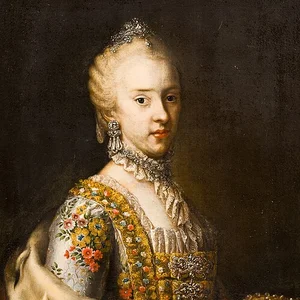

Mary of Nazareth is, according to the Gospels, the mother of Jesus of Nazareth. A central figure in Christianity and venerated in Islam under the name Maryam, she holds a major place in the religious and cultural history of the West.
Mary of Nazareth
Mary of Nazareth
France
6 min read
Frequently asked questions
Famous Quotes
« My soul magnifies the Lord, and my spirit rejoices in God my Savior.»
« Behold the handmaid of the Lord; let it be done to me according to your word.»
« Do whatever he tells you.»
Key Facts
- According to tradition, lived in Nazareth in Galilee at the turn of the Christian era (1st century).
- The Annunciation: the angel Gabriel announces to her that she will give birth to Jesus (account from the Gospel of Luke).
- Mother of Jesus of Nazareth, a foundational figure in the Christian narrative of origins.
- Venerated in Islam under the name Maryam, the only woman named in the Quran.
- The object of a major cult (Marian devotion) developed especially from the Council of Ephesus in 431.
Works & Achievements
Canticle of praise attributed to Mary at the Visitation. It became one of the great hymns of Christian liturgy, set to music by countless composers.
Mary's consent (“Let it be done unto me according to thy word”) is regarded in Christian tradition as the founding act of the Incarnation.
The act by which Mary, according to the Gospel, brings about Jesus's first public miracle; it establishes her role as intercessor.
Mary witnesses the crucifixion of her son; this scene, the “Stabat Mater,” has inspired an immense body of artistic and musical work.
Official recognition of Mary as “Mother of God,” which fixes her central place in Christian theology and devotion.
Anecdotes
According to the Gospel of Luke, the angel Gabriel appears to Mary, a young girl from Nazareth, and announces that she will give birth to Jesus. This scene, called the Annunciation, is one of the most frequently depicted episodes in all of Western art.
At the wedding at Cana, recounted in the Gospel of John, it is Mary who notices that the wine has run out and quietly prompts her son to act. Jesus then turns water into wine: in the text, this is his very first miracle.
Mary is the only woman mentioned by name in the entire Quran, where she is called Maryam. The nineteenth sura even bears her name and tells of the birth of Jesus beneath a palm tree.
The Protoevangelium of James, a second-century text not included in the Bible, recounts that the young Mary was entrusted to the Temple of Jerusalem and that she was spinning the purple thread destined for the sanctuary veil when the angel came to find her.
At the Council of Ephesus in 431, the bishops proclaimed Mary “Theotokos,” meaning “Mother of God.” Tradition holds that the city's crowd accompanied the decision by torchlight in immense rejoicing.
Primary Sources
The angel said to her: “Do not be afraid, Mary, for you have found favor with God. Behold, you will conceive and bear a son, and you shall name him Jesus.”
Then Mary said: “My soul magnifies the Lord, and my spirit rejoices in God my Savior, for he has looked upon his lowly servant.”
When the wine ran out, the mother of Jesus said to him: “They have no wine.” […] His mother said to the servants: “Do whatever he tells you.”
“The angels said: O Mary, Allah has chosen you, purified you, and chosen you above all the women of the world.”
“And she took the purple and began to spin it. […] Behold, an angel of the Lord stood before her, saying: Do not fear, Mary.”
Key Places
Village in Galilee where, according to the Gospels, Mary lived and received the announcement from the angel. A Basilica of the Annunciation stands there today.
Town in Judea where tradition places the birth of Jesus, after Mary and Joseph's journey for the census.
Village in the hills of Judea where tradition locates the Visitation: Mary visits her cousin Elizabeth, the future mother of John the Baptist.
Site of the wedding where, according to the Gospel of John, Mary asks Jesus to intervene, prompting his first miracle.
Religious center of Judaism where tradition places the Presentation of Jesus at the Temple and, according to the apocryphal texts, the childhood of Mary.
City in Asia Minor where a late tradition places the final years of Mary, near the “House of the Virgin.” The city hosted the Council of 431.
Typical Objects

A large veil covering the head and shoulders, a constant attribute of Mary in Christian iconography. A relic venerated in Constantinople was believed to be her veil.

According to the Protoevangelium of James, Mary was spinning the purple thread for the Temple veil at the moment of the Annunciation. These weaving tools depict her as a pious and hardworking young girl.

A flower the angel Gabriel often holds out to Mary in Annunciation scenes. The lily symbolizes her purity and virginity.

Inspired by the Book of Revelation, which describes “a woman crowned with twelve stars,” it adorns Mary's head in art as Queen of Heaven.

A color reserved for Mary in painting, because ultramarine blue, made from lapis lazuli, was one of the most precious pigments. It evokes the sky and majesty.

A terracotta vessel that the women of Nazareth carried to the village spring. An Eastern tradition places the Annunciation near a well, and the jug evokes Mary's daily life.
School Curriculum
Vocabulary & Tags
Key Vocabulary
Daily Life
Morning
Like the women of Galilee, Mary begins her day early: she revives the hearth, grinds grain by hand and kneads the dough for the daily bread. Going to draw water from the village spring is one of the first tasks.
Afternoon
The afternoon is spent on household chores: spinning wool and flax, weaving, preparing meals. The women often gather at the spring or the communal oven, the village's places of exchange.
Evening
In the evening, the household gathers around a simple meal by the light of an oil lamp. The Sabbath, on Friday evening, marks a time of prayer and rest set to the rhythm of the Jewish blessings.
Food
The diet is that of the peasants of Galilee: barley or wheat bread, olive oil, dried pulses, figs, dates and grapes. Meat is rare, reserved for feasts; fish from the Sea of Galilee sometimes rounds out the meals.
Clothing
Mary wears a long wool or linen tunic gathered at the waist, covered by a cloak, and a veil concealing her hair according to the custom of Jewish women. The colours are natural, unbleached or soberly dyed.
Housing
The house in Nazareth is modest: one or two stone rooms, often built against a cave used as a storeroom and stable. The flat roof, made of beams and packed earth, serves as a terrace for drying the harvest.
Historical Timeline
Period Vocabulary
Liens externes & ressources
Références
Œuvres
Le Magnificat
rapporté dans l'Évangile de Luc
Le « Fiat » de l'Annonciation
récit de Luc
L'intervention aux noces de Cana
récit de Jean
La présence au pied de la croix
récit de Jean
La proclamation comme Theotokos
concile d'Éphèse, 431