Imaginary interview with Sayyida al-Hurra
by Charactorium · Sayyida al-Hurra (1485 — 1561) · Military · Politics · 5 min read
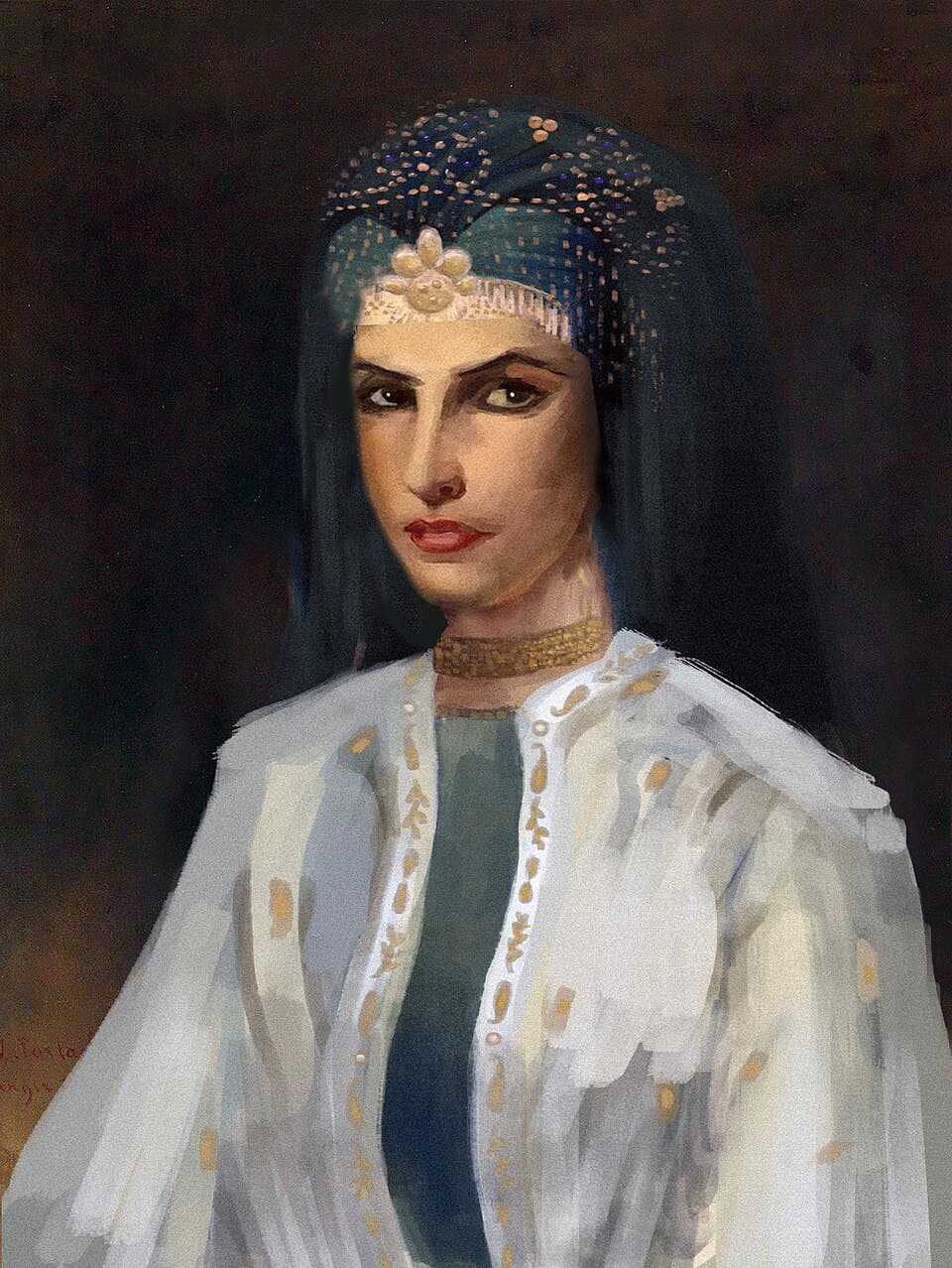
Tetouan, an evening in the late 1530s. In a palace in the medina, water sings in the fountains of the patios and the scent of orange trees rises from the shaded courtyards. The governor receives us between two couriers from Algiers, draped in an embroidered caftan, the seal placed beside her on a silk cushion.
—You are called Sayyida al-Hurra. What exactly is meant by this name?
What you take for a name is not one. Al-Hurra means the free lady, she who governs by her own right and answers to no one above her. My birth name has almost been forgotten — some whisper Lalla Aicha — and that matters little to me: a girl's name counts less than a title earned. When I seal an act in Tetouan, it is not the daughter of a man who affixes her stamp, but the sovereign of this city. I have learned that a title is not given; it is held, day after day, on the ramparts and in the courts. They say I am one of the last to bear it. So be it: I will have borne it upright.
A girl's name counts less than a title earned.
—What is a morning like when you govern a city alone?
After prayer, the doors are opened for me and the complaints come in with the light. A merchant accuses his neighbor, a widow claims her due, a captain demands compensation for a poorly shared prize. I listen, I decide, and while an advisor recites, my eye wanders toward the port to count the sails. Governing Tetouan is not ruling from a throne: it is ensuring the walls hold, that the wheat arrives, that no one sleeps with fear in their belly. My governor's seal never leaves my hand in the morning — every letter that leaves me commits the entire city. People think power is made of pomp; it is made of disputes settled before noon.
People think power is made of pomp; it is made of disputes settled before noon.
—You were born in the shadow of lost Granada. What memory do you keep of it?
I was not yet ten when Granada fell in 1492, and with it the last kingdom of our people in Spain. I did not see its walls, but I grew up among those who had left them weeping, in Chefchaouen, the fortress my father Ali ibn Rashid had raised against the Portuguese. These people of al-Andalus carried their country in their chests: fabrics, recipes, the art of cutting stone and embroidering silk. Exile was not a lament for them; it was a skill they deposited on this land. I drank that in with the water of the fountains. One does not recover from a defeat by dwelling on it, but by rebuilding elsewhere more beautiful than what was lost.
These people of al-Andalus carried their country in their chests.
—Why did you make Tetouan a land of welcome for these refugees?
Because an empty city is nothing but a pile of stones, and Tetouan had long been a ruin before Grenadines raised it again. I opened its doors to those driven from the peninsula: they brought me the hands of artisans, the heads of merchants, the eyes of navigators. Look at my palace — its flowering patios, its walls of zellij, the coolness of its fountains: it is al-Andalus that still breathes here. The caftan I wear, embroidered to the wrists, comes from that elegance. I have been reproached for loving the Andalusians too much; I reply that they made my city rich and learned while Spain contented itself with burning their memory.
An empty city is nothing but a pile of stones.
—How did you come to command privateering in the Mediterranean?
The Spaniards did not stop biting our coasts — Melilla taken in 1497, then Oran, Mers el-Kébir, Bougie. When one after another your ports are taken, you do not turn the other cheek: you take to the sea. I armed galiots, those slim ships that go by sail and oar and fall upon the enemy before he can turn about. The Strait of Gibraltar became my hunting ground: no Christian vessel passed without reckoning with the corsairs of Tetouan. This is called privateering, and beware of confusing it with piracy: the pirate steals for his pocket, the corsair makes war in the name of a power. That power, on this shore, was me.
When one after another your ports are taken, you take to the sea.
—Your name remains linked to that of Barbarossa. What was between you?
A sharing of the sea, simply. Barbarossa ruled over Algiers and held the eastern basin; I commanded the west, facing the coasts of Spain and Portugal. Our couriers sped from port to port, coordinating expeditions like two hands of the same body. He rose high, that man — the Ottomans made him grand admiral, kapudan pasha, in 1533. I had no empire behind me, only my city and my will. But when the Spaniards wanted to ransom their captives, they did not write first to Algiers: they wrote to me. We negotiated ransoms at my table. A powerful ally makes you great, but it is your own weight that earns respect.
He held the east, I commanded the west.
—What did these captives and ransoms represent in your governance?
Much more than booty. Every Christian taken at sea became a letter that Spain had to write to me, a knee it had to bend. The authorities of Seville and Lisbon could not deal over my head: to see their prisoners again, they had to come to me, discuss the price, await my pleasure. That is where my true weight lay — not in the number of my galleys, but in the fact that I could not be ignored. The ransom fed the city, yes, but above all it bought something more precious: recognition. A kingdom that treats you as an equal, even reluctantly, has already ceased to despise you.
Every captive taken at sea was a knee that Spain had to bend.
—In 1541, a sultan wanted to marry you. How was it decided?
The sultan Ahmad al-Wattasi, who reigned from Fez, asked for my hand in marriage. The honor was great, but I set my condition: I would not leave Tetouan to marry in his capital. Let him come. And he came. They say no Moroccan sovereign had ever married outside his city — I was that exception. Understand: it was not caprice. If I had run to Fez as a docile bride, I would have entered as a subject. By making him come under my walls, I kept my rank intact. A woman who rules does not surrender; one surrenders to her. The marriage sealed an alliance, not a submission.
A woman who rules does not surrender; one surrenders to her.
—Your power was eventually taken from you. What happened?
The blow did not come from the Spaniards or the sea — it came from my own house. My son-in-law raised his hand against my authority and stripped me of the governance of Tetouan, this city I had held for nearly thirty years. Such is the bitter irony: I was able to stand up to empires, negotiate with kings, command corsairs, and it was a man of my family who undid me. Power is like that — you guard it from distant enemies and lose it by the nearest hands. I retired to Chefchaouen, where I had grown up among the exiles of Granada. The loop closed upon itself, like a wave returning to the shore from which it came.
I stood up to empires, and it was a man of my house who undid me.
—If people remember you in a century, what would you like them to remember?
I do not know what the chroniclers will write — already in my lifetime, some paint me as a fearsome corsair, others as a refined Andalusian lady, and both are right. If I could imagine being read long after me, I would like them to remember this: a woman governed Tetouan by full right, shared the Mediterranean with Barbarossa, and made kings bend for their captives. Not by miracle, but by sustained will. The refugees I welcomed left their zellij and their embroideries in my walls; let them at least remember that under the title of al-Hurra, there was a sovereign, not a convenient legend. I reigned. That is a verb few women of my time could conjugate.
I reigned: a verb few women of my time could conjugate.
This imaginary interview was generated by artificial intelligence from sources documented in Sayyida al-Hurra's profile. It dramatises what the figure might have said based on what we know about them, but does not constitute attested historical testimony. For primary sources and factual documentation, refer to the full profile.