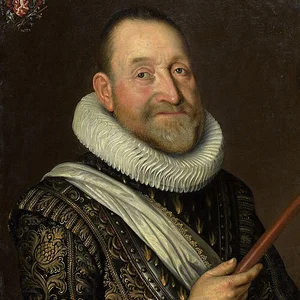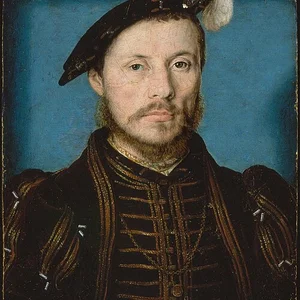

Italian general and statesman in the service of Spain, governor of the Spanish Netherlands. A renowned strategist of his time, he was meant to support the Spanish Armada in 1588 to invade England, a threat referenced by Elizabeth I in her Tilbury speech.
Alessandro Farnese(1520 — 1589)
Alexander Farnese
France
6 min read
Frequently asked questions
Key Facts
- Born in 1545 in Rome, son of Ottavio Farnese and Margaret of Austria, illegitimate daughter of Charles V
- Distinguished himself at the naval Battle of Lepanto in 1571 against the Ottomans
- Appointed governor-general of the Spanish Netherlands in 1578, he won the Battle of Gembloux that same year
- Reconquered the southern provinces and took Antwerp after a long siege (1584-1585)
- Tasked in 1588 with coordinating his troops with the Spanish Armada to invade England; died in 1592
Works & Achievements
The young Farnese distinguished himself there through his bravery alongside Don John of Austria against the Ottoman fleet.
Reconciliation of the Catholic Walloon provinces with Spain, cleverly dividing the revolt of the Netherlands.
A methodical campaign retaking towns and strongholds of Flanders and Brabant on behalf of Philip II.
A masterpiece of siege warfare marked by the famous bridge across the Scheldt that blockaded the city.
The massing of an invasion army in Flanders meant to support the Spanish Armada, ultimately thwarted.
Bold interventions that forced Henry IV to lift the sieges of Paris and then Rouen.
Anecdotes
Known in his time as "the great Farnese," Alessandro was the grandson of Pope Paul III and the nephew of Margaret of Parma, governor of the Netherlands: it was through her that he was introduced to governing the provinces he eventually came to rule himself.
In 1571, at only 26 years old, he fought in the great naval battle of Lepanto against the Ottoman fleet, alongside Don John of Austria, and distinguished himself by his bravery when boarding an enemy ship.
His military masterpiece was the Siege of Antwerp (1584-1585): to cut the city off from the sea, he had a gigantic bridge built across the Scheldt, several hundred meters long, despite the tides and the fire ships launched by the besieged.
In 1588, he was to embark his troops from Flanders to join the Spanish Armada and invade England, but the plan failed: Queen Elizabeth I referred to this threat in her famous speech at Tilbury before her soldiers.
An excellent diplomat as well as a soldier, Farnese managed to divide the rebellious provinces of the Netherlands by bringing the southern regions (present-day Belgium) back into the Spanish Catholic camp through the Union of Arras, while suppressing the Protestant north.
Primary Sources
I know I have the body but of a weak and feeble woman, but I have the heart and stomach of a king, and of a king of England too.
Correspondence in which the governor reports to the King of Spain on the state of military operations and the government of the Netherlands.
Act by which the Catholic Walloon provinces reconciled with the King of Spain, negotiated under Farnese's authority.
Contemporary Jesuit account celebrating Farnese's campaigns, notably the siege of Antwerp and the construction of the bridge over the Scheldt.
Key Places
Birthplace of Alessandro Farnese, where his family, allied with the papacy, wielded great influence.
A great trading city of the Low Countries whose capture after a long siege (1584-1585) marked the military peak of Farnese's career.
Seat of government of the Spanish Netherlands, from which Farnese administered the provinces as governor-general.
Site of the great naval battle of 1571 against the Ottomans, in which the young Farnese took part.
His family's Italian duchy, of which he became the sovereign duke; the heart of Farnese power.
A town in Artois where the Union of Arras (1579) was signed and where Farnese died in 1592 during his French campaigns.
Typical Objects

Ceremonial and battle armor worn by the great captains of the Renaissance, often engraved and gilded. Farnese was depicted wearing such armor in his official portraits.

A long, slender sword carried by 16th-century nobles and officers, both a dueling weapon and a symbol of rank.

A short baton held by generals to signify their authority over the troops. A classic attribute of the commander-in-chief in military portraits.

A large bronze artillery piece used to batter the ramparts of besieged cities, a key element of the sieges led by Farnese, such as the one at Antwerp.

An exceptional military structure linking the two banks of the river to cut off Antwerp's maritime supply lines. A feat of engineering that sealed the city's fate in 1585.

Handwritten maps of the Netherlands and its fortifications, indispensable to the strategist for planning sieges and marches.
School Curriculum
Vocabulary & Tags
Key Vocabulary
Daily Life
Morning
Rising early in the field, the governor would attend Mass, then receive his officers to assess the enemy positions. He read the dispatches that had arrived by courier from Madrid and dictated his replies to his secretaries.
Afternoon
The afternoons were often spent on horseback, inspecting the trenches, batteries, and fortifications of the besieged cities. He held council with his engineers and captains to decide on maneuvers.
Evening
In the evening, he wrote his voluminous correspondence with Philip II, who demanded to be informed of the smallest detail. Meals might bring together the nobles of his general staff around strategic discussions.
Food
Like the great lords of his time, he ate roasted meats, game, white bread, and wines from Italy and Spain. On campaign, the everyday fare grew harsher, shared with the lot of the soldiers.
Clothing
He wore damascened armor and the commander's sash in battle, and rich doublets of dark velvet, a ruff, and hose in the Spanish fashion for ceremonial occasions. The elegant sobriety of Philip II's court shaped his wardrobe.
Housing
He lodged sometimes in the governors' palaces in Brussels, sometimes under canvas or in improvised field quarters during the long sieges. His family residence remained the ducal palace of Parma.
Historical Timeline
Period Vocabulary
Liens externes & ressources
Références
Œuvres
Participation à la bataille de Lépante
1571
Union d'Arras
1579
Reconquête des provinces du sud
1579-1585
Siège et prise d'Anvers
1584-1585
Préparation de l'invasion de l'Angleterre
1588
Campagnes de secours à la Ligue en France
1590-1592