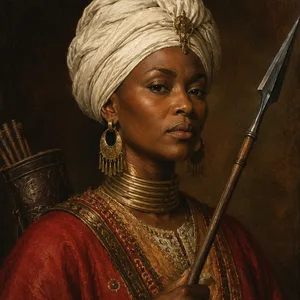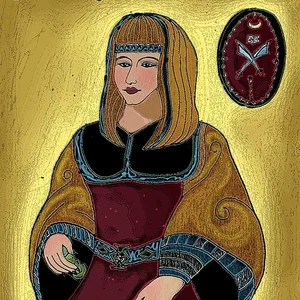

Born into an Andalusian family exiled after the fall of Granada, Sayyida al-Hurra became governor of Tétouan in the early 16th century. An ally of the corsair Barbarossa of Algiers, she led privateering campaigns in the western Mediterranean against the Iberian powers and was one of the few women to rule as a sovereign in the Muslim world of her time.
Sayyida al-Hurra(1485 — 1561)
Sayyida al-Hurra
Maroc
6 min read
Frequently asked questions
Key Facts
- Born around 1485, her Andalusian family fled the Kingdom of Granada after its fall in 1492 and settled in northern Morocco.
- Became governor (hakima) of Tétouan around 1515, a city she rebuilt and ruled as a sovereign.
- Allied herself with the corsair Barbarossa of Algiers to wage privateering warfare against Spanish and Portuguese ships in the western Mediterranean.
- Married the Wattasid sultan of Fez, Ahmad al-Wattasi, in 1541, an exceptional event: the king travelled to Tétouan to marry her.
- Overthrown around 1542 by her own son-in-law, she lost power and vanished from the records.
Works & Achievements
She ruled the city as a sovereign for nearly thirty years, ensuring its security, trade, and prosperity.
She made Tétouan a haven for the Muslims driven out of Spain, enriching the city with their culture and expertise.
This alliance coordinated privateering across the two basins of the Mediterranean and strengthened resistance against the Iberian powers.
She led the corsairs who harried Spanish and Portuguese coasts and ships, making Tétouan a feared maritime power.
The Iberian authorities had to deal directly with her to ransom their prisoners, which gave her real diplomatic weight.
This union sealed her rank: according to tradition, the sultan had to come to Tétouan to marry her rather than to Fez.
Anecdotes
"Sayyida al-Hurra" is not really a first name but a title: it means “the sovereign and free lady,” that is, a woman who rules in her own right. Her birth name remains uncertain (perhaps Lalla Aisha), and she is considered one of the last women in Muslim history to have borne this title of sovereign.
The daughter of Ali ibn Rashid, the founder of Chefchaouen, she grew up among the Andalusian refugees driven out of Spain after the fall of Granada. All her life she would keep the memory of that exile, and she made Tétouan a refuge for these Muslim families who had come from al-Andalus.
To lead the privateering war in the Mediterranean, she allied herself with the famous corsair Barbarossa, master of Algiers: he controlled the eastern basin, while she commanded the raiding in the western basin, off the Spanish and Portuguese coasts.
In 1541, the Sultan of Morocco Ahmad al-Wattasi wished to marry her. According to the chronicles, she refused to travel to Fez, the capital, and demanded that the sultan come himself to Tétouan for the wedding: it would be the only time a Moroccan ruler is said to have married outside his capital.
The Spanish and Portuguese authorities had to negotiate directly with her for the release of their captives, proof of her real power. Her career nonetheless came to an abrupt end around 1542, when she was overthrown by her own son-in-law and stripped of her authority; she then withdrew to Chefchaouen, where she died.
Primary Sources
The author reports that Tétouan, long in ruins, was rebuilt by a captain who had come from Granada, and that its inhabitants, great enemies of the Christians, waged war on them at sea and held many captives.
The Spanish chronicle describes northern Morocco, peopled with refugees from al-Andalus, the power of the Banu Rashid family established at Chefchaouen, and Tétouan as a corsair den on the route through the strait.
The chronicler describes the corsairs of Tétouan who plundered the Iberian coasts and the ransom trade by which captured Christians were bought back.
Key Places
The last Muslim kingdom in Spain, from which her Andalusian family was driven out after the city fell in 1492. Sayyida al-Hurra is thought to have been born in this region around 1485.
A town founded by her father Ali ibn Rashid as a fortress against the Portuguese. Sayyida al-Hurra grew up there and retreated to it after her downfall, until her death.
A town in northern Morocco that she governed for nearly three decades and made prosper as an Andalusian refuge and a base for privateering.
The capital of her ally, the corsair Barbarossa, which had become an Ottoman base. It was from Algiers that privateering in the Mediterranean was coordinated.
A strategic passage between the Mediterranean and the Atlantic, a hunting ground for the corsairs of Tétouan against Spanish and Portuguese ships.
Typical Objects

A sleek, fast ship powered by both sail and oar, used by Barbary corsairs to intercept enemy vessels and carry out boarding attacks. It was the instrument of the privateering campaigns that Sayyida al-Hurra commanded.

A sharp-edged weapon with a curved blade, formidable in close combat and boarding actions. It could also symbolize military command.

A piece of artillery mounted aboard ship to bombard vessels and coastal strongholds. Its use transformed privateering warfare in the 16th century.

A long, richly embroidered ceremonial robe, inherited from the refined culture of al-Andalus. The caftan marked the rank and dignity of a great lady such as the governor of Tetouan.

An engraved stamp used to authenticate official documents and letters. It embodied the sovereign authority that Sayyida al-Hurra exercised over Tetouan.

An instrument inherited from Arab scholars, used to measure the height of the stars in order to find one's way at sea. It was essential to the sailors who crisscrossed the Mediterranean.
School Curriculum
Vocabulary & Tags
Key Vocabulary
Daily Life
Morning
The morning began with prayer and washing, then with the administration of the city: Sayyida al-Hurra received petitions from her subjects, listened to her advisers, and oversaw the activity of the port. Governing Tétouan demanded settling disputes and ensuring the security of the ramparts.
Afternoon
The afternoon was devoted to the affairs of privateering: organizing expeditions, dividing up the spoils, and negotiating the ransoms of Christian captives. She also exchanged letters with her ally Barbarossa in Algiers.
Evening
In the evening, court life resumed: family meals, receptions for notables and Andalusian merchants, and discussions of the latest news from Spain and the Mediterranean.
Food
The cuisine blended Andalusian and Moroccan traditions: bread, couscous, lamb and poultry stews fragrant with spices, olives, citrus fruits, almonds, and figs. Honey pastries were added, all accompanied by scented water and fruit syrups.
Clothing
She wore long, richly embroidered kaftans inherited from the elegance of al-Andalus, silk fabrics, a veil, and gold and silver jewelry that marked her rank as a great lady.
Housing
She lived in a palace in the medina of Tétouan, arranged around flower-filled courtyards and fountains, in the refined style of Andalusian architecture, with walls of zellige tilework and shaded coolness.
Historical Timeline
Period Vocabulary
Liens externes & ressources
Références
Œuvres
Gouvernement de Tétouan
vers 1515-1542
Accueil des réfugiés andalous
début du XVIe siècle
Alliance avec Barberousse d'Alger
années 1510-1530
Commandement de la course en Méditerranée occidentale
vers 1515-1542
Maîtrise du commerce des captifs et des rançons
années 1520-1540
Mariage politique avec le sultan Ahmad al-Wattasi
1541