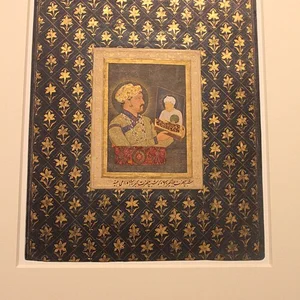

The third emperor of the Mughal dynasty, Akbar ruled over northern India from 1556 to 1605. A brilliant military strategist and administrator, he left his mark on history through his policy of religious tolerance toward Hindus and Muslims alike.
Akbar the Great
Abu'l-Fath Jalal-ud-din Muhammad Akbar
6 min read
Frequently asked questions
Key Facts
- Ascends the Mughal throne in 1556 at the age of 13
- Wins the Second Battle of Panipat in 1556, consolidating Mughal power
- Abolishes the jizya, the tax levied on non-Muslims, in 1564
- Founds the Din-i Ilahi around 1582, a syncretic doctrine blending several religions
- Begins construction of the capital at Fatehpur Sikri from 1571
- Reigns until his death in 1605, extending the empire over most of the Indian subcontinent
Works & Achievements
Imperial capital blending Islamic, Hindu and Jain styles, regarded as a high point of Mughal architecture.
Organization of the nobility into military and civil ranks, which structured the Mughal state for more than a century.
A system for assessing land and taxes that ensured stable revenues and a fairer fiscal system.
Repeal of the tax on non-Muslims, a founding gesture of his policy of religious tolerance.
House of Worship bringing together thinkers of all religions to debate matters of faith freely.
A syncretic spiritual path combining elements of several religions, centered on the figure of the emperor.
A studio bringing together Hindu and Persian artists, the birthplace of the Mughal miniature school and the illustrated Akbarnama.
Official chronicle of his reign written by Abu'l Fazl, a major source on the Mughal Empire.
Anecdotes
Having ascended the throne at just 13 years old in 1556, the young Akbar was at first guided by his regent Bairam Khan. A few years later, he took the reins of power himself and proved to be an exceptional ruler, transforming a fragile kingdom into one of the greatest empires of his time.
Although he was one of the most powerful men in the world, Akbar probably could neither read nor write. To make up for this, he had books read aloud to him every day and built up an immense library of more than 24,000 manuscripts, which he knew in detail.
Curious about all religions, Akbar had a “House of Worship” (Ibadat Khana) built at Fatehpur Sikri, where he invited Muslims, Hindus, Jains, Zoroastrians and even Jesuit missionaries from Goa to debate God and faith together.
Akbar abolished the jizya, the tax that non-Muslims had to pay, and married Hindu princesses without forcing them to convert. This tolerance, rare in his day, earned him the respect of a large part of his Hindu subjects, who were the overwhelming majority in the empire.
A great lover of animals, Akbar owned thousands of war elephants and, it is said, enjoyed taming the most rebellious ones himself — an extremely dangerous exercise he practiced to test his courage.
Primary Sources
His Majesty, by his generous nature and his vast wisdom, regarded all men as worthy of kindness, without distinction of religion or sect.
The emperor divided the empire into provinces (subahs) and fixed the revenues of each district so that fiscal justice might prevail over peasant and noble alike.
The king listens with equal attention to the doctors of every creed, desiring to understand the truth of each.
The emperor summoned scholars from every religion and pressed them with questions about the foundations of their faith.
Key Places
Birthplace of Akbar in 1542, during the exile of his father Humayun after he was driven from the throne.
Imperial capital and center of Mughal power, where Akbar died in 1605. His tomb is located at Sikandra, near the city.
Capital city built by Akbar starting in 1571, an architectural masterpiece where he established the Ibadat Khana. It was abandoned after a few years.
Plain north of Delhi where Akbar won the Second Battle of Panipat in 1556, sealing the restoration of the Mughal Empire.
Rajput fortress of Mewar captured by Akbar in 1568 after a fierce siege, a major step in his expansion.
Major city in the Punjab where Akbar moved his court around 1585 to better defend the empire's northwestern frontier.
Typical Objects

A curved sword with a broad blade, the emblematic weapon of Mughal and Rajput cavalrymen. **Akbar**, renowned for his physical vigour, wielded it with skill.

A mount of battle and prestige, covered in armour and precious cloth. **Akbar** maintained vast stables of elephants for both war and ceremony.

A book richly illustrated with miniatures, produced in the imperial workshop (*kitabkhana*). The *Akbarnama* itself was copied and painted with extraordinary refinement.

A gold coin of the Mughal Empire, struck in the emperor's name. It served for trade and asserted **Akbar**'s sovereignty over his territories.

A silk headdress adorned with a jewelled aigrette (*sarpech*) set with precious stones. A distinctive mark of imperial rank at the Mughal court.

A powerful bow made of horn, wood and sinew, the favoured weapon of Mughal cavalrymen. **Akbar** excelled at archery on horseback.
School Curriculum
Vocabulary & Tags
Key Vocabulary
Daily Life
Morning
Akbar would rise before dawn and appear at his balcony (jharokha) so the people could see him, a custom known as darshan. He then attended to affairs of state, received reports and petitions, and sometimes inspected his stables of elephants and horses.
Afternoon
The afternoon was devoted to public audiences in the Diwan-i-Am, where the emperor dispensed justice and heard requests. He also enjoyed hunting, polo, and military exercises to keep himself fit.
Evening
In the evening, in the Diwan-i-Khas, Akbar gathered scholars, poets, and clerics for philosophical and theological discussions. Books were read aloud to him, for he could not read himself.
Food
The imperial table offered refined dishes blending Persian and Indian cuisines: fragrant rice, spiced meats, fruits from Kashmir, and iced sorbets. Akbar nonetheless ate in moderation and reduced his consumption of meat, influenced by Jain and Hindu ideas.
Clothing
He wore long tunics (jama) of silk and fine muslin, bound with a sash, and a turban adorned with an aigrette of precious stones. He encouraged the blending of Hindu and Muslim styles in court fashion.
Housing
Akbar resided in vast palaces of red sandstone, notably at Agra, Lahore, and Fatehpur Sikri, adorned with courtyards, gardens, and audience halls. These complexes harmoniously combined Islamic architecture with Indian traditions.
Historical Timeline
Period Vocabulary
Liens externes & ressources
Références
Œuvres
Fondation de Fatehpur Sikri
à partir de 1571
Système administratif des mansabdars
vers 1571-1580
Réforme fiscale (zabt) avec Todar Mal
années 1580
Abolition de la jizya
1564
Création de l'Ibadat Khana
1575
Din-i Ilahi
1582
Atelier impérial de peinture (kitabkhana)
années 1560-1600