Imaginary interview with Shōshi
by Charactorium · Shōshi (988 — 1074) · Politics · Literature · Culture · 5 min read
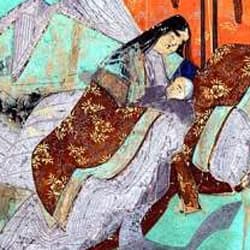
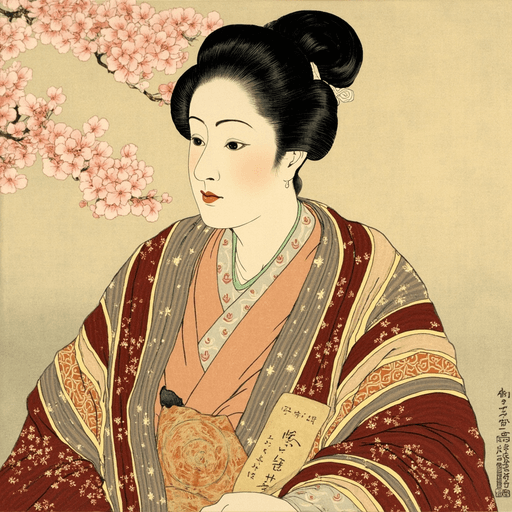
Kyoto, night falls on the Dairi and the oil lamps flicker behind the silk curtains. Beneath a painted screen where a cherry branch runs, an old woman in monastic robes receives us — Jōtōmon'in, once Empress Shōshi, daughter of the most powerful of the Fujiwara. Her voice is low, her words weighed like grains of incense.
—Do you remember the day you entered the imperial palace?
I was eleven years old. They dressed me in the jūnihitoe, those twelve layers of silk whose hems at the wrists had to form gradations worthy of the season — and the weight was such that a child could barely walk. My father, the regent Fujiwara no Michinaga, sent me to the emperor Ichijō as one places a stone on a go board. I knew nothing of the world, except that one must obey and stand straight behind the kichō. The court already had another lady, the empress Teishi, beloved of the sovereign. Only later did I understand how this rivalry of two houses would give birth to beauty: for to prevail, one had to shine, and to shine, one needed learned women.
My father sent me to the emperor as one places a stone on a go board.
—How did this rivalry with Teishi’s court shape your own?
Between empresses, one does not fight with armies: one fights with waka, with the grace of calligraphy, with the arrangement of colors on a sleeve. Teishi’s court radiated, spiritual and brilliant; so I had to gather around me even sharper minds. That is how my father and I sought out the best nyokan of the time. When Teishi died in childbirth, in my twelfth year, I was raised to the rank of chūgū, principal empress. But I never forgot that my splendor owed something to her who was no more — for without a rival to match, my ladies would never have written with that fire.
Between empresses, one does not fight with armies: one fights with waka.
—Tell us about Murasaki Shikibu, who wrote in your chambers.
I had her come among my ladies-in-waiting, around my seventeenth year. She was a widow, silent, with a learning that even men envied — and which she took care to hide, for a woman too learned in Chinese characters was considered insolent. In my chambers in the Dairi, by lamplight, she blackened sheet after sheet with the tale of Prince Genji. I asked her to continue, again, always; my court had to be nourished by a work that no other court would possess. She also kept her diary, where she described my cherry-colored robes and my hair spread on either side of my face. It is strange to know oneself thus observed by one’s own servant.
I asked her to continue, again, always: my court had to be nourished by a work that no other court would possess.
—At the time, did you measure the scope of the Genji Monogatari?
How could I have? A monogatari, for us, was a ladies’ entertainment, a story read in low voices between services. No one imagined it would cross the centuries. But I sensed there was something else: Murasaki did not merely tell palace loves; she expressed mono no aware, that gentle sadness before things that pass — the falling flower, the aging lover. I loved to have it read to me on moonlit nights, from the open galleries. They say the last chapters take place in Uji, where my family owned a villa by the water. If I am to be read still in a century, it will be through her hand, not mine.
No one imagined it would cross the centuries: a monogatari was a ladies’ entertainment.
—What were the afternoons like in your salon?
They belonged to poetry. A stanza was set, and each lady had to respond in a few breaths with a waka of thirty-one syllables — five, seven, five, seven, seven. It was a game, but a game where one’s entire soul was judged: one’s culture, one’s wit, one’s mastery of the old poems of the Man’yōshū. I always had within reach my inkstone, the suzuri, and my brush, for a poorly calligraphed answer was as good as a foolish one. Sometimes the thirteen-stringed koto accompanied our evenings, played behind a silk screen. To write quickly and well, in Heian, was not an ornament: it was proof that one deserved to be loved.
To write quickly and well was not an ornament: it was proof that one deserved to be loved.
![三国志. 1-65 / 陳寿 [撰] ; 裴松之 注
sangokushi](https://s3.charactorium.com/moiki-packages/gallery/ad8be9a570dc09c8.jpg)
—It is said that the art of dressing was as codified as that of writing. Why so much importance given to colors?
Because a sleeve speaks before the mouth. Kasane no irome, the art of layering silks, obeyed laws as strict as the rites: such a shade of red for early spring, such a gradation of green when young shoots rise. To mismatch one’s colors was to betray ignorance of the season, hence of the order of the world — a grave fault, whispered about with laughter. The jūnihitoe sometimes weighed more than a child, but we wore it like a second skin. Refinement, that miyabi expected of a lady, was read in that infinitesimal detail: the edge of a lining glimpsed at the wrist. I was considered, they say, a model in these matters.
A sleeve speaks before the mouth.
—In 1008 your first son was born. What did this birth represent for your father?
A triumph. For years, my father had waited for a grandson bearing Fujiwara blood to one day ascend the throne. When I gave birth to Prince Atsuhira, the future Emperor Go-Ichijō, the joy at the palace was, they say, indescribable; prayers were recited in all the great temples of the capital. It was then that my father composed those famous verses, where he compared this world, which he held entirely, to the full moon lacking nothing. The following year I gave a second son, Go-Suzaku. Two emperors issued from my body: that is what made my house the absolute mistress of the empire. I was the gate through which their power passed.
Two emperors issued from my body: I was the gate through which their power passed.
![三国志. 1-65 / 陳寿 [撰] ; 裴松之 註
sangokushi](https://s3.charactorium.com/moiki-packages/gallery/79d943b6b8a77352.jpg)
—After the death of Emperor Ichijō, what was your role in court affairs?
My husband abdicated, ill, then passed away when I was twenty-three, and I became dowager empress. Formal power belonged to the men — to my father, then to my brothers, regents in the name of my still-child sons. But a mother of an emperor is not nothing. I was consulted, my support sought in court quarrels; my authority was moral rather than proclaimed, and often I calmed what men’s ambition inflamed. I saw my father become sesshō, regent in the name of my son Go-Ichijō, at the zenith of our house. I was the fixed point around which those ambitions turned — present in everything, named in nothing.
My authority was moral rather than proclaimed: present in everything, named in nothing.
—You took Buddhist orders. What led you to that life?
Weariness of the world, and the number of my bereavements. After my father’s death, in my fortieth year, nothing more held me to the vanities of the court; I took orders and received the title of Jōtōmon'in. Every great lady of Heian knows that after having tasted this world, one must turn toward the beyond — that is the path wisdom traces. I now clasped the juzu, the crystal rosary, between my fingers, and I financed ceremonies, supported temples. My father had built the Hōjōji, called the peerless dwelling, with indescribable splendor. To thus withdraw was not to flee: it was to fulfill the ultimate duty of a noble life.
After having tasted this world, one must turn toward the beyond: that is the path wisdom traces.
—You lived to be eighty-six. What weight does such a long life carry?
That of outliving all that one loves. I buried my husband, then my all-powerful father, then my two sons who became emperors — the natural order was reversed, and a mother wept for her sovereign children. I saw the brilliance of my house rise to my father’s full moon, then I saw its decline dawn: an emperor, Go-Sanjō, sat on the throne without a Fujiwara mother, a thing thought impossible. I remained, an old woman in a gray robe, witness to what was fading. Splendor, like the cherry blossom, lasts only the time to behold it. Perhaps I was kept so long to learn that to the very end.
Splendor, like the cherry blossom, lasts only the time to behold it.

This imaginary interview was generated by artificial intelligence from sources documented in Shōshi's profile. It dramatises what the figure might have said based on what we know about them, but does not constitute attested historical testimony. For primary sources and factual documentation, refer to the full profile.