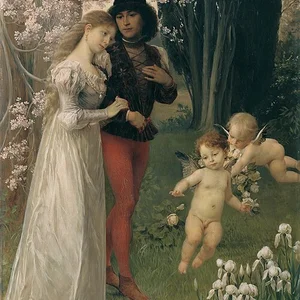

A thirteenth-century Italian nobleman and lord of Rimini, Paolo Malatesta is best known for his tragic passion with Francesca da Rimini, his sister-in-law. Immortalized by Dante in the Inferno of the Divine Comedy, he has become one of the great symbols of courtly and fatal love in medieval literature.
Paolo Malatesta(1246 — 1285)
Paolo Malatesta
8 min read
Frequently asked questions
Key Facts
- Born around 1246, member of the powerful Malatesta family of Rimini
- Nicknamed 'Paolo il Bello' (Paolo the Handsome) for his charm
- Killed in 1285 by his own brother Giovanni Malatesta, known as Gianciotto, who discovered him with Francesca da Rimini
- Placed by Dante in the second circle of Hell (the lustful) in the Divine Comedy, Canto V, alongside Francesca
- His story inspired Rodin's “The Kiss” (1882) and numerous Romantic works
Works & Achievements
Paolo Malatesta was appointed podestà — chief magistrate — of Florence in 1282, one of the most influential cities in Italy. This office reflects his political standing and the reputation his family had built across the peninsula, far beyond their home stronghold of Rimini.
Before Florence, Paolo served as podestà in other communes along the Adriatic coast, demonstrating the Malatesta family's ability to place their members in positions of authority in neighboring cities.
As a prominent member of the ruling house, Paolo took part in the governance and defense of Malatesta territory in the Marches, contributing to the rise of a family power that would reach its cultural peak in the 14th and 15th centuries under the arts-patronizing court of Sigismondo Malatesta.
Anecdotes
Paolo Malatesta was nicknamed 'il Bello' — the Beautiful — owing to his remarkable beauty, which earned him a reputation throughout the Adriatic region. This nickname contrasts painfully with that of his brother Giovanni, known as 'Gianciotto' — John the Lame — which reinforced in the popular imagination the idea of a cruel inequality between the two men that fate had bound to the same woman.
According to the tradition reported by Dante, the passion between Paolo and Francesca was awakened on the day they were reading together the romance of Lancelot of the Lake. Upon discovering how the knight and Queen Guinevere kissed for the first time, they were seized by the same impulse. Dante immortalized this moment with a celebrated phrase: “A Gallehault was the book, and he who wrote it” — naming the story itself as the go-between of their fatal love.
In 1282, Paolo Malatesta was appointed podestà of Florence — that is, the supreme magistrate charged with governing the city — demonstrating a very real political stature beyond his romantic legend. This role required legal expertise and the ability to arbitrate conflicts between factions, a charge entrusted to him by the Florentines in the midst of the wars between Guelphs and Ghibellines.
Giovanni Malatesta, upon discovering his wife's adultery with his own brother, killed them both with a sword thrust, probably at the castle of Gradara around 1285. This act, legally tolerated under medieval codes of honor, plunged the Malatesta family into a tragedy that would span centuries thanks to Dante's pen.
In the fifth canto of the Inferno in the Divine Comedy, Dante encounters Paolo and Francesca swept eternally by a whirlwind among the souls of the lustful. So moved by Francesca's account that he faints from pity — “I fell as a dead body falls” — the poet underscores through this gesture how, despite the theological condemnation, he felt genuine compassion for the two lovers.
Primary Sources
Amor, ch'al cor gentil ratto s'apprende, prese costui de la bella persona che mi fu tolta; e 'l modo ancor m'offende. [...] Galeotto fu 'l libro e chi lo scrisse: quel giorno più non vi leggemmo avante.
E in questo anno fue fatto podestà di Firenze messer Paolo Malatesta da Rimini, uomo di grande affare e di bella persona.
Gianciottus, frater Pauli, irruit super eos ambo et occidit eos gladio in adulterio deprehensis, ut fertur communiter in Romandiola.
Paolo, detto il Bello, figliuolo di Malatesta da Verucchio, fu podestà di Firenze nell'anno MCCLXXXII, e poi fu ucciso dal suo fratello Giovanni per cagione di Francesca sua moglie.
Key Places
A city in the Adriatic Marches and historic stronghold of the Malatesta family. Paolo was born and raised here, at the heart of the political struggles between Guelphs and Ghibellines that shook the Italian communes of the 13th century.
A medieval fortress perched on a hill in the Marches, traditionally identified as the place where Giovanni Malatesta discovered Paolo and Francesca together and killed them. The castle is today a monument commemorating the memory of the two lovers.
The great Tuscan commune where Paolo Malatesta served as podestà in 1282. This political mission attested to his family's prestige and placed him within the networks of power of central and northern Italy.
A city in Emilia-Romagna, residence of Guido da Polenta, Francesca's father. It was from Ravenna that Francesca was taken away to be married to Gianciotto Malatesta, in a political alliance sealing the union of the two families.
Typical Objects

The main weapon of the Italian medieval nobility, worn at the belt as a mark of status and used in conflicts between lordships. It was with such a sword that Giovanni Malatesta allegedly killed Paolo and Francesca after catching them in the act.

A 13th-century Arthurian prose romance written in French, hand-copied onto parchment and illustrated with miniatures painted in gold and vivid pigments. According to Dante, it was while reading this text together that Paolo and Francesca fell in love.

An engraved metal matrix bearing the family arms, used to authenticate the official acts of the podestà and the documents of the lordship. Paolo's seal attested to his legal authority over the communes he administered.

A flexible armour woven from interlinked iron rings, worn beneath the heraldic surcoat in battle and at tournaments. It was the standard protection of the 13th-century medieval knight and signalled membership of the warrior nobility.

A legal document drawn up in Latin by a notary, recording the decisions of the podestà or agreements between noble families. The administration of Italian communes rested on an intense output of written records, of which these parchments were the everyday medium.

A stringed instrument found in the noble courts of 13th-century Italy, used to accompany love songs and epic tales. Music held a central place in the aristocratic culture of the lordships, where troubadours and jongleurs enlivened evening gatherings.
School Curriculum
Vocabulary & Tags
Key Vocabulary
Daily Life
Morning
Paolo began his day with religious offices in the chapel of the family palace or fortress. He then received reports from his officers and devoted the morning to administrative affairs: reading petitions written on parchment, holding audiences with the notables of the lordship, and settling local disputes.
Afternoon
The afternoon was often given over to chivalric pursuits: weapons training in the castle courtyard, horsemanship, and sometimes regional tournaments. In times of peace, Italian nobles might also hunt on the seigniorial lands or inspect the agricultural estates on which the family's income depended.
Evening
Evenings were spent in the great hall of the palace, sharing a meal with family members and the knights of the household. After dinner, troubadours and jugglers entertained the court; romances of chivalry were also read aloud — among them the Lancelot du Lac which, according to Dante, sealed the fate of Paolo and Francesca.
Food
The diet of a 13th-century nobleman in central-northern Italy favored roasted meats (pork, poultry, game), white wheat bread, and imported spices (pepper, cinnamon, ginger) that marked social standing. Local wine accompanied every meal, and fish from the nearby Adriatic featured regularly on the fast days required by the Church.
Clothing
Paolo wore the distinctive dress of the Italian high nobility: a fine wool or silk tunic in the Malatesta colors, an embroidered surcoat, hose, and a fibula-clasped mantle. For military occasions he donned a coat of mail and heraldic surcoat; for ceremonies, furs of vair or ermine announced his rank as a lord.
Housing
Paolo resided chiefly in the Malatesta family's fortresses and palaces in Rimini and in the surrounding castles, including Gradara. These dwellings combined defensive strength — towers, ramparts, drawbridge — with relative comfort in the private apartments: monumental fireplaces, wall tapestries for insulation against the cold, and carved wooden furniture.
Historical Timeline
Period Vocabulary
Liens externes & ressources
Références
Œuvres
Podestariat de Florence
1282
Podestariat de Pesaro
vers 1280
Administration des domaines Malatesta
1270-1285