Imaginary interview with Siramori Diabaté
by Charactorium · Siramori Diabaté (1925 — 1989) · Music · Culture · 7 min read
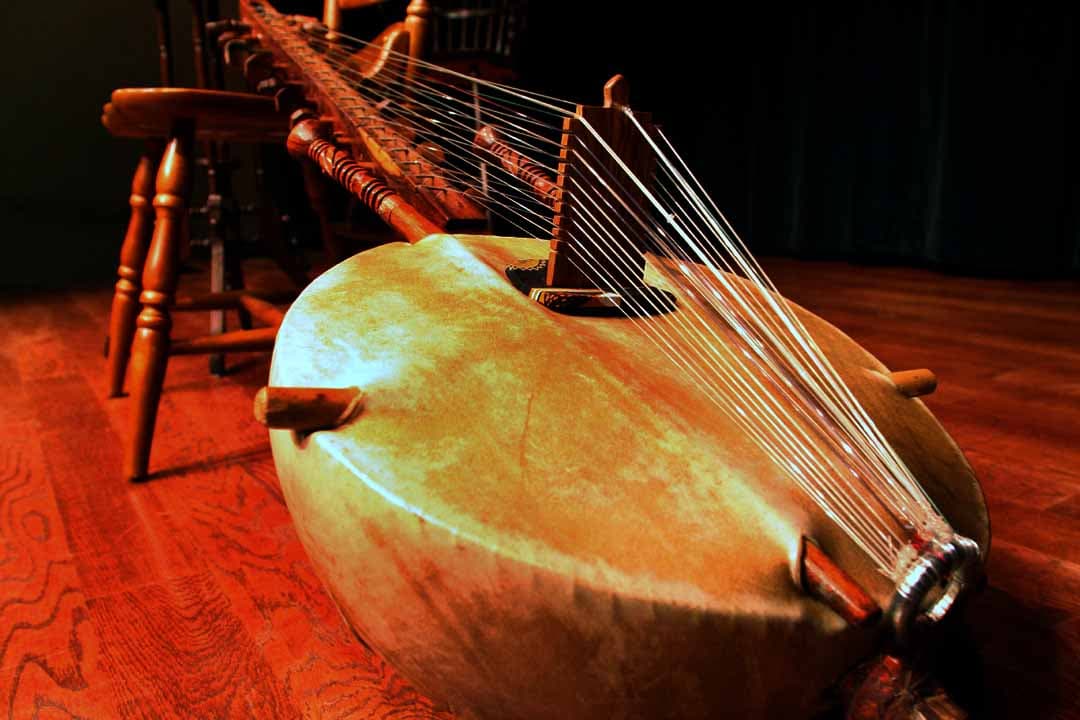
Kéla, a dry-season evening in the late 1980s. In the mud-brick courtyard, under a mango tree, an old woman in a lustrous bazin boubou motions for you to sit. Around her, koras rest against the wall; her voice, however, never fully rests. Siramori Diabaté agrees to speak about a lifetime spent carrying the memory of the Manden.
—How did you become a griotte, in this village of Kéla?
You don't become one, you are born into it, as you are born a girl or a boy. My mother sang, my grandmother sang before her, and from childhood I knew that the word of the Diabaté was entrusted to me as a deposit. Before dawn even broke over Kéla, I would wake up and recite passages of the epic under my breath, softly, so as not to wake anyone — just to keep my memory awake, like tending a fire under the embers. It is a discipline, you see. Our art is called jeliya: it is not just singing, it is knowing the genealogies, the names, the exact order of things. A jelimuso, a griotte, is not an entertainer. She is the living memory of a people, and that burden, you no more choose than you choose your blood.
You don't become a griotte, you are born into it, as you are born a girl or a boy.
—What happened in your courtyard on ceremony nights?
In the evening, everything changed. The mud-brick courtyard became a stage without planks or curtain. The men tuned the kora, its twenty-one strings, and the balafon laid down its first notes as one sets foot in water, cautiously. Then I entered the song. A wedding, a funeral, a celebration — and we would not stop. I sang entire nights, until the first rooster answered my voice. I moved from song to narrative, from narrative to commentary, without ever breaking the thread. The elders would come and sit in silence, and I felt my voice carry over the banco walls, all the way to the farthest huts. It was not fatigue I felt, but a kind of gentle fever. As long as people listened, something in me refused to fall silent.
I sang entire nights, until the first rooster answered my voice.
—It is said you were among the few griottes allowed to sing at the Kamabolon. What did that place represent?
The Kamabolon is the sacred hut of Kangaba, very close to us. Every seven years, it is rethatched, and the griots of Kéla come to recite the epic there. But not everything is said aloud, understand. There are passages that the crowd may hear, and others that belong inside the hut, to authorized ears only. I had that right — that burden, rather, for it is a heavy one. Inside there, singing is not entertainment: it is remaking the world aright, putting everything back in its place, as in the earliest times of Soundiata. One does not enter there with a light voice. One enters as before the ancestors, because they listen too.
Singing inside the hut is not entertainment: it is remaking the world aright.
—Do you remember those septennial ceremonies, spread across your entire life?
How could I forget them? They marked my life better than any calendar. 1952, 1959, 1966, 1973, 1980 — each time, seven more years in my voice, seven more years in my bones. As a child, I watched the elders recite at the Kamabolon; then one day it was my turn, and another day I saw the youngest look at me as I had looked at my masters. That is how the chain holds: no one is irreplaceable, but no one must miss their rank. The ceremony does not celebrate a man; it celebrates continuity. As long as the hut is rethatched and someone knows the right words, the Manden does not die. That is why I never missed my seventh summer.
—Why were you so adamant about not changing a single word of the epic?
Because a displaced word is a betrayed ancestor. People think a story can be told however you like, with your own pretty turns of phrase. No. In jeliya, every name has its weight, every sentence its place, and if I remove one stone, the whole wall may crumble. I taught that to my children and my nephews in the afternoon, when the heat forced us to stay in the shade: I made them repeat the royal genealogies until they no longer stumbled. I told them we are not the authors of what we sing — we are its guardians. A guardian adds nothing, subtracts nothing. They pass on intact what was entrusted to them, so that the one who comes after receives the same thing, not a worn copy.
A displaced word is a betrayed ancestor.
—How does one transmit such knowledge to the next generation?
Through repetition and blood, never through books. A griot child listens before speaking, and speaks before singing. They begin with names — the Keïtas, the Konatés — then the ties between families, then the order of events, and only afterward comes the melody. No steps are skipped. I chose my moments: the afternoon for patient learning, the evening for listening to real songs. What is transmitted this way is not in a single head; it is in an entire lineage. The jeli, in our language, designates the one who carries the hereditary word; the jelimuso is the woman who carries it. When I am gone, if I have done my work well, nothing will be lost: they will know, because I made them say and repeat, until the words became their own.
A griot child listens before speaking, and speaks before singing.
—Researchers from Europe and America came to record you. How did that feel?
They arrived with their devices and reels, those people from the CNRS, the Musée de l'Homme, and that man, Charles Bird, with his collaborators from their distant university. Between 1967 and 1974, they returned often. I admit at first it surprised me: our word had never been laid down on anything but breath and memory. Now it was entering a machine. I eventually understood that it was not a betrayal, but another form of deposit. My voice of today, which old age will tire, would remain as is in their archives, in Paris and far away. So I sang for them as I sang for my own, without changing anything. Let the box keep what it wants; the essential, the chain of the living, continued in Kéla.
Our word had never been laid down on anything but breath and memory.
—Can a strictly oral tradition truly survive in sound archives?
An archive keeps the voice, it does not keep the griotte. That is all the difference. On their recordings, you hear the origins of Soundiata, son of Sogolon Kondé and King Naré Maghann Konaté, his difficult childhood, his exile, his reconquest of the Manden — it is all there, word for word. But the child who listens to a reel does not learn jeliya; they only learn a sound. They lack the elders' gaze, the sweat of nights of rehearsal, the responsibility of carrying it before one's own community. The machine preserves; only the human being transmits. I am grateful that my voice is saved, believe me. But if one day only the reels remain and no one in Kéla to pick up the thread, then it will be but a beautiful tomb. A singing tomb, but a tomb.
An archive keeps the voice, it does not keep the griotte.
—What did Mali's independence in 1960 mean to you?
A new morning, and yet a very old morning. In 1960, when the country became free and Modibo Keïta took office, I was suddenly treated as a national treasure. It made me smile: I was the same the day before and the day after, only the looks had changed. But I understood what they were seeking. A people newly born to itself needs to know where it comes from. And I carried precisely that: the thread linking the Empire of Mali of Soundiata, in the thirteenth century, to the brand-new Mali of today. The president bore the very name of the kings I sang — Keïta. How could one not see a continuity? They celebrated in me not a woman, but a proof: that the greatness of the Manden was not a tale, but a root still alive.
I was the same the day before and the day after, only the looks had changed.
—Radio carried your voice to Malians who would never see you. What did you think of that?
Radio Mali did something strange: it broke down the walls of the courtyard. For years, my songs were broadcast over the airwaves, and people from Bamako, from villages I would never know, heard my voice without seeing me. Once, my word went no further than the last banco wall of Kéla. Now it crossed the entire country. It was dizzying, and a little unsettling too: on the radio, you cannot hear if the elders nod, you do not know if the words land right. But I told myself that after independence, the youth of the cities, who were forgetting jeliya, needed to hear where they came from. If my voice could remind a child in Bamako that they are a child of the Manden, then the machine had served some good purpose.
Radio did something strange: it broke down the walls of the courtyard.
—If you imagined being listened to a century from now, what would you want people to remember?
That is a question beyond what an old woman can claim to know. But since you invite me, I dream this: that whoever listens to me in a hundred years not merely admire my voice as one admires a beautiful object in a display case. Rather, let them understand that behind each song there was a chain — my mother, my grandmother, and before them jelimusow whose names I have even forgotten. I am but a link, neither the first nor, I hope, the last. Let them keep, then, more than my words, the fidelity that carried them: betray nothing, invent nothing, pass on intact. If in a century a child of Kéla still knows the story of Soundiata because another told it to them mouth to ear, then I will have truly lived.
I am but a link, neither the first nor, I hope, the last.
This imaginary interview was generated by artificial intelligence from sources documented in Siramori Diabaté's profile. It dramatises what the figure might have said based on what we know about them, but does not constitute attested historical testimony. For primary sources and factual documentation, refer to the full profile.