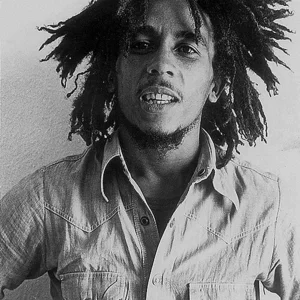

Bob Marley was a Jamaican singer, guitarist, and songwriter, and a major figure of reggae. As a spokesman for the Rastafari movement, he brought Jamaican music to audiences around the world and embodied a message of peace and resistance.
Bob Marley(1945 — 1981)
Bob Marley
Jamaïque
6 min read
Frequently asked questions
Famous Quotes
« One love, one heart»
« Get up, stand up, stand up for your rights»
« Emancipate yourselves from mental slavery»
Key Facts
- Born on February 6, 1945, in Nine Mile (Jamaica)
- Founded the band The Wailers in 1963 with Peter Tosh and Bunny Wailer
- Album Exodus in 1977, named album of the century by Time Magazine
- One Love Peace Concert in 1978 in Kingston to reconcile Jamaica's rival political factions
- Died on May 11, 1981, in Miami of cancer
Works & Achievements
The band's first international album, it introduced reggae to audiences worldwide.
A tender evocation of life in the Trench Town neighbourhood, it became one of his best-loved songs.
A rebellious anthem calling on people to stand up for their rights, written with Peter Tosh.
A landmark album recorded after the assassination attempt, named Album of the 20th Century by Time magazine.
A universal call for unity and peace that became a global symbol.
A stripped-down acoustic-guitar song, a meditation on freedom and the emancipation of the mind.
A show of support for Africa's anti-colonial struggle, performed at Zimbabwe's independence celebrations.
A collection of his greatest hits, among the best-selling albums of all time.
Anecdotes
Bob Marley was born in 1945 in Nine Mile, a small village in the Jamaican mountains. His father was a white Briton, an army officer, and his mother a young Black Jamaican woman. This mixed heritage often led to him being rejected during his childhood, which fueled his attachment to the themes of unity and tolerance.
In December 1976, two days before a major peace concert in Jamaica, armed men burst into Bob Marley's home and shot him in the arm and chest, along with his wife Rita. Despite his injuries, he took to the stage two days later, saying that “the people who are trying to make this world worse aren't taking a day off, so why should I?”.
In April 1980, Bob Marley was invited to perform at the independence ceremonies of Zimbabwe, an immense honor for a musician. His song “Zimbabwe”, written in support of the African anti-colonial struggle, made it a true anthem for the new country.
Bob Marley was passionate about football and played it almost every day, even while on tour. It was a foot injury, which he refused to treat for reasons tied to his Rastafari beliefs, that revealed the cancer that would take his life in 1981, at only 36 years old.
A member of the Rastafari movement, Bob Marley wore long dreadlocks and regarded the Ethiopian emperor Haile Selassie as a sacred figure. His beliefs shaped his entire life: diet, music, and his commitment to the freedom of Black peoples.
Primary Sources
One love, one heart, let's get together and feel all right.
Emancipate yourselves from mental slavery, none but ourselves can free our minds.
Get up, stand up, stand up for your rights. Don't give up the fight.
Could we have, up here onstage here, the presence of Mr. Michael Manley and Mr. Edward Seaga? — a call for the reconciliation of Jamaica's two rival political leaders.
Key Places
Bob Marley's birthplace village in the mountains of Saint Ann Parish; he is buried there today in a mausoleum.
Working-class neighborhood of the Jamaican capital where Marley grew up and formed the Wailers; birthplace of the reggae he sang about in “No Woman, No Cry.”
Marley's home and studio, site of the 1976 assassination attempt, now turned into the Bob Marley Museum.
Capital where Marley performed during the country's independence ceremonies in April 1980, a symbol of his Pan-African commitment.
City where Bob Marley died on May 11, 1981 from cancer, after a final course of treatment in Germany.
Typical Objects

Bob Marley composed and accompanied his songs on the guitar, an instrument central to reggae alongside the bass and the drums.

Marley's long coiled locks were a symbol of his belonging to the Rastafari movement and a rejection of Western conventions.

A knitted cap in green, yellow and red used to hold and protect the dreadlocks, which became an emblem of the movement.

Marley was passionate about football, which he played every day, even while on tour; the sport held a major place in his life.

The colours green, yellow and red, taken from the Ethiopian flag, symbolise for Rastafaris Africa, freedom and the blood shed by black people.

An essential tool of his concerts, the microphone carried his voice to vast crowds, turning every song into a political and spiritual message.
School Curriculum
Vocabulary & Tags
Key Vocabulary
Tags
Daily Life
Morning
When he could, Bob Marley often started his day early with a game of football or a run, followed by a light meal. Music was never far away: he would hum, strum his guitar and work on new melodies.
Afternoon
Afternoons were spent in the studio or in the yard of 56 Hope Road, where musicians, friends and visitors would gather. There they rehearsed and discussed politics and Rastafari spirituality, in an open and lively atmosphere.
Evening
Evenings were devoted to late rehearsals, recording sessions or concerts. On tour, Marley played before huge crowds, turning every stage into a place of gathering and message.
Food
As a Rastafari, Marley followed an “ital” diet: natural food, mostly plant-based, without pork or processed foods. Vegetables, fruit, natural juices and fish made up the bulk of his meals.
Clothing
He wore simple, casual outfits: jeans, shirts and tracksuits, often in Rastafari colours (green, yellow, red). His dreadlocks and sometimes a knitted cap completed his recognizable look.
Housing
His main home was the house at 56 Hope Road in Kingston, at once a residence, a studio and a place of communal life. Far from ostentatious luxury, it remained open to musicians and people from the neighbourhood.