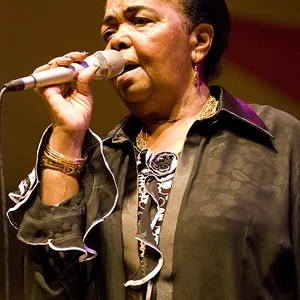

Siramori Diabaté (c. 1920–1989) was a renowned Malian griot woman from the village of Kéla, Mali, belonging to the Mandinka people. A keeper of the Sundiata Keita epic, she was one of the most celebrated transmitters of the griot oral tradition in the 20th century.
Siramori Diabaté(1925 — 1989)
Siramori Diabaté
Mali
8 min read
Frequently asked questions
Key Facts
- Born around 1920 in Kéla (Mali), a village renowned as the center of the Mandinka griot tradition tied to the Sundiata epic
- A member of the Diabaté lineage, a hereditary griot family entrusted with the founding epic of the Mali Empire
- Her voice and repertoire were recorded by researchers and ethnomusicologists in the 1970s–1980s, contributing to the documentation of this oral heritage
- She passed away in 1989, having transmitted her knowledge to her descendants and sustaining the chain of oral transmission
- Recognized as one of the great voices of the 20th-century Mandinka oral tradition (sources: scholarship by researchers such as Lucy Durán)
Works & Achievements
Siramori Diabaté's central work was the living transmission of the founding epic of the Mali Empire. She was one of the most authoritative custodians of this tradition in her generation.
A series of audio recordings made by French ethnomusicologists, forming a precious archive of Siramori's songs and epic narratives as they were performed in their time.
A collection compiled by Charles Bird and his collaborators, now held in American university archives, documenting the variants of the epic as performed by Siramori.
Regular radio broadcasts that allowed millions of Malians to hear Siramori Diabaté's voice, helping to popularize the griot tradition in post-independence Mali.
Participation in the septennial ceremonies of the sacred hut of Kangaba — a major ritual act in Mande tradition in which the recitation of the epic carries cosmic and political significance.
Anecdotes
Siramori Diabaté was considered the living guardian of the epic of Sundiata Keita, the founder of the Mali Empire in the 13th century. During the Kamabolon ceremonies at Kangaba, held every seven years, she was one of the few griots authorized to sing the most sacred passages of this epic before the sacred hut.
Her performances could last several hours, or even an entire night, without interruption. She alternated between song, recitation, and commentary, accompanied by kora and balafon players, holding her audience spellbound through the power of her voice and the precision of her memory.
She was recorded in the 1960s and 1970s by ethnomusicologists and Western researchers who traveled to Mali specifically to preserve the Mande oral tradition. These recordings now constitute priceless sound archives, held notably in Paris and Bamako.
Siramori Diabaté passed her knowledge to her children and nephews according to the jeli tradition, in which knowledge is transmitted strictly from generation to generation within griot families. She insisted that every word of the epic carried a precise meaning and could not be altered without betraying the memory of the ancestors.
At the time of Mali's independence in 1960, Siramori was celebrated as a living symbol of Mande cultural identity. The new Malian authorities regarded her as a national treasure, embodying the continuity between the glorious medieval Mali Empire and modern Mali.
Primary Sources
Siramori Diabaté recites and sings the origins of Sundiata Keita, son of Sogolon Kondé and King Naré Maghann Konaté, describing his difficult childhood and exile before the reconquest of Manden.
The griot Mamadou Kouyaté declares: "I am a griot. I am Djeli Mamadou Kouyaté, son of Bintou Kouyaté and Djeli Kedian Kouyaté, a master of the art of speech. Since time immemorial, the Kouyaté have served the Keïta princes of Manden."
Recording sessions conducted in Kéla and Kangaba document the ritual practices associated with the sacred Kamabolon hut, in which Siramori played a central role as keeper of oral memory.
Broadcast of Siramori Diabaté's songs and epic narratives on national airwaves, as part of the cultural policy promoting Mande traditions following independence.
Key Places
A sacred village in the Manden region and the ancestral home of the Diabaté family. Kéla is regarded as the guardian of the oral tradition of the Sundiata epic; it is here that Siramori was born, lived, and passed down her knowledge.
The holy city of the Manden, close to Kéla, where the Kamabolon ceremony is held every seven years. Siramori played a central role there as keeper of the epic memory during these major rituals.
The Malian capital where Siramori performed on national radio and at official ceremonies after independence. The city was the main vehicle for bringing her art to contemporary audiences.
The territory of the ancient Mandinka Empire founded by Sundiata Keita in the 13th century, whose epic memory Siramori preserved. This historic heartland stretches between present-day Guinea and southwestern Mali.
Typical Objects

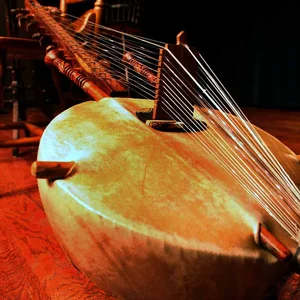
A 21-string plucked bridge harp, emblematic of Mande griot music. Although Siramori was primarily a singer, she always performed accompanied by kora players, whose instrument symbolizes the bond between the living and their ancestors.

A xylophone with gourd resonators, a ritual instrument of the Manden often associated with royal ceremonies. It accompanied Siramori's epic recitations on important occasions.
📷 CC BY-SA 4.0 · Wikimedia Commons ↗
A small plucked-string lute, one of the oldest instruments of the Manden. It was used during evening gatherings and storytelling sessions that Siramori led in the village.

A flowing garment made from rich bazin fabric — dyed and given a glossy finish — worn during major ceremonies. Jelimusow (female griots) wore boubous in vibrant colors as a mark of their status and the solemnity of their role.

A pierced gourd, rubbed or struck to serve as a supplementary percussion instrument during songs. Siramori would sometimes use these light percussion instruments to keep rhythm during her own performances.

Bead necklaces and bracelets, paired with protective amulets, worn by female griots during ceremonies. They signified the jelimusow's spiritual connection to the forces of tradition and to the ancestors.
School Curriculum
Vocabulary & Tags
Key Vocabulary
Tags
Daily Life
Morning
Siramori rose before dawn with the first prayers and the sounds of the village stirring. She devoted the early morning hours to quiet vocal exercises, reciting passages of the epic under her breath to keep her memory sharp — a discipline passed down to her by her mother and grandmother, both griots before her.
Afternoon
Afternoons were often given over to rehearsals with the village musicians — kora and balafon players — in preparation for upcoming ceremonies. She also welcomed young members of the griot family to teach them royal genealogies and ritual songs, ensuring the tradition would be carried forward.
Evening
Evenings were the heart of her artistic life. At festivals, weddings, or funeral rites, Siramori would take her place in the courtyard and launch into performances that could last until dawn. Her powerful voice carried across the entire village, and the elders would come to listen in reverent silence.
Food
Her daily diet was that of a Sahelian Malian village: tô (millet or sorghum porridge), rice with fish or peanut sauce, and leafy vegetables such as fonio and okra, along with mangoes and shea fruit in season. On feast days, yassa or roasted chicken would be prepared for guests.
Clothing
Day to day, Siramori wore a printed cotton wrap skirt tied at the waist and a light boubou. For ceremonies, she dressed in her finest grand boubou of bazin riche — a shimmering, richly colored fabric — with a matching headscarf wrapped into an elaborate turban, a mark of her standing as a great jelimuso.
Housing
She lived in a mud-brick (banco) house with a thatched or corrugated metal roof, typical of the village of Kéla. The central beaten-earth courtyard, ringed by family rooms, served as a shared living space, an outdoor kitchen gathered around the fire, and a natural stage for nighttime performances.
Historical Timeline
Period Vocabulary
Visual Style
Style visuel chaleureux et majestueux évoquant le Mali des années 1960-1980 : palette de terres ocres et d'indigo profond, boubou bazin brodé, village mandingue en pisé sous un baobab.
Sound Ambience
Ambiance sonore d'un village mandingue au Mali : kora, balafon, voix épique féminine grave et mélismatique, percussions sur calebasse, chœur de femmes, bruits de la savane sahélienne.