 flip
flipKhobz dar (home bread)
Khobz dar (home bread)
Why this dish? In the Fez medina, each household kneaded its bread at home and sent it to bake at the neighborhood oven (ferran). For Laâbi, round bread is the absolute marker of daily life and the very opposite of prison hunger — "far from the flavors of the medina of his childhood."
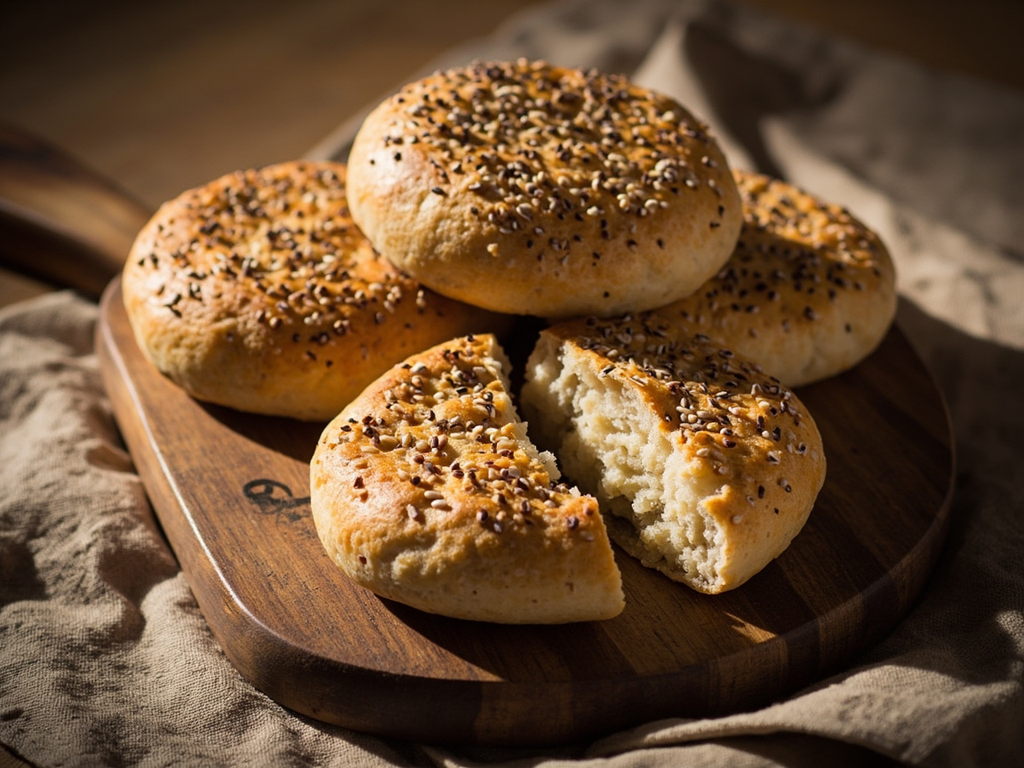
Round, slightly domed flatbread with dense crumb and golden crust, made from fine semolina and flour. The everyday bread, broken by hand and used to scoop up tagines and sauces.
Bread, my friend, is not just one food among others: it is the ground beneath our feet. As a child, I carried our dough stamped with the house seal to the neighborhood ferran, and I could recognize our bread among a hundred by its crust. We never throw away a crumb; we pick it up and kiss it — for he who has known hunger behind walls knows what a mouthful is worth. Break it by hand, never with a knife, and let the sauce nestle in it.
- •Fine wheat semolina — two measures (structure)
- •Wheat flour — one measure (binder)
- •Sourdough or yeast — a little (fermentation)
- •Salt — a pinch (seasoning)
- •Warm water — as needed for dough (hydration)
Khobz dar (home bread)
Round, slightly domed flatbread with dense crumb and golden crust, made from fine semolina and flour. The everyday bread, broken by hand and used to scoop up tagines and sauces.
Why this dish? In the Fez medina, each household kneaded its bread at home and sent it to bake at the neighborhood oven (ferran). For Laâbi, round bread is the absolute marker of daily life and the very opposite of prison hunger — "far from the flavors of the medina of his childhood."
Bread, my friend, is not just one food among others: it is the ground beneath our feet. As a child, I carried our dough stamped with the house seal to the neighborhood ferran, and I could recognize our bread among a hundred by its crust. We never throw away a crumb; we pick it up and kiss it — for he who has known hunger behind walls knows what a mouthful is worth. Break it by hand, never with a knife, and let the sauce nestle in it.
Ingredients (period version)
- Fine wheat semolina — two measures (structure)
- Wheat flour — one measure (binder)
- Sourdough or yeast — a little (fermentation)
- Salt — a pinch (seasoning)
- Warm water — as needed for dough (hydration)
Ingredients
- Fine wheat semolina — 300 g (structure)
- Wheat flour — 200 g (binder)
- Active dry yeast — 1 packet (7 g) (fermentation)
- Salt — 1 tsp (seasoning)
- Warm water — about 30 cl (hydration)
Method
- Mix semolina, flour, and salt; dissolve yeast in a little warm water.
- Knead for 10 minutes, adding water gradually until you have a smooth, supple dough.
- Shape into two flattened discs 2 cm thick, place on a floured cloth, prick the tops with a fork.
- Let rise for 1 hour under a cloth, then bake at 220°C for 25-30 minutes until golden brown. The bread sounds hollow when tapped on the bottom when done.
How it was made : The family bread was kneaded at dawn by the women, marked with a distinctive sign, then taken to the communal oven of the neighborhood where the baker baked it for everyone. This bread oven was one of the social hearts of the medina, along with the mosque, the hammam, and the fountain.
The contemporary twist : A sprinkle of sesame seeds and black cumin on the crust before baking, for a medina bread with the scent of the souk.
Abdellatif Laâbi · Charactorium