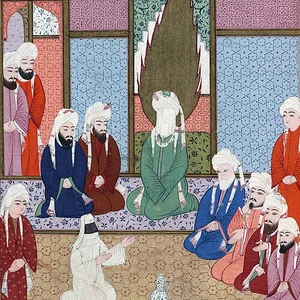

Aisha (614–678) was the third wife of the Prophet Muhammad and daughter of Abu Bakr, the first caliph. After Muhammad's death, she played a major political and religious role in the transmission of hadiths.
Frequently asked questions
Key Facts
- Born around 614 in Mecca, daughter of Abu Bakr
- Married Muhammad around 623–624, after the Hijra
- After Muhammad's death (632), became a central religious authority
- Participated in the Battle of the Camel (656) against Ali ibn Abi Talib
- Died in Medina in 678, having transmitted approximately 2,210 hadiths
Works & Achievements
Aisha is the source of more than 2,200 hadiths recorded in the major Sunni collections (Bukhari, Muslim, etc.), making her one of the five most important transmitters of the Prophetic Sunnah.
For nearly 46 years after the Prophet's death, Aisha held open classes for both men and women, training dozens of jurists and transmitters who spread her knowledge throughout the Islamic world.
Uniquely positioned by her intimate closeness to Muhammad, Aisha transmitted irreplaceable details about his daily life, ritual practices, and character — foundational information for Islamic law (fiqh).
By leading an armed coalition against Ali, Aisha took part in the first Islamic civil war (fitna). Her involvement, despite ending in defeat, left a lasting mark on the political history of early Islam.
Anecdotes
Aisha was renowned for her exceptional memory and sharp intelligence. She memorized thousands of hadiths — the sayings and actions of the Prophet — and became one of the most cited sources in Islamic tradition, transmitting more than 2,200 accounts to her disciples.
At the Battle of the Camel in 656, Aisha personally led an army against Caliph Ali ibn Abi Talib, seated in a litter atop a camel. This is the first and only time a woman commanded an army in the early civil wars of Islam.
A famous episode known as the 'Affair of the Necklace' nearly destroyed Aisha's reputation: falsely accused of infidelity during a military expedition, she was ultimately exonerated by a Quranic revelation (Surah 24), which further strengthened her standing within the Muslim community.
After the death of Muhammad in 632, Aisha continued to live in the small room adjoining the mosque in Medina where she had shared her life with the Prophet. This room became a place of pilgrimage, and for decades Aisha held there a kind of 'salon' where jurists and scholars came to consult her.
Aisha taught both men and women alike, which was remarkable for the time. She did not hesitate to correct the Prophet's companions when she felt they were inaccurately reporting his words, asserting with authority what she herself had heard or witnessed.
Primary Sources
Aisha reported: "The Prophet used to start things from the right whenever possible, in his ablutions, his walking, and in all his affairs."
Aisha said: "We set out with the Prophet with the sole intention of performing the pilgrimage. When we reached Sarif, my menses began..."
"Those who brought forward the lie are a body among yourselves... For every one of them will be the punishment proportionate to the sin he has committed..."
Ibn Sa'd reports that Aisha was the most learned woman of her time among the believers, and that the greatest Companions would bring their religious questions to her.
"Aisha went forth at the Battle of the Camel in an enclosed litter mounted on a red camel named Askar, and the fighting took place around her."
Key Places
The holy city of Arabia where Aisha was born around 614. The heart of pre-Islamic Arab civilization and later the spiritual center of early Islam.
The city where Aisha spent most of her life, in the chamber adjoining the Prophet's Mosque. She taught there and died there in 678.
Aisha's chamber was directly adjacent to this mosque; after Muhammad's death, it became the first female Islamic teaching space in history.
A city in present-day Iraq, near which the Battle of the Camel took place in 656 — the first major armed conflict among Muslims — where Aisha led the opposition against Caliph Ali.
The historic necropolis of Medina where many of the Prophet's Companions were buried. Aisha was laid to rest here upon her death in 678.
Typical Objects

A wood plank coated with a white substance, used to record hadiths and Quranic verses. Aisha used it to write down the Prophet's words, which she then passed on to her students.

A piece of fabric covering the head and shoulders, prescribed by Quranic revelation particularly in relation to the Prophet's wives. Aisha helped define its proper use through her testimonies.

An enclosed covered seat carried by a camel, allowing women to travel in privacy. It was from a hawdaj that Aisha commanded her troops at the Battle of the Camel in 656.

A string of beads used to count invocations and prayers. Aisha is mentioned in the hadiths as practicing dhikr (remembrance of God) with such an object.

Essential writing instruments for transmitting Islamic knowledge. Although oral tradition was dominant, the reed pen symbolizes Aisha's role as a primary source of Quranic and prophetic learning.

A thin mat made of plant fibers on which Aisha performed her daily prayers in her room adjoining the mosque of Medina.
School Curriculum
Vocabulary & Tags
Key Vocabulary
Tags
Daily Life
Morning
Aisha would rise before dawn for the Fajr prayer in her room adjoining the mosque. After prayer, she devoted the early morning to reciting the Quran and answering the first questions brought to her by believers.
Afternoon
The afternoon was dedicated to teaching: disciples would come to hear her accounts of the Prophet and receive legal opinions. She sometimes received men and women separately, speaking from behind a curtain when addressing the former.
Evening
In the evening, Aisha prayed the Maghrib and Isha before retiring to her simple room. She used these hours to dictate hadiths to those close to her, or to practice invocations (dhikr) before falling asleep on her mat.
Food
Food in Medina was simple and modest: barley flatbreads (khubz), dates, camel or goat's milk, and occasionally grilled meat during festivals. Aisha reported that the Prophet's household sometimes went several weeks without lighting a fire to cook.
Clothing
Aisha wore long robes (jilbab) of linen or cotton in natural tones — ivory, beige, brown — and covered her head with a khimar. Her clothing was plain, in keeping with the austere way of life of the prophetic household.
Housing
She lived in a small room (hujra) of dried mud brick, with a palm-leaf roof, adjoining the mosque in Medina. The room was tiny — barely a few square meters — furnished with a mat, a water jar, and a few basic utensils.
Historical Timeline
Period Vocabulary
Visual Style
Style enluminure islamique médiévale, tons ocre et bleu nuit, intérieurs en pisé de Médine, arabesques géométriques, lumière de bougie dorée.
Sound Ambience
L'atmosphère sonore de la Médine du VIIe siècle : appel à la prière, murmures d'érudits, vent du désert et bruissement de palmes autour des maisons en pisé.
Liens externes & ressources
Références
Œuvres
Corpus de hadiths transmis par Aïcha
VIIe siècle
Enseignement oral à la mosquée de Médine
632–678
Témoignages sur la vie privée du Prophète
VIIe siècle
Rôle dans la bataille du Chameau (656)
656