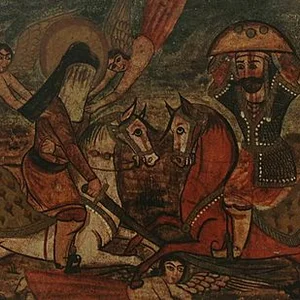

Cousin and son-in-law of the Prophet Muhammad, Ali ibn Abi Talib was the fourth caliph of Islam (656–661). A central figure of Shia Islam, he is regarded by Shia Muslims as the first rightful imam. His caliphate was marked by the First Fitna, a civil war that gave rise to the foundational Sunni-Shia divide.
Frequently asked questions
Famous Quotes
« The worth of a man is what he excels in.»
« Do not judge your strength by what you carry, but by what you refuse to carry.»
Key Facts
- Born around 599 in Mecca, he was one of the earliest converts to Islam.
- Husband of Fatima, daughter of the Prophet Muhammad, and father of Hasan and Husayn.
- Fourth Rightly Guided Caliph (Rashidun) from 656 to 661.
- His reign was marked by the First Fitna: the Battle of the Camel (656) and the Battle of Siffin (657).
- Assassinated in 661 in Kufa by a Kharijite; his martyrdom became the founding event of the Shia tradition.
Works & Achievements
A collection of speeches, letters, and aphorisms attributed to Ali ibn Abi Talib, considered a masterpiece of classical Arabic prose. A foundational text of Shia Islam, it is studied for its spiritual, ethical, and literary value.
A lengthy letter of administrative and ethical instructions written by Ali to his newly appointed governor of Egypt, detailing the ruler's duties toward the people. This text is regarded as one of the earliest treatises on Islamic governance.
An arbitration agreement signed after the Battle of Siffin between the representatives of Ali and Muawiya to settle their politico-religious conflict. Though challenged by the Kharijites, it represents a pioneering attempt at diplomatic resolution of an intra-Islamic dispute.
A compilation of aphorisms and moral sayings attributed to Ali, covering themes of justice, wisdom, piety, and governance. Widely valued in both Shia and Sunni traditions for its ethical teachings.
Anecdotes
Ali ibn Abi Talib was one of the first to convert to Islam, at around ten years old, living in the household of the Prophet Muhammad, whose cousin he was. This early devotion earned him an exceptional place in the nascent Muslim community.
On the night of the Hijra in 622, Ali slept in the Prophet's bed to deceive the Meccan enemies into believing Muhammad was still there, allowing him to flee to Medina. This courageous act, which put his own life at risk, has remained famous in Islamic tradition as proof of his absolute devotion.
Ali was renowned for his bravery in battle and his fairness as a judge. It is reported that he once appeared before an Islamic court as a plaintiff against an ordinary man over a suit of armor — and lost the case for lack of sufficient evidence, accepting the verdict without invoking his rank as caliph.
Called 'Bab al-'Ilm' (the Gate of Knowledge) by the Prophet according to Shia tradition, Ali was widely recognized for his scholarship and eloquence. His speeches and letters were compiled centuries later in the Nahj al-Balagha, a work considered a masterpiece of classical Arabic prose.
Ali was assassinated in 661 in Kufa by a Kharijite named Ibn Muljam, who struck him with a poisoned sword during the dawn prayer. Before dying, Ali reportedly asked that his killer be treated with justice and humanity, without torture — an act of clemency that only deepened his legend.
Primary Sources
O people, fear God and beware of this deceitful world, which lures its inhabitants only to abandon them, which flatters only to enslave.
The Prophet said to Ali: 'You are to me as Aaron was to Moses, except that there shall be no prophet after me.'
Ali ibn Abi Talib was designated caliph following the assassination of Uthman, and the people of Medina pledged their allegiance to him in the year 35 of the Hijra.
The Battle of Siffin lasted many days between the forces of Ali and those of Mu'awiya; when defeat threatened Mu'awiya's troops, they raised copies of the Quran on the tips of their spears to demand arbitration.
Key Places
Ali ibn Abi Talib's birthplace and the cradle of Islam, where he spent his childhood in the Prophet's household and witnessed the first revelations. It was here that he converted to Islam as one of the very first believers.
The city Ali accompanied the Muslim community to during the Hijra, where he lived throughout the Prophet's lifetime and the reigns of the first caliphs. It was in Medina that the faithful pledged their allegiance to him as the fourth caliph.
An Iraqi city that Ali made his capital during his caliphate, preferring to be closer to the newly conquered provinces. It was in the mosque of Kufa that he was assassinated in 661, and the city went on to become a major center of Shia Islam.
A city neighboring Kufa that is home to the shrine of Ali ibn Abi Talib, one of the most sacred pilgrimage sites in Shia Islam, visited by millions of the faithful every year.
The site of the decisive Battle of Siffin in 657, in which Ali faced Mu'awiya. The battle ended in a disputed arbitration and hastened the permanent rift between Sunni and Shia Islam. This place symbolizes the first major civil war in Islam.
Typical Objects

Ali's legendary sword, renowned for its forked tip or central groove, said to have been given to him by the Prophet after the Battle of Uhud. It became a symbol of Shia Islam and appears on many Islamic banners and emblems to this day.

Ali is traditionally regarded as one of the first to compile the Quran in a specific order following the Prophet's death. His mastery of the Quranic text and its interpretation was central to his spiritual and political authority.

Essential writing instruments for administering the caliphate and composing the letters and speeches of Ali preserved in the Nahj al-Balagha. His eloquence, both written and spoken, was a defining mark of his authority.

Protective armor worn by Arab warriors of the era, which Ali himself is said to have disputed in court — an episode illustrating both his courage in battle and his deep commitment to judicial fairness.

Ali was renowned for the fervor and regularity of his prayers. It was during the dawn prayer that he was fatally struck in the mosque of Kufa in 661.

An engraved ring used to authenticate the caliphate's official decrees and correspondence. It symbolized supreme authority and was indispensable to governing the rapidly expanding Islamic empire.
School Curriculum
Vocabulary & Tags
Key Vocabulary
Tags
Daily Life
Morning
Ali rose before dawn for the Fajr prayer, which he performed with great devotion at the communal mosque. After prayer, he devoted time to reciting the Quran and studying before receiving the first affairs of the caliphate.
Afternoon
The afternoon was dedicated to administering the empire: public audiences in which he settled disputes, dictating letters to his governors, and consulting with his advisors. He was known for personally dispensing justice, directly involving himself in judicial matters.
Evening
In the evening, Ali gathered with his family — his sons Hasan and Husayn — for theological discussions and religious instruction. He also made time for the poor and the needy, sometimes receiving them personally, true to his ideal of caliphal humility.
Food
In keeping with the Muslim tradition of the time, Ali's diet was frugal: barley bread, dates, milk, legumes, and occasionally meat on feast days. It is reported that he refused excess and lived modestly despite his position as caliph.
Clothing
Ali wore simple white or undyed wool garments, without ostentatious adornment, in keeping with the ideal of frugality preached by the Prophet. A turban wrapped his head, and he carried his legendary sword Dhu al-Fiqar at his belt during military expeditions.
Housing
Ali lived in a simple mud-brick dwelling in Kufa, his capital, rejecting the luxury of palaces. His home was open to visitors and those seeking justice, reflecting his ideal of a leader accessible to and close to the community of believers.
Historical Timeline
Period Vocabulary
Visual Style
Esthétique des manuscrits enluminés islamiques primitifs : arabesques géométriques, calligraphie arabe, palette ocre et indigo, architecture en brique de terre crue.
Sound Ambience
Atmosphère sonore de l'Arabie et de l'Irak du VIIe siècle : appels à la prière, marchés animés, caravanes, récitation coranique et bruits de camp militaire.
Liens externes & ressources
Références
Œuvres
Nahj al-Balagha (La Voie de l'Éloquence)
VIIe siècle (compilé au Xe–XIe siècle)
Lettre à Malik al-Ashtar (gouverneur d'Égypte)
658
Arbitrage de Doumah al-Jandal
658
Recueil de maximes et sentences (Ghurar al-Hikam)
VIIe siècle (compilé au XIe siècle)