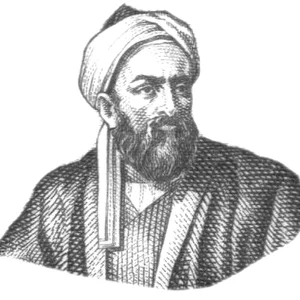

A Persian polymath (973–1048), Al-Biruni was one of the greatest minds of the medieval Islamic world. Astronomer, mathematician, geographer, and historian, he wrote more than 150 works and was one of the first scholars to study India in a systematic, scientific way.
Frequently asked questions
Famous Quotes
« Knowledge of what exists in the universe is a religious duty.»
Key Facts
- Born in 973 in Khwarezm (present-day Uzbekistan), died around 1048
- Wrote the Kitab al-Hind (c. 1030), the first scientific and ethnological study of India
- Accurately calculated the Earth's circumference and measured latitude using an original geometric method
- Translated Greek and Indian works into Arabic, contributing to the transmission of ancient knowledge
- Author of more than 150 works covering astronomy, mathematics, pharmacology, and philosophy
Works & Achievements
Al-Biruni's first major work, comparing the calendars and chronological traditions of many peoples — Greeks, Persians, Arabs, Jews, and Christians. It demonstrates a remarkable intellectual openness to cultural diversity.
Al-Biruni's masterwork, considered the first ethnographic and scientific study of India. In it, he analyzes Indian religion, philosophy, mathematics, and customs with remarkable impartiality.
An astronomical encyclopedia in eleven volumes dedicated to Sultan Masud I. It brings together his work on spherical trigonometry, planetary motion, and the determination of latitude.
A pedagogical manual written in both Arabic and Persian, covering arithmetic, geometry, astronomy, and astrology. It is one of the rare medieval scientific texts produced simultaneously in two languages.
A mineralogical treatise measuring the density of metals and gemstones with remarkable experimental precision. It stands as one of the earliest genuinely quantitative approaches in the field of mineralogy.
A pharmacological encyclopedia comparing the names and properties of medicinal plants in Arabic, Persian, Greek, Syriac, and Sanskrit. A testament to his multilingual scholarship applied to the field of medicine.
Anecdotes
To measure the Earth's circumference, Al-Biruni climbed alone to the top of a mountain near Nandana (in present-day Pakistan). From the angle of dip of the horizon, he calculated a value of 6,339 km for the Earth's radius — a staggeringly accurate result for the time, within less than 1% of the value accepted today.
When Sultan Mahmud of Ghazni conquered Khwarezm in 1017, he took Al-Biruni by force to his court as 'intellectual plunder.' What could have been a captivity became the opportunity of a lifetime: Al-Biruni accompanied the campaigns into India, learned Sanskrit, and wrote the Kitab al-Hind, the first scientific and anthropological study of India by a Muslim scholar.
As a young scholar, Al-Biruni engaged in a spirited philosophical correspondence with Ibn Sina (Avicenna), his contemporary. The two giants of Islamic science debated by letter the nature of heat, light, and the void — an intellectual duel that reflects the extraordinary vitality of the Islamic Golden Age.
While observing the geological strata of the Indus plain, Al-Biruni concluded that the region had once been covered by the sea, based on marine fossils found in the rocks. This proto-geological insight, formulated in the 11th century, would not be confirmed by European science until several centuries later.
Al-Biruni measured the specific density of eighteen precious stones and metals using a hydrostatic balance, with remarkable precision. His results, recorded in his mineralogy treatise, closely match modern values — a testament to experimental rigor well ahead of his time.
Primary Sources
"The Hindus believe that the number of existences of a soul is unlimited; they think that it passes successively through all kinds of living beings... But the essence of their doctrine comes down to the transmigration of souls."
"We wished to gather in this book the calendars used by different peoples, so that the reader may convert dates from one era to another and not be at a loss when encountering a date in a historical work."
"The Earth is round, and its inhabitants live on its entire surface; those at the antipodes have their feet pointing toward ours, and yet they do not fall, for there is no absolute 'down' in the universe."
"I weighed each stone in air, then in water, and calculated the ratio between the two measurements to deduce the specific density of each substance."
Key Places
Al-Biruni's birthplace and capital of the Khwarezm region in Central Asia. It was in this thriving cultural center that he received his earliest intellectual education.
Capital of the Ghaznavid Empire (in present-day Afghanistan), where Al-Biruni spent most of his adult life under the patronage of Sultans Mahmud and then Masud. It was here that he wrote his major works.
The site from which Al-Biruni conducted his famous measurement of the Earth's circumference using triangulation. Now in ruins in present-day Pakistan.
An intellectual city near present-day Tehran where Al-Biruni found refuge and met other scholars, particularly during his exile from Khwarezm.
Al-Biruni traveled through this region multiple times during Mahmud's campaigns in India. There he made pioneering geological observations about ancient seas.
Typical Objects

A celestial measuring instrument that Al-Biruni mastered completely and described in great detail. He used it to determine latitude, time, and the direction of Mecca.

A scale used to weigh objects in both air and water in order to calculate their density. Al-Biruni used it to determine the densities of eighteen minerals with remarkable precision.

Collections of calculations used to predict the positions of celestial bodies. Al-Biruni compiled several of these and compared those of Greek, Indian, and Islamic astronomers.

Al-Biruni learned Sanskrit in order to read Indian scientific and philosophical texts directly. His collections of manuscripts were an essential source for the Kitab al-Hind.

A common instrument among traveling scholars for measuring the time and the position of the sun. Al-Biruni described several models of it in his treatises.

Fundamental tools of medieval Islamic geometry. Al-Biruni used them for his mathematical constructions and his cartographic work mapping regions of India.

The everyday tools of the medieval scholar for writing treatises. Al-Biruni is said to have composed the equivalent of 13,000 pages of text over the course of his life.
School Curriculum
Vocabulary & Tags
Key Vocabulary
Daily Life
Morning
Al-Biruni rose before dawn to perform the fajr prayer, then immediately recorded his astronomical observations from the night. He devoted the early morning hours to writing and revising his treatises, taking advantage of the morning clarity and the quiet of the courtyard.
Afternoon
Afternoons were reserved for mathematical calculations, experiments weighing minerals, and working sessions with his students or translators. When in India, he received Brahmin scholars to discuss philosophy and science in Sanskrit.
Evening
At sunset, after the maghrib prayer, Al-Biruni ate a simple dinner and then climbed to the rooftop or into the courtyard to observe the night sky. He recorded the position of the stars with his astrolabe, noted his measurements, and sometimes dictated his observations to a scribe.
Food
As a Muslim court scholar in Central Asia, Al-Biruni ate flatbread (nan), spiced rice, mutton, legumes, dates, and dried fruits. He drank water, herbal tea, and fermented milk (kefir), in keeping with the dietary customs of the region.
Clothing
Al-Biruni wore the dress of an Islamic court scholar: a long robe (jubba) in wool or linen depending on the season, often blue or dark-colored, belted, with a white or beige turban indicating his status. In India, he sometimes adopted lighter garments suited to the climate.
Housing
In Ghazni, Al-Biruni resided in the outbuildings of the Ghaznavid palace, with a cell-library featuring wall niches for his scrolls and codices. The room had a stone-tiled floor, was heated by a brazier in winter, and opened onto an inner courtyard with a fountain.
Historical Timeline
Period Vocabulary
Visual Style
Style miniature perso-islamique aux tons lapis-lazuli, safran et or, avec décors géométriques, instruments astronomiques et manuscrits enluminés dans un cadre de cour ghaznévide.
Sound Ambience
Atmosphère sonore d'un savant de cour médiéval en Asie centrale : appel à la prière, caravanes de la Route de la Soie, astrolabe sous les étoiles de Ghazni, calame sur parchemin.
Liens externes & ressources
Références
Œuvres
Al-Athar al-Baqiya (Chronologie des nations anciennes)
vers 1000
Kitab al-Hind (Le Livre de l'Inde)
vers 1030
Al-Qanun al-Masudi (Le Canon de Masud)
1037
Kitab al-Tafhim (Introduction aux éléments de l'astrologie)
vers 1029
Kitab al-Jamahir fi ma'rifat al-jawahir (Traité des pierres précieuses)
vers 1048
Saidana (Pharmacologie)
vers 1045