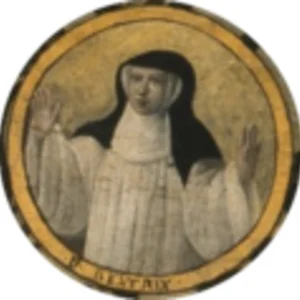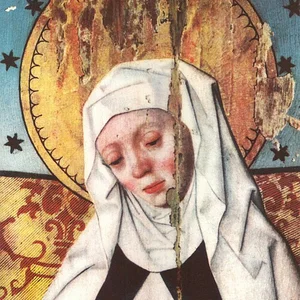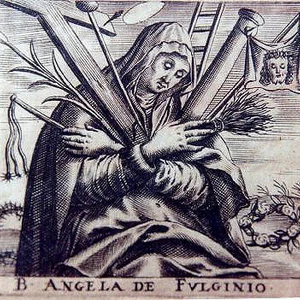

A 13th-century Italian mystic, Angela of Foligno was a Franciscan tertiary whose visions were recorded in the Book of Visions and Instructions. A major figure in medieval spirituality, she was beatified in 1693 and canonized in 2013.
Frequently asked questions
Famous Quotes
« Love is not yet loved.»
« I saw a thing so full and so vast that I cannot speak of it.»
Key Facts
- Born around 1248 in Foligno, in Umbria (central Italy)
- After the deaths of her husband and children around 1288, she devoted herself entirely to the spiritual life
- Joined the Franciscan Third Order and dictated her visions to her confessor, Brother Arnaldo
- Her Book of Visions and Instructions (Liber de vera fidelium experientia) was composed between 1292 and 1296
- Died on January 4, 1309 in Foligno; canonized by Pope Francis in 2013
Works & Achievements
A masterpiece of medieval mysticism, this book records the visions, ecstasies, and teachings of Angela as dictated to Brother Arnold. It is divided into a Memoriale (tracing the stages of her mystical ascent) and Spiritual Instructions addressed to her disciples.
The first part of the Liber, describing thirty stages of spiritual transformation leading to union with God. This text stands as one of the most intense accounts in Western Christian mysticism.
A collection of letters and oral teachings by Angela intended to guide her disciples, covering evangelical poverty, contemplation of the Passion, and love of God.
Anecdotes
Angela of Foligno led a comfortable, worldly life for many years as the wife of a wealthy merchant. Around 1285, the successive deaths of her mother, husband, and children plunged her into an intense spiritual crisis that became the starting point of a radical conversion. Rather than seeing these losses as misfortune, she understood them as a divine call to abandon everything for God.
During a pilgrimage to Assisi, while praying before the Portiuncola (the chapel of Santa Maria degli Angeli), Angela was seized by such a violent ecstasy that she began crying out and writhing on the ground. Her traveling companion, the Franciscan friar Arnold, was so embarrassed that he initially considered leaving her — but he would go on to become the faithful scribe of her visions.
After her conversion, Angela gave away all her possessions to the poor, joined the Franciscan Third Order, and led a life of penance and contemplation in Foligno. She gathered a community of disciples — men and women alike — whom she guided spiritually. Her depth of mystical teaching earned her the title 'mistress of theologians.'
Angela repeatedly described a mystical experience she called the 'divine darkness': an encounter with God in total obscurity, beyond all images and language, that left her simultaneously annihilated and fulfilled. This negative theology, inherited from Pseudo-Dionysius, would have a lasting influence on Rhenish and Flemish mysticism in the 14th century.
Primary Sources
"I saw a thing so dark that I remember nothing of any of God's works, nor of the Trinity, nor of anything else. And I could no longer see anything of corporeal things... and in that darkness I saw the Trinity."
"Then I understood that the soul which contemplates God can in no way speak of Him, because whatever can be said of Him falls far short of the truth."
"Poverty is the royal road. Whoever has chosen it has chosen the cross of Christ, and whoever has chosen the cross has chosen Christ himself."
Key Places
Angela's birthplace and the setting of her entire spiritual life. It was in this Umbrian city that she converted, lived as a Franciscan tertiary, and drew her disciples.
Angela made a pilgrimage to Assisi, the cradle of Franciscanism, where she experienced one of her most celebrated ecstasies before the Porziuncola — a defining moment in her mystical vocation.
The chapel of the Porziuncola, the quintessential Franciscan sanctuary, where Angela was seized by a profound ecstasy during her pilgrimage — a decisive turning point on her spiritual journey.
Angela's regular place of prayer in Foligno, where she frequently met with her confessor Brother Arnold and where her community of disciples gathered.
Typical Objects

Angela wore the grey rough-cloth robe of Franciscan tertiaries, a symbol of penitence and detachment from material possessions. This garment marked her belonging to the spiritual family of Saint Francis.
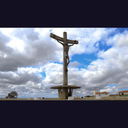
The crucified Christ was Angela's central object of meditation; she described numerous visions of Christ's suffering body, which she contemplated in order to unite herself with his Passion.
📷 CC BY-SA 2.0 · Wikimedia Commons ↗
Like any educated Franciscan tertiary, Angela recited the psalms throughout the canonical hours. This chanted prayer structured her day and nourished her contemplative life.

The discipline (a small cord used for mortification) was a tool of bodily penance commonly used by medieval mystics seeking to unite their sufferings with those of Christ.

Angela practiced prolonged fasting, sometimes sustaining herself on nothing but bread and water for long periods, in keeping with the Franciscan ideal of evangelical poverty.

It was on parchment that Brother Arnold recorded, as Angela dictated, the account of her visions and teachings — giving birth to the Liber that secured her lasting legacy.
School Curriculum
Vocabulary & Tags
Key Vocabulary
Daily Life
Morning
Angela would rise before dawn to recite Matins and Lauds, the first hours of the liturgical prayer cycle. She would then join the church for the morning Mass, a moment of intense recollection during which she could be seized by prolonged ecstasies.
Afternoon
The afternoon was devoted to silent prayer, meditation on the Passion of Christ, and visits to the sick and poor of Foligno. She also received her disciples to guide them spiritually, sometimes dictating her visions and reflections to Brother Arnold.
Evening
In the evening, after reciting Vespers and Compline, Angela would often extend her vigil into the night in prayer. She sometimes spent entire nights in contemplation, oblivious to cold and exhaustion, in a state of mystical union with God.
Food
Angela practiced rigorous fasting, sometimes on bread and water alone, as an act of penance and union with Christ's suffering. She reported that during periods of intense mystical grace, she could go without any food for several days, the Eucharist being her only sustenance.
Clothing
She wore the grey roughspun habit of the Franciscan tertiaries, unadorned and unembellished, with a rope cord at the waist and simple sandals. The garment was deliberately worn and patched, in keeping with the ideal of poverty preached by Saint Francis.
Housing
After the death of her family, Angela lived in a modest house in Foligno, which she transformed into a place of prayer and hospitality. Having given away her possessions, she welcomed her disciples and the poor there. Her dwelling was stripped of all luxury, adorned only with a crucifix and a devotional image.
Historical Timeline
Period Vocabulary
Visual Style
Style enluminure ombro-toscane du XIIIe siècle, mêlant rigueur byzantine et humanité naissante du proto-gothique : tons de bure, ocre et bleu outremer, fonds dorés, atmosphère de recueillement franciscain.
Sound Ambience
L'univers sonore d'Angèle de Foligno est celui de l'Italie médiévale franciscaine : plain-chant, cloches des heures canoniales, silence contemplatif entrecoupé de psalmodies murmurées dans les pierres froides d'une chapelle ombrienne.
Liens externes & ressources
Références
Œuvres
Liber de vere fidelium experientia (Le Livre de l'expérience des vrais fidèles)
vers 1292-1309
Memoriale
vers 1292-1296
Instructions spirituelles
vers 1296-1309