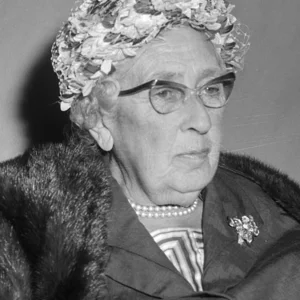

Agatha Christie (1890-1976) was a British novelist, widely known as the 'Queen of Crime'. The author of 66 detective novels, she created the iconic characters Hercule Poirot and Miss Marple. Her works are among the best-selling in the history of world literature.
Agatha Christie(1890 — 1976)
Agatha Christie
Royaume-Uni, Royaume-Uni de Grande-Bretagne et d'Irlande
8 min read
Frequently asked questions
Famous Quotes
« Crime is a common problem. The solution is the extraordinary.»
« The little grey cells… one must use them, mon ami.»
Key Facts
- Born on 15 September 1890 in Torquay, England.
- First novel published in 1920: The Mysterious Affair at Styles, which introduced Hercule Poirot.
- Author of 66 detective novels, 14 short story collections, and 33 plays.
- Her play The Mousetrap has been running continuously in London since 1952 — a world record.
- Died on 12 January 1976; elected a member of the Detection Club and appointed Dame Commander of the Order of the British Empire (DBE) in 1971.
Works & Achievements
Agatha Christie's debut novel, it introduces Belgian detective Hercule Poirot. Written during the First World War, it established the logical puzzle mystery genre in the English language.
Considered a masterpiece of detective fiction, it caused a sensation with its completely unexpected ending. It is regularly cited among the greatest mystery novels of all time.
One of Christie's most celebrated novels, its plot unfolds aboard a train stranded in the snow. Its astonishing resolution left a lasting mark on the history of crime fiction worldwide.
The best-selling mystery novel in history, with over 100 million copies sold. Ten strangers find themselves stranded on an island and are killed off one by one in accordance with the verses of a nursery rhyme.
A stage play that opened at St Martin's Theatre in London, it holds the world record for the longest continuously running play, with over 28,000 performances across the decades.
One of the most representative novels featuring Miss Marple, the elderly amateur detective from St Mary Mead. It perfectly illustrates this iconic character's method of observation and psychological deduction.
Written in secret during the Second World War and published in 1975, this novel brings Hercule Poirot's career to a close. His death made the front page of the New York Times — a remarkably rare honour for a fictional character.
Anecdotes
In 1926, Agatha Christie mysteriously vanished for eleven days, triggering one of the largest manhunts in British history. More than a thousand police officers and fifteen thousand volunteers searched for her. She was eventually found in a Yorkshire hotel, registered under a false name, unable — or unwilling — to explain her disappearance.
Agatha Christie worked as a nurse and a pharmacy dispenser during the First World War. This experience gave her an in-depth knowledge of poisons, which she put to expert use in her novels: of the 66 she wrote, poisoning is the most common method of murder.
Christie is the most translated author in history after the Bible and Shakespeare. Her works have been translated into more than 100 languages and have sold over two billion copies worldwide — an absolute record for crime fiction.
Her play 'The Mousetrap', which opened in London in 1952, holds the record for the longest continuously running show in the history of world theatre. It ran without interruption for more than 70 years in London's West End.
Agatha Christie was a passionate amateur archaeologist. She regularly accompanied her second husband, archaeologist Max Mallowan, on excavations across the Middle East, particularly in Iraq and Syria. She made the most of these trips to write several novels, including 'Murder in Mesopotamia'.
Primary Sources
«It was a wild night. The wind was howling outside, and the rain was beating against the windows.» First novel published in 1920, it introduces Hercule Poirot and lays the foundations of the mystery novel.
«I have enjoyed greatly the second blooming that comes when you finish the life of the emotions and of personal relations; and suddenly find — at the age of fifty, say — that a whole new life has opened before you.»
«I think I was rather bored with him by the time I wrote The ABC Murders... A.C. does not love Poirot. He is an egocentric, and she finds him tiresome.»
«I, Hercule Poirot, am about to die. But before I do, I must tell you the truth about the case of Styles — the last case I ever solved, and the one of which I am least proud.»
Key Places
Agatha Christie's favourite summer home, acquired in 1938 and now owned by the National Trust. It was here that she found the inspiration and peace of mind she needed to write; several settings in her novels draw directly from it.
Agatha Christie's birthplace, where she grew up in a prosperous Victorian middle-class family. The coastal setting and elegant villas of Torquay permeate the atmosphere of many of her novels.
Christie travelled on this legendary train several times to join her husband on archaeological digs in the Middle East. Her most famous novel, 'Murder on the Orient Express' (1934), is set entirely aboard it.
Assyrian archaeological site where Max Mallowan led major excavations in the 1940s and 1950s. Christie worked there as a photographer and restorer of ancient ivory artefacts, and wrote several novels in a mud-brick house on site.
West End theatre where The Mousetrap has been performed continuously since 25 November 1952, holding the all-time world record for the longest-running play in theatre history.
Typical Objects

Christie wrote her novels on a portable Remington typewriter, often while travelling on the Orient Express or at archaeological dig sites. The typewriter symbolises her remarkable writing discipline — she produced an average of one novel per year.

Her experience as a pharmacy dispenser during the First World War gave her a precise command of toxic substances. She kept toxicology reference books to ensure the scientific accuracy of her plots.

Christie jotted down ideas for plots, characters, and dialogue in notebooks she showed to no one. Several of these notebooks, discovered after her death, reveal the creative process behind her most celebrated novels.

Christie travelled extensively throughout the Middle East, Europe, and the Near East, often aboard the Orient Express. Her large leather trunk, stamped with her initials, accompanied her to every archaeological dig her husband worked on.

A devoted tea drinker — much like her quintessentially British characters — Christie made a habit of working through her plots during afternoon tea. The tea-time ritual is a recurring presence throughout her novels.

A symbol of her time in the Middle East alongside her husband Max Mallowan, the trowel represents Christie's double life: celebrated novelist and scientific collaborator on excavations at Ur, Nimrud, and Arpachiyah.
School Curriculum
Vocabulary & Tags
Key Vocabulary
Tags
Daily Life
Morning
Agatha Christie was an early riser who liked to start the day with a hot bath — she claimed it was where she came up with her best murder ideas. She would enjoy a hearty English breakfast (eggs, toast, tea) before going through her mail. She had no dedicated writing desk and sometimes wrote directly at the dining room table.
Afternoon
Afternoons were devoted to writing, often at the typewriter, with no outline in advance: Christie built her plots as she went. She allowed herself an obligatory tea break at 4 p.m., a moment of reflection and sociability she considered essential to her creativity.
Evening
Evenings were for family and music: an accomplished pianist, Christie would regularly play after dinner. She read voraciously — novels, biographies, scientific works — and sometimes worked in her notebooks before turning in early.
Food
Christie was fond of traditional British cooking: Sunday roasts, puddings, creams, and cakes. A self-confessed lover of chocolate and clotted cream, she cheerfully admitted to her indulgences. During her expeditions to the Middle East, she approached local cuisines with genuine curiosity.
Clothing
Christie dressed with the understated elegance of the British middle class between the wars: silk or crêpe dresses, pearls, and cloche hats in the 1920s, followed by more sober suits in later decades. On archaeological digs, she wore practical linen clothing.
Housing
Christie lived in several homes, most notably Greenway House in Devon, her favourite summer residence, with its terraced gardens overlooking the River Dart. In London, she kept a flat in Chelsea. On excavations, she stayed in mud-brick houses with very basic comforts.
Historical Timeline
Period Vocabulary
Visual Style
Esthétique Art Déco d'un manoir anglais des années 1930 : intérieurs feutrés aux teintes chaudes, jardins ordonnés du Devon, et le style graphique élégant des premières couvertures Penguin Crime.
Sound Ambience
Atmosphère feutrée d'un manoir anglais des années 1930, entre le crépitement du feu, le tintement du service à thé et le cliquetis de la machine à écrire — le cadre sonore dans lequel Christie imaginait ses intrigues.
Liens externes & ressources
Références
Œuvres
La Mystérieuse Affaire de Styles (The Mysterious Affair at Styles)
1920
Le Meurtre de Roger Ackroyd (The Murder of Roger Ackroyd)
1926
Le Crime de l'Orient-Express (Murder on the Orient-Express)
1934
Dix Petits Nègres (And Then There Were None)
1939
La Souricière (The Mousetrap)
1952
Cinq heures vingt-cinq (4.50 from Paddington)
1957
Curtain : la dernière affaire de Poirot (Curtain: Poirot's Last Case)
1975