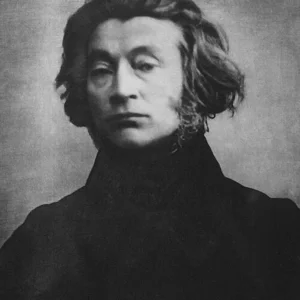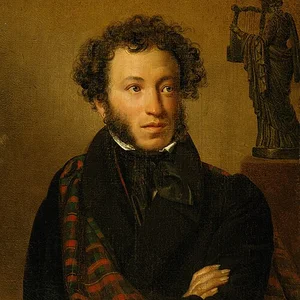

Considered the father of modern Russian literature, Pushkin (1799–1837) wrote foundational works such as Eugene Onegin and The Queen of Spades. Killed in a duel at 37, he embodies Russian Romanticism.
Alexander Pushkin(1799 — 1837)
Alexander Pushkin
Empire russe
8 min read
Frequently asked questions
Famous Quotes
« I have erected a monument to myself not made by human hands.»
« O thou who art my muse, my light, my life!»
Key Facts
- Born in Moscow in 1799 into a noble family of partial African descent through his maternal great-grandfather
- Exiled by Tsar Alexander I from 1820 to 1826 for his liberal ideas
- Published Eugene Onegin between 1825 and 1832, a novel in verse regarded as a masterpiece of Russian literature
- Monitored by tsarist censorship throughout his career under Nicholas I
- Died in a duel on February 10, 1837, in Saint Petersburg, mortally wounded by his brother-in-law
Works & Achievements
Pushkin's first major narrative poem, inspired by Russian folk tales and the epic tradition. It revealed to the public a young genius capable of renewing the Russian poetic language by infusing it with humor, lightness, and national color.
A novel in verse considered Pushkin's absolute masterpiece and an encyclopedia of 19th-century Russian life. The character of Onegin, a disillusioned aristocrat incapable of love, gave birth to the type of the 'superfluous man' in Russian literature.
A historical drama in prose and verse inspired by Shakespeare, tracing the reign of Tsar Boris Godunov and the Time of Troubles. Censored by Nicholas I, it was not performed on stage until after the author's death.
A fantastical short story blending card games, obsession, and madness in imperial Saint Petersburg. This brief and dense narrative, strikingly modern in feel, is considered a model of the genre and inspired a celebrated opera by Tchaikovsky.
An epic poem featuring the equestrian statue of Peter the Great and a lowly clerk ruined by the flood of 1824. The text masterfully sets the grandeur of the state against the crushing of the individual.
A collection of five prose tales, the first major prose narrative cycle in Russian literature. With humor and economy of means, Pushkin explores universal human situations: love, chance, and death.
An unfinished historical novel tracing the youth of Abram Petrovich Gannibal, Pushkin's African ancestor. This deeply autobiographical text reflects the poet's attachment to his singular origins.
Anecdotes
Pushkin was a passionate gambler and lived his entire life buried in debt. One evening, he wagered the entire first chapter of Eugene Onegin in a game of whist — and lost. He had to buy back his own manuscript in order to publish it.
At the age of 15, during the inauguration of the Imperial Lyceum at Tsarskoye Selo in 1815, Pushkin recited a poem before the elderly Derzhavin, the greatest Russian poet of the era. Derzhavin was so moved that he wanted to embrace the young prodigy, but the boy fled the room, red-faced with shyness.
Pushkin was exiled twice by the Tsar: first in 1820 to the south of Russia for poems deemed subversive, then in 1824 to his family estate at Mikhaylovskoye. It was during this second exile that he wrote some of his greatest works, transforming his punishment into a period of extraordinary creative output.
The fatal duel of January 27, 1837 pitted Pushkin against Baron Georges d'Anthès, a French officer in the Tsar's service, whose persistent pursuit of his wife Natalya had humiliated the poet. Shot in the abdomen, Pushkin took two days to die. His final words were addressed to his books: "Farewell, my friends."
Pushkin had African ancestry through his great-grandfather Abram Petrovich Gannibal, an Ethiopian general who had been brought to Russia as a slave, then freed and adopted by Peter the Great. The poet was proud of this heritage and drew upon it in his unfinished novel The Moor of Peter the Great.
Primary Sources
My uncle, a man of the strictest integrity, by falling gravely ill has won everyone's respect and could not have done better. His example is a lesson to others.
I am only happy in the countryside. In Petersburg, I suffocate. My thoughts cannot flow freely there. At Boldino, I wrote as I had never written before.
Many of my friends were among the conspirators, and I was absent from Senate Square only by chance. I owe it to my exile that I was not implicated.
I love you, Peter's creation! I love your stern and graceful aspect, the majestic flow of the Neva, its granite banks.
I humbly beseech Your Majesty for permission to travel abroad to attend to my health and family affairs, pledging to remain faithful to my duties to the State.
Key Places
It was at this elite lyceum, founded by Alexander I, that Pushkin spent his formative years from 1811 to 1817. There he forged lifelong friendships and revealed his precocious poetic genius.
The imperial capital and setting of many of Pushkin's works, including The Bronze Horseman and The Queen of Spades. The poet lived his years of fame there and met his death in a duel in 1837.
The family estate in the Pskov region where Pushkin was placed under house arrest from 1824 to 1826. It was there that he wrote Boris Godunov and continued Eugene Onegin, turning exile into a crucible of creativity.
In the autumn of 1830, stranded by a cholera epidemic, Pushkin experienced at Boldino one of the most productive periods of his life: in three months he wrote some thirty major works.
Pushkin was born in Moscow on June 6, 1799, into a family of minor nobility. The ancient, vibrant, and colorful city contrasts with imperial Saint Petersburg and fed his imagination with images of old Russia.
Typical Objects

Pushkin wrote all his manuscripts with a goose quill, often filling the margins with portraits and silhouettes. His handwritten notebooks, preserved in Saint Petersburg, bear witness to his rapid, feverish style of writing.

The flintlock pistols used in the fatal duel were a French-made pair, a mark of the aristocratic refinement of the era. Dueling was a highly codified social institution among the Russian nobility of the 19th century.

Portrait after portrait, Pushkin is depicted in a dark frock coat with a fur collar — an emblematic garment of the Russian nobility. This coat symbolized both European elegance and adaptation to the harsh Saint Petersburg winter.

Card games — particularly whist and faro — were a consuming passion for Pushkin and a central theme in The Queen of Spades. He lost considerable sums at the table, accumulating debts that weighed on him throughout his adult life.

Pushkin founded this literary journal in 1836, the last project of his life, to provide Russian letters with a platform independent of imperial censorship. It continued to publish after his death and became one of the most influential periodicals in 19th-century Russia.

Pushkin was an avid reader of Byron, whose work inspired his early Romantic poetry. He owned French editions of the English poet's writings, and the Byronic spirit of brooding, disillusioned heroes permeated his own characters.
School Curriculum
Vocabulary & Tags
Key Vocabulary
Daily Life
Morning
Pushkin was fond of sleeping late, having often spent the night in the drawing room or at his writing desk. He would have a light breakfast — strong tea, black bread — before plunging into his manuscripts. His most productive mornings were spent at Boldino or Mikhailovskoye, far from the bustle of St. Petersburg.
Afternoon
Afternoons were devoted to visits, horseback rides through the countryside, or, in St. Petersburg, to literary and society salons where the poet shone in conversation. He frequented gaming clubs and officers' circles, with a passion for whist and faro.
Evening
Evenings were often spent in company — balls, theatrical performances, dinners at the homes of noble friends. Back home, Pushkin would sometimes take up his pen again late at night by candlelight, covering his drafts with crossings-out and small pen-sketched portraits.
Food
Pushkin's table reflected the habits of the Russian nobility: borscht or shchi soup, fish from the Neva, roasted meats, vodka and French champagne at receptions. In exile in the countryside, he appreciated simpler fare — salt pork, kasha (buckwheat porridge), and baked apples.
Clothing
Pushkin dressed in the European fashion, in a dark frock coat and embroidered waistcoat, high shirt collar and cravat. He wore an officer's uniform at court ceremonies, as required of any nobleman in the Tsar's service. He was known for his fondness for rings and signet rings on his fingers.
Housing
In St. Petersburg, Pushkin rented successive apartments in bourgeois buildings, often in precarious financial circumstances despite his status. His last apartment, on the Moika Embankment, is today a museum. In the country, he lived in the family manor house at Mikhailovskoye — simple and rustic, surrounded by birch forests and fields.
Historical Timeline
Period Vocabulary
Visual Style
Le style visuel de l'univers pouchkinien associe le raffinement néoclassique des palais de Saint-Pétersbourg à l'austérité romantique des hivers russes — dorures, uniformes pourpres et lumière de bougie dans la pénombre.
Sound Ambience
L'atmosphère sonore de Pouchkine mêle le silence feutré des salons aristocratiques de Saint-Pétersbourg, le grattement de la plume sur le papier et les bruits de la ville impériale sous la neige — cloches d'église, traîneaux et vent mordant du Nord.
Liens externes & ressources
Références
Œuvres
Rouslan et Ludmila
1820
Eugène Onéguine
1825-1832
Boris Godounov
1825
Le Cavalier de bronze
1833
Les Récits de feu Ivan Pétrovitch Belkine
1831
Le Nègre de Pierre le Grand (inachevé)
1827