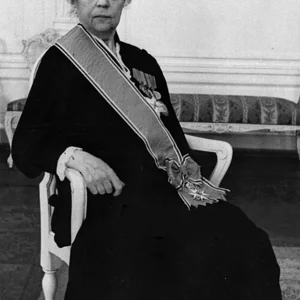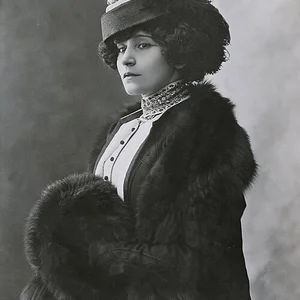

Japanese poet and novelist (1878–1942), a major figure in the revival of waka poetry during the Meiji era. A committed feminist, she advocated for women's emancipation and opposed Japanese militarist nationalism.
Frequently asked questions
Famous Quotes
« Oh, my brother, I weep for you — do not give your life. (Kimi shinitamo koto nakare, 1904)»
Key Facts
- 1878: born in Sakai (Osaka)
- 1901: publication of the tanka collection Midaregami (Tangled Hair), a poetic revolution
- 1904: anti-war poem 'Kimi shinitamo koto nakare' ('Thou Shalt Not Die') addressed to her brother during the Russo-Japanese War
- 1921: founds the Myōjō poetry school with her husband Tekkan
- 1942: dies in Tokyo
Works & Achievements
Akiko's first and most celebrated tanka collection, it revolutionized classical poetry by introducing a free, sensual, and subversive feminine voice. Its scandalous success immediately made it a major literary event of the Meiji era.
This pacifist poem addressed to her brother conscripted during the Russo-Japanese War is Akiko's most politically charged work. It drew fierce attacks from nationalists, yet remains to this day her most widely cited piece outside Japan.
Her second tanka collection confirms Akiko's mastery and deepens her favorite themes: love, nature, and the condition of women.
Akiko translated Murasaki Shikibu's 11th-century novel into modern Japanese twice. This monumental work of literary popularization helped reintroduce the Japanese public to a foundational work written by a woman.
A landmark feminist essay in which Akiko challenges the prevailing ideology that reduces women to their role as mothers serving the nation. She argues that economic independence is the primary condition for women's emancipation.
Her final tanka collection, published the year of her death, reflects a refined style and a serene gaze upon a life devoted to poetry and freedom.
Anecdotes
In 1901, Akiko published her first tanka poetry collection, 'Midaregami' (Tangled Hair), which caused a scandal in Meiji Japan. Her poems described romantic desire and female sensuality with striking frankness — themes that were taboo at the time. The collection was immediately censored, but it became a major literary event and launched the twenty-three-year-old into the ranks of national poets.
In 1904, when her younger brother was called up during the Russo-Japanese War, Akiko wrote him a poem that has since become famous: 'Kimi Shini Tamō Koto Nakare' (You Must Not Die). In it, she implores her brother to preserve his life rather than sacrifice it for the Emperor. This pacifist text drew fierce condemnation from nationalists, but is today considered one of the earliest feminist and anti-militarist texts in modern Japanese literature.
In 1912, Akiko traveled alone across Siberia by train to join her husband Tekkan, who had gone to study in Paris. This journey of several weeks — extraordinarily bold for a Japanese woman of the era — left a deep impression on her. She discovered Europe, met artists and intellectuals, and strengthened her convictions about women's emancipation through contact with Western feminist movements.
Mother of thirteen children, Akiko never stopped writing. Over the course of her life she published more than fifty thousand tankas, while also writing essays, novels, and translating The Tale of Genji — the eleventh-century masterpiece — into modern Japanese. Her ability to balance a large family with an exceptional literary output earned the admiration of her contemporaries and remains a symbol of the creative woman claiming her intellectual independence.
Primary Sources
Haru mijikashi / nani ni fuchaku no / inochi zo to / chikara aru chichi no / oshie wo zo kiku — 'The spring is short: why ever should I think / Life immortal? These words came to my ears / Spoken by a father of great power.'
Oh, my young brother, I weep for you. / Thou shalt not die. / Last born of our parents, / most beloved of all — / thou shalt not die in war.
The day the mountains move has come. / I say this, but no one believes me. / The mountains have been asleep for a while only. / Long ago, in fire, they had all moved.
I did not come here on a whim, but because I believed in something: that women have the right to think, to travel, to love, and to write for themselves.
Before being a mother, I am a human being. The State cannot ask women to sacrifice themselves in the name of motherhood without first guaranteeing their economic and intellectual independence.
Key Places
Akiko was born on December 7, 1878, in this prosperous merchant city in the Osaka region. Her father ran a well-known confectionery shop; it was in the family library that she first discovered classical Japanese literature.
Akiko settled in Tokyo after her marriage to Tekkan in 1901. She spent most of her adult life there, taking part in the capital's literary circles and editing the journal *Myōjō*.
Akiko traveled to Paris alone to rejoin her husband and spent several months discovering the French capital. This European sojourn deepened her feminist thinking through her exposure to women's emancipation movements across Europe.
Kyoto, the ancient imperial capital, was a major source of poetic inspiration for Akiko. She drew on *wabi-sabi* aesthetics and the traditions of *waka* poetry to renew the great classical form from within.
Typical Objects

An essential tool of classical Japanese writing, the ink brush is the instrument with which Akiko composed her tanka poems. Her mastery of calligraphy was inseparable from her poetic art.

On this polished stone, Akiko would grind ink with water before each writing session. This slow, ritual gesture is an integral part of the poet's mental preparation in the Japanese tradition.

This literary journal, founded by her husband Tekkan and to which Akiko contributed from the very beginning, was the publication that introduced her to the Japanese public starting in 1900.

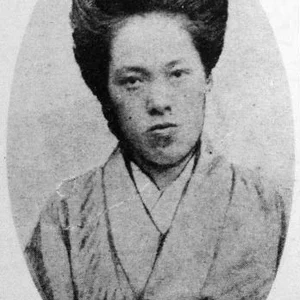
In period photographs, Akiko appears in a traditional kimono with floral patterns. The garment illustrates the tension between the modernity of her ideas and her attachment to classical Japanese aesthetics.

Akiko translated this 11th-century masterpiece into modern Japanese twice, making the founding work of Japanese literature — written by a woman — accessible to readers of the Meiji and Taishō eras.

A common accessory of daily life in Japan, the folding fan is also a traditional medium for poetry. It symbolizes the refined cultural world in which Akiko moved — even as she sought to shake it up.
School Curriculum
Vocabulary & Tags
Key Vocabulary
Tags
Daily Life
Morning
Akiko rises early, before the children, to enjoy the silence of dawn. She prepares her ink on the suzuri, arranges her sheets of washi paper, and composes several tankas while Tokyo stirs to life. This morning ritual is sacred: it is in this quiet that she finds the images and rhythms of her poetry.
Afternoon
Afternoons are devoted to household duties — she runs a large home with thirteen children — and to editorial work. She reviews manuscripts, writes essays for the journals she contributes to, and receives young poets or feminist activists who come to consult her at her Tokyo home.
Evening
In the evenings, Akiko rejoins her husband Tekkan for literary discussions and often for reading ancient and modern poems aloud. She sometimes works late into the night on her translation of *The Tale of Genji*, by lamplight, surrounded by dictionaries and classical editions.
Food
Akiko's everyday cooking is that of the Japanese middle class of the Meiji era: rice, miso soup, pickled vegetables, grilled or simmered fish, tofu. During her stay in Paris in 1912, she discovered French cuisine with curiosity, an experience she recalls with amusement in her letters.
Clothing
Akiko almost always wears the kimono, the everyday garment in Japan of her time. In photographs, she appears in kimonos with understated floral patterns or simple stripes. Her hair, often loose or simply pinned back, becomes a symbol: where society imposed strictly codified hairstyles on women, her disheveled hair represents the freedom claimed in her first collection.
Housing
Akiko lives in a traditional Japanese house in Tokyo, with tatami rooms, sliding washi-paper partitions (shoji), and a small interior garden. The home is both a lively family space and a literary workshop: books pile up throughout her study, arranged around the low desk at which she writes seated on the floor, in keeping with Japanese custom of the time.
Historical Timeline
Period Vocabulary
Visual Style
Esthétique de l'ère Meiji-Taishō mêlant l'élégance de l'estampe japonaise et la modernité des premières revues littéraires : lignes délicates, fleurs de cerisier, indigo profond et reflets dorés sur laque noire.
Sound Ambience
Atmosphère sonore du Japon des ères Meiji et Taishō : le bruissement des pinceaux sur le papier washi côtoie les cloches de temple et les premiers bruits de la ville moderne en transformation.
Liens externes & ressources
Références
Œuvres
Midaregami (Cheveux emmêlés)
1901
Kimi Shini Tamō Koto Nakare (Tu ne dois pas mourir)
1904
Kogiwa (À la rive du vieux fleuve)
1905
Shin-shin yaku Genji Monogatari (Nouvelle traduction du Dit du Genji)
1912–1913 (1re version), 1938–1939 (2e version)
Bosei shugi wo haikyo su (Contre le maternalisme)
1916
Hakuōki (Fleurs de prunier blanc)
1942