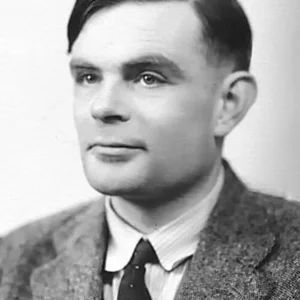

British mathematician and cryptologist (1912-1954), Alan Turing is the founder of theoretical computer science and artificial intelligence. He contributed to the decryption of the Enigma machine during the Second World War and formalized the concepts of computability and algorithm.
Alan Turing(1912 — 1954)
Alan Turing
Royaume-Uni
7 min read
Frequently asked questions
Famous Quotes
« Can a machine think?»
« The question 'Can machines think?' I believe is too meaningless to deserve discussion.»
Key Facts
- 1936: Publication of the landmark paper 'On Computable Numbers', defining the Turing machine
- 1939-1945: Work at Bletchley Park on decrypting the German Enigma machine
- 1950: Publication of 'Computing Machinery and Intelligence', establishing the concept of the Turing test
- 1952: Conviction for indecency under British laws of the time
- 1954: Death by cyanide poisoning at the age of 41
Works & Achievements
Founding paper of theoretical computer science in which Turing introduces the concept of a universal machine (the Turing machine) and formalizes the notion of computability. This work establishes the mathematical foundations of modern computing.
As a cryptologist at Bletchley Park, Turing contributed to the decryption of German encoded messages during the Second World War, enabling the Allies to access crucial strategic intelligence.
Seminal paper founding the field of artificial intelligence, in which Turing poses the question "Can machines think?" and proposes the famous Turing Test as a criterion for evaluating machine intelligence.
Electromechanical machine designed by Turing to automate the decryption of Enigma, representing one of the first specialized computers and a precursor to digital calculators.
Turing contributed to the conceptual design of this pioneering computer and proposed its architecture. The ACE was one of the first stored-program digital computers.
Theoretical work on the emergence of patterns in biological systems, establishing the mathematical foundations of modern theoretical biology and explaining how order can arise from chemical chaos.
Anecdotes
During World War II, Alan Turing worked at Bletchley Park, the British codebreaking centre. He designed an electromechanical machine called the 'Bombe' that could break the codes of the Enigma machine used by the Nazi army. This invention is said to have shortened the war by approximately two years and saved millions of lives.
In 1950, Turing proposed the famous 'Turing Test', a criterion for determining whether a machine can demonstrate intelligence indistinguishable from that of a human. He posed the fundamental question: 'Can machines think?' This test remains a reference point in artificial intelligence to this day.
In 1936, Alan Turing formalised the concept of the 'Turing machine', a theoretical model that precisely defines what a computer can compute. This fundamental contribution to theoretical computer science established the mathematical foundations of all modern computers.
Turing was a passionate and highly competitive marathon runner, despite his exceptional scientific talents. He reportedly considered competing in the Olympic Games and trained regularly, revealing a complex personality that extended far beyond his mathematical contributions.
After the war, Turing worked on creating the ACE (Automatic Computing Engine), one of the first truly programmable British computers. He wrote the first programming manual for this computer, laying the groundwork for what would become modern computer programming.
Primary Sources
The 'machines' I shall describe may be compared to a man in the process of computing a real number by means of an unlimited paper tape divided into squares, on each of which a symbol is written.
I propose to consider the question, 'Can machines think?' This should begin with definitions of the meaning of the terms 'machine' and 'think'.
The machine must be capable of accepting information from the outside world, and of acting upon this information in a way which produces results in the outside world.
It is proposed that a system of chemical substances, called morphogens, reacting together and diffusing through a tissue, is adequate to account for the main phenomena of morphogenesis.
Key Places
Alan Turing's birthplace on 23 June 1912. London was also the centre of his academic and professional activities, notably at the University of Cambridge and the National Physical Laboratory.
British codebreaking centre where Turing worked during the Second World War. He led the cryptanalysis team there and contributed to breaking the Enigma machine, which profoundly impacted the course of the war.
Institution where Turing studied mathematics and obtained his degree. He also taught there and conducted foundational research in number theory and mathematical logic.
City where Turing worked at the University of Manchester after the war, contributing to the development of the Manchester Mark 1, one of the first programmable digital computers.
Turing stayed at Princeton University between 1936 and 1938 to pursue his research in logic and computability theory, foundational work for theoretical computer science.
Alan Turing's place of residence during his final years and the site of his death on 7 June 1954. It is an important place of remembrance in the mathematician's personal life.
Typical Objects

Electromechanical encryption machine used by the German army during World War II. Alan Turing contributed to decrypting its messages at Bletchley Park, which played a crucial role in the Allied victory.

Computing device from the 1930s–1940s representing the state of computing technology at the time. These machines inspired Turing's theoretical reflections on computability and algorithms.

Input and output medium for early computers, used to program and store data. This system was central to the machine architectures that Turing conceptualized theoretically.
British computer built after World War II at the National Physical Laboratory, for which Turing provided the specifications and innovative logical design.

Emblematic tools of Turing's mathematical and academic work, reflecting his activity as a researcher and lecturer at Cambridge and Manchester.

Foundational 1950 publication in which Turing introduces the concept of the 'Turing Test' to evaluate artificial intelligence, marking the beginning of modern theoretical computer science.

Classified documents representing the strategic importance of Turing's work during World War II and the geopolitical stakes of the Cold War affecting his career.
School Curriculum
Vocabulary & Tags
Key Vocabulary
Tags
Daily Life
Morning
Alan Turing generally wakes up early and has a frugal breakfast, typical of the British middle class of the era. He gets ready quickly, often with little concern for his appearance, and heads to his workplace on foot or by public transport. His mornings are devoted to intensive mathematical work, with maximum concentration before lunch.
Afternoon
In the afternoon, Turing continues his mathematical research or cryptanalysis tasks, notably at Bletchley Park during the Second World War where he leads the team working on the Enigma machine. He sometimes takes time for academic discussions with colleagues, exchanging ideas on theoretical problems. His activities also occasionally include walks or jogging, which he practices regularly for physical exercise.
Evening
In the evening, Turing dines modestly, often alone or with scientific colleagues. He may devote time to reading, mathematical correspondence, or personal reflection on his theoretical work. Unlike conventional social life, he prefers solitary intellectual activities or specialised discussions to socialising.
Food
Turing's diet corresponds to British rationing standards during and after the Second World War. It includes bread, dairy products, tea, eggs, and occasionally meat. With little interest in gastronomy, he eats simply and functionally, prioritising efficiency over culinary quality.
Clothing
Turing wears the typical attire of a British academic: a plain suit, shirt, tie, and tweed jacket. His appearance is generally unkempt, with dishevelled hair and little attention paid to fashion. His clothes are functional rather than elegant, reflecting his relative indifference to social conventions regarding appearance.
Housing
Turing lives in modest accommodation, typical of the English university middle class: first with his parents or in university lodgings, then in a small rented flat close to his workplaces. His living space is cluttered with books, mathematical papers, and scientific equipment, revealing his intellectual priorities over domestic comfort.
Historical Timeline
Period Vocabulary
Visual Style
Un style graphique alliant Art déco et modernisme géométrique, mêlant schémas scientifiques des années 1940, motifs mathématiques abstraits et éléments mécaniques. L'atmosphère évoque la rigueur intellectuelle et la précision cryptographique, avec une palette froide rehaussée d'accents métalliques inspirés du constructivisme soviétique.
Sound Ambience
Une ambiance immersive capturant l'atmosphère d'un laboratoire de recherche britannique des années 1940, mêlant les sons mécaniques des premières machines de calcul aux bruits sourds du contexte de guerre, créant un environnement de travail scientifique intense et fondateur.
Liens externes & ressources
Références
Œuvres
On Computable Numbers, with an Application to the Entscheidungsproblem
1936
Travaux de décryptage de la machine Enigma
1939-1945
Computing Machinery and Intelligence
1950
Bombe électromécanique (Bombe de Turing)
1940
ACE (Automatic Computing Engine)
1946-1950
Morphogenèse chimique et modèle réactionnel-diffusionnel
1952