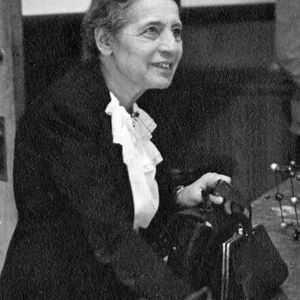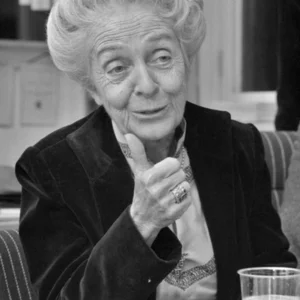

An Italian-American neurologist, Rita Levi-Montalcini discovered nerve growth factor (NGF), revolutionizing neurobiology. She won the Nobel Prize in Medicine in 1986, and continued her research despite fascist racial laws that forced her to work in secret. She remained active in science past the age of 100.
Rita Levi-Montalcini(1909 — 2012)
Rita Levi-Montalcini
États-Unis, Italie, royaume d'Italie
9 min read
Frequently asked questions
Famous Quotes
« Above all, don't fear difficult moments. The best comes from them.»
« My body has aged, but not my brain.»
Key Facts
- Born in 1909 in Turin into a cultured Jewish family, she earned her medical degree in 1936.
- Persecuted under the fascist racial laws of 1938, she set up a clandestine laboratory at home and continued her research on the nervous system.
- Discovered nerve growth factor (NGF) in the 1950s during her work at Washington University in St. Louis.
- Awarded the Nobel Prize in Physiology or Medicine in 1986, shared with Stanley Cohen, for the discovery of NGF.
- Appointed Senator for Life in Italy in 2001, she remained active in research until her death at age 103 in 2012.
Works & Achievements
Rita Levi-Montalcini's landmark scientific discovery: the identification of a protein that stimulates the growth and ensures the survival of neurons. This discovery revolutionized neurobiology and paved the way for understanding neurodegenerative diseases such as Alzheimer's and Parkinson's.
A foundational scientific publication in the Proceedings of the National Academy of Sciences, presenting nerve growth factor to the scientific world for the first time. This paper went on to become one of the most cited references in cell biology.
An autobiography published the year after she received the Nobel Prize, in which Rita Levi-Montalcini traces her life from childhood in Turin to her scientific recognition. Translated into many languages, the book is both a testament to science and a personal account of resistance to totalitarianism.
A European brain research institute founded in Rome by Rita Levi-Montalcini to accelerate the understanding and treatment of neurodegenerative diseases. She served as its scientific director well into the later years of her life.
A work of popular science in which Rita Levi-Montalcini pays tribute to the great unsung scientists of history. It reflects her lifelong commitment to bringing scientific culture to the general public.
Anecdotes
When the fascist racial laws of 1938 barred her from practicing medicine as a Jewish woman, Rita Levi-Montalcini set up a clandestine laboratory in her bedroom in Turin. She dissected chicken embryos on her nightstand, refusing to let Nazi ideology extinguish her passion for science.
In 1943, driven out of Turin by the Allied bombings, she fled with her family to Florence under a false identity. There she continued her research in secret, carrying her precious embryos and microscope in a suitcase, risking her life rather than abandon science.
In 1952, during a pivotal experiment in Rio de Janeiro with Hertha Meyer, Rita Levi-Montalcini observed for the first time under the microscope an explosion of nerve fibers growing around a tumor. She described this vision as 'the most beautiful of my entire scientific career' — the very night she realized she had just discovered nerve growth factor.
Appointed Senator for Life in Italy in 2001 at the age of 92, she continued to sit in the Senate and vote on legislation into her final years. In 2006, at 97, she declared that her brain was functioning better than ever, attributing her intellectual longevity to curiosity and a passion for knowledge.
When the Nobel Prize was announced in 1986, Rita Levi-Montalcini was 77 years old. She shared the prize with Stanley Cohen, her American collaborator. In her Stockholm address, she paid tribute to Viktor Hamburger, the researcher who had invited her to Saint Louis, stating that without that encounter, her discovery would never have come to light.
Primary Sources
Nell'autunno del 1938, mentre ascoltavo alla radio il discorso di Mussolini che promulgava le leggi razziali, non provai terrore, ma una fredda determinazione: avrei continuato a fare ricerca, in qualunque modo.
The discovery of NGF in the early 1950s came about as a result of a series of strange and unpredictable events... I looked at the tumor and suddenly the most beautiful sight confronted my eyes: a dense halo of nerve fibers around the tumor.
A nerve growth-stimulating factor has been extracted from mouse sarcoma 180 and 37... The factor stimulates growth and differentiation of sensory and sympathetic ganglia in the chick embryo.
I thank you for giving me this opportunity to work in Saint Louis. The results we are obtaining on nerve fiber growth exceed anything I would have dared hope for.
Key Places
Rita Levi-Montalcini's birthplace, where she studied medicine and set up her first clandestine laboratory in her family bedroom in 1940, defying fascist racial laws.
The city where the Levi-Montalcini family took refuge in 1943 under false identities, fleeing the bombing raids and Nazi persecution. Rita continued her research underground until the Liberation in 1945.
The laboratory of Professor Viktor Hamburger, where Rita Levi-Montalcini settled in 1947. It was here that she and Stanley Cohen conducted the work that would lead to the discovery and isolation of NGF.
In 1952, Rita Levi-Montalcini worked here with biologist Hertha Meyer, a pioneer in tissue culture. It was here that she first observed under the microscope the spectacular proliferation of nerve fibers induced by NGF.
The Roman laboratory she founded and directed from 1962, which became one of the most important neurobiology research centers in Europe. She continued her work on NGF there and trained several generations of researchers.
Typical Objects

The central tool of all Rita Levi-Montalcini's work, which she used from her earliest clandestine research in her room in Turin. It was under the microscope that she observed in 1952 the explosion of nerve fibers that revealed NGF.

Rita Levi-Montalcini used chicken embryos as an experimental model to study the development of the nervous system. During the war, she obtained eggs on the black market to continue her clandestine research.

Precision instruments essential for dissecting the nerve ganglia of tiny embryos. Her surgical dexterity, developed during her medical training, was praised by all her collaborators.

Like any rigorous researcher, Rita Levi-Montalcini meticulously recorded every experiment, every observation, every result. Her notebooks kept during the clandestine period stand as a unique testimony to scientific resistance under fascism.

A technique she learned during her stay in Rio de Janeiro with Hertha Meyer. These cultures allowed her to directly observe the action of NGF on living neurons outside the body — a decisive step toward her discovery.

Presented in December 1986 in Stockholm, this medal represents the crowning achievement of a lifetime spent overcoming political, racial, and institutional obstacles. Rita Levi-Montalcini was 77 years old when she received it.
School Curriculum
Vocabulary & Tags
Key Vocabulary
Tags
Daily Life
Morning
Rita Levi-Montalcini rises early, usually before 7 a.m. She has a light Italian breakfast — strong coffee and toast — before going through the latest scientific publications. She arrives at the laboratory by 8 a.m., the first of the team, to prepare the day's experiments and examine the tissue cultures set up the night before.
Afternoon
The afternoon is devoted to meticulous dissections of chicken embryos, microscope observation, and detailed recording of results in her laboratory notebook. She supervises her students and postdoctoral researchers with rigor but warmth, discussing findings with tireless curiosity. Team meetings and discussions with her American colleagues are conducted in English, which she speaks fluently.
Evening
In the evening, Rita Levi-Montalcini returns home and prepares or shares a simple Italian dinner. She reads scientific articles, writes letters to her European collaborators, and maintains a regular correspondence with her sister Paola, a painter. She goes to bed late, her mind always active, often jotting down new ideas at her bedside.
Food
Her diet remains deeply Italian even in St. Louis: pasta, fresh vegetables, olive oil, and moderate red wine. She eats little but carefully, favoring quality over quantity. Back in Italy, she rediscovers the Piedmontese flavors of her childhood during her frequent returns to Rome.
Clothing
In the laboratory, she always wears an impeccably clean white coat over understated, elegant clothes — a reflection of her bourgeois Turinese upbringing. Outside of work, she dresses in a classic, restrained style, true to the Italian elegance of the 1950s: dark suits, light blouses, neatly styled hair. She pays little attention to fashion but takes care to maintain a tidy appearance.
Housing
In St. Louis, she lives in a modest apartment near the university campus, which she shares for a few years with her sister Paola during extended visits. The apartment is functional, filled with books and scientific journals, with a few of her sister's artworks on the walls. In Rome, she occupies an apartment in the Parioli neighborhood — central and cultured — which she decorates tastefully and where she hosts colleagues and intellectuals.
Historical Timeline
Period Vocabulary
Visual Style
Portrait réaliste et sobre d'une chercheuse dans un laboratoire des années 1950, alliant rigueur scientifique et dignité personnelle, avec une palette aux tons chauds et cliniques évoquant l'Italie d'après-guerre et l'Amérique académique.
Sound Ambience
Ambiance sonore d'un laboratoire de neurobiologie des années 1950, mêlant les sons précis de la manipulation scientifique et le calme studieux d'une université américaine, avec une touche d'Italie dans les conversations.
Liens externes & ressources
Références
Œuvres
Découverte du Nerve Growth Factor (NGF)
1952-1956
Article 'A nerve growth-stimulating factor isolated from sarcomata 37 and 180' (avec Stanley Cohen)
1954
Éloge de l'imperfection (Elogio dell'imperfezione)
1987
Fondation de l'EBRI (European Brain Research Institute)
2002
Le Galilée oublié : les cerveaux qui ont changé le monde
1999